.svg)
.svg)
.svg)

A commercial bridge loan is short-term, asset-backed financing you use when speed or a transitional business plan matters more than getting the lowest rate. It works when you have a credible refinance or sale lined up within 12 to 36 months. Without that exit, you’re just renting expensive money and hoping the market cooperates.
TL;DR:
- Bridge loans typically offer 8% to 11% costs from institutional lenders and up to 14% from hard-money lenders, with LTVs around 50% for quick closings.
- They are suitable mainly for fast acquisitions, value-add projects, stabilization, recapitalizations, or distressed rescues, not long-term buy-and-hold strategies.
- Qualifying hinges on a clear exit plan, conservative LTV, and sufficient reserves, rather than credit score or income documentation.
- The main risk is refinancing failure, which can lead to paying higher rates or scrambling for extensions if market conditions shift.
- For small businesses, SBA 504 bridge financing offers a predictable path to long-term, fixed-rate funding, emphasizing exit certainty over minimal rate differences.
A commercial bridge loan is a short-term, interest-only loan secured by the property itself rather than years of tax returns and financial statements. Lenders underwrite the asset first and the borrower second, which is why these loans close faster than a conventional commercial mortgage. Most run 12 to 24 months, though some institutional programs stretch to 36 months when a value-add plan needs extra runway, according to Avana Capital’s borrower guide.
The pricing structure looks different from permanent debt, too. Expect these building blocks:
That last point cuts both ways. Less paperwork means a faster close, but it also means the lender is betting heavily on the property’s value holding up.
Pricing on commercial real estate financing through a bridge structure varies more by lender type than by property type. Institutional balance-sheet lenders tend to price all-in costs around 8% to 11%, tied to SOFR plus a spread. Private debt funds run closer to 9% to 12%, and hard-money lenders can push past 13% to 14% when the deal carries real execution risk, per PeerSense’s 2026 bridge lending data.
Loan-to-value guidance splits into two lanes:
Fast fact: The 50% asset-based LTV standard is the mechanism that lets lenders skip tax returns and still close in 14 to 30 days, according to PeerSense. Some anchor lenders advertise term sheets in as few as 3 to 14 days for straightforward deals, per Anchor Commercial Capital.
Lenders will still want a recent appraisal, a rent roll or operating history, a clear scope of work if renovation is involved, and a stated exit strategy before they issue terms. Skip any one of those and expect delays, not a faster close.
Bridge financing solves a narrow set of problems well and performs poorly outside of them. Here’s where it earns its cost:
Where bridge loans don’t belong: long-term buy-and-hold deals with no planned refinance, or borrowers who can’t articulate what the exit looks like in twelve months.
Every advantage of a bridge loan comes with a corresponding cost, and modeling both sides before you sign is what separates a good bridge decision from a bad one.
The case for bridge financing:
The case against it:
Pro Tip: Run your exit math with a six-month delay built in. If the deal still works with slower lease-up or a softer refinance market, you’ve built in a real buffer instead of a hopeful one.
Not all bridge capital behaves the same way, and picking the wrong lender archetype for your deal size and timeline costs you money either in rate or in missed deadlines.
A mortgage broker who works across these lender types earns their fee when your deal doesn’t fit neatly into one bucket, matching your timeline and asset to the right capital source instead of the first quote you get.
Qualifying for a bridge loan comes down less to your credit profile and more to whether the deal itself makes sense on paper. Work through this before you approach a lender:
Before signing, ask every lender: What takeout assumptions are you underwriting to? What’s the prepayment penalty structure? Is this loan recourse or non-recourse? What does an extension cost if I need one?
Pro Tip: Treat a “soft” takeout commitment as no commitment at all. If your refinance lender hasn’t underwritten the deal, you don’t have an exit, you have a hope.
Watch for red flags: a bridge lender who won’t discuss extension pricing upfront, a timeline that assumes zero delays, or a deal where the seller or broker has quietly disclosed vacancy issues that don’t match your rent roll.
Small-business borrowers face a specific version of this problem: bridge into what, exactly? Fbdc has spent more than 35 years financing small-business real estate and equipment through SBA 504 lending, and that experience shapes how a bridge decision should get made for this borrower type.
For a small business, the exit isn’t just “refinance.” It’s refinancing into the right structure.
Most coverage of commercial bridge loans fixates on rate comparisons, and that’s the wrong starting point. The research is consistent on this: pricing spreads across lender archetypes matter less than whether your takeout financing is pre-underwritten.
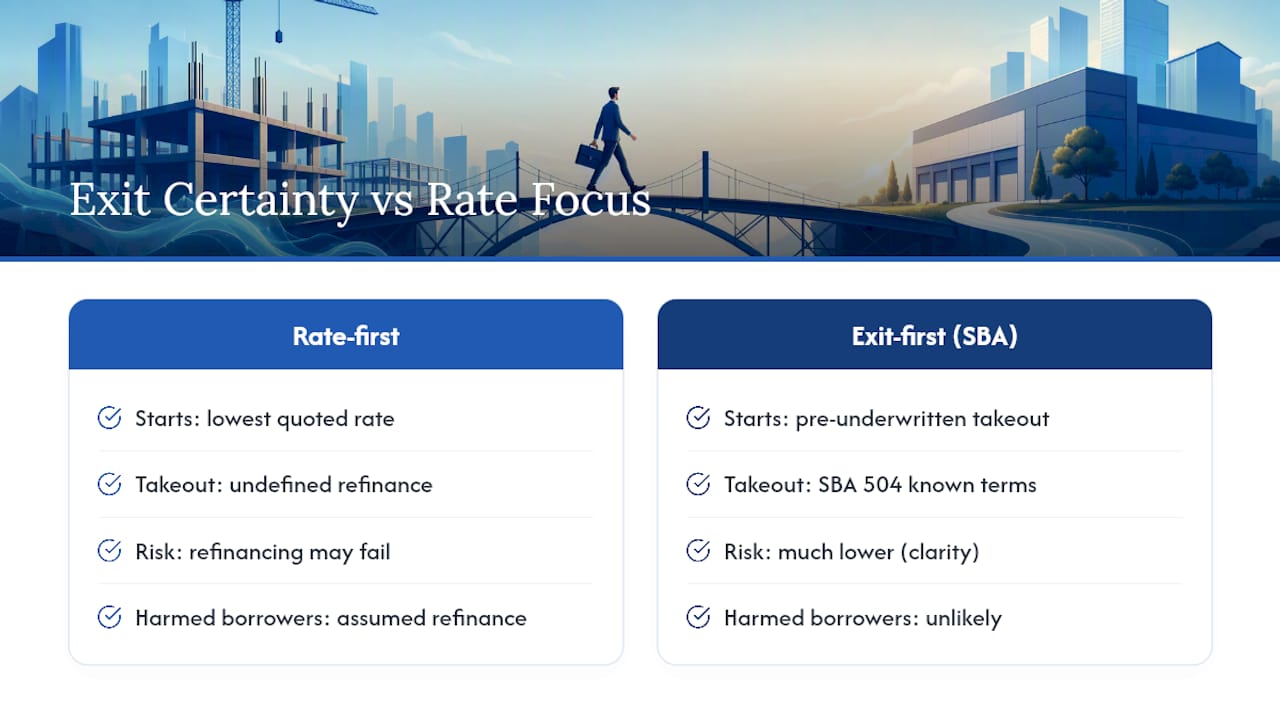
Conventional advice tells borrowers to shop rate first. That’s backwards. Shop exit certainty first, then let rate break the tie between comparable offers. The borrowers who get hurt by bridge financing aren’t the ones who paid a point more in origination fees. They’re the ones who assumed refinancing would “just happen” and discovered, six months before maturity, that the permanent market had tightened or their operating history didn’t yet support the loan they needed.
For small-business owners specifically, this is where an SBA-aware bridge path changes the calculation entirely. Bridging toward SBA 504 permanent financing, rather than toward an undefined conventional refinance, gives you a target with known terms well before your bridge loan matures. Prioritize that clarity over the lowest quoted rate. The rate is negotiable. A missing exit is not.
— PHENYX
If speed is what your deal needs but you don’t want to gamble on an undefined refinance later, Fbdc’s 504 Velocity Bridge Loan Program gives small-business borrowers a bridge structure built to land directly in SBA 504 permanent financing, not a generic private takeout.
Fbdc has originated SBA 504 loans for small businesses acquiring real estate and equipment for more than 35 years, with down payments as low as 10% and long-term fixed rates once you convert to the permanent 504 structure. Before you commit to a bridge loan, run your numbers through the 504 loan calculator to see what your permanent takeout could look like, then connect with Fbdc’s team about pre-qualification. Eligibility is limited to for-profit small businesses that meet SBA 504 criteria, so a quick conversation upfront saves you from structuring a bridge loan around an exit that won’t actually qualify. Start by reviewing how the SBA 504 process works and get a clear read on your options before your next acquisition or refinance deadline arrives.

