.svg)
.svg)
.svg)

If you need to close quickly and your plan is to refinance into an SBA 504 loan, a short-term SBA-aligned bridge (interim second, also called a 504 bridge) is often the right tactic, not a private hard money loan. This article covers SBA 504–eligible, owner-occupied projects only, where the Certified Development Company (CDC) portion funds on a delayed schedule and a bridge closes that gap. The Small Business Administration (SBA) sets the eligibility rules, and lenders like FBDC offer bridge programs built specifically to coordinate with that schedule.
TL;DR:
- A short-term SBA-aligned bridge is designed to close funding gaps until the CDC’s debenture funds, typically within six months, and is built around SBA eligibility and timing.
- Private hard money loans differ by focusing on collateral value, with higher interest rates, shorter terms, and no connection to SBA refinancing strategies.
- Using an SBA bridge makes sense mainly for owner-occupied projects facing urgent deadlines, auction purchases, or construction milestones, where refinancing is planned.
- For typical SBA 504 projects, bridge interest costs range from 9% to 12%, but long-term savings occur with fixed rates over 20 to 25 years once the CDC debenture funds.
- Confirming eligibility early, understanding occupancy rules, and coordinating appraisals with CDC funding schedules are critical to successful bridge-to-504 conversions.
The phrase “bridge loan vs hard money” gets thrown around loosely, but for an SBA 504 borrower, the comparison that matters isn’t bridge versus hard money at all. It’s whether to use an SBA-aligned interim second (often called a 504 bridge) to close now and refinance into SBA 504 permanent financing later, versus waiting for the CDC portion to fund before closing at all.
That distinction matters because private hard money financing, the kind real estate investors use for flips and rapid acquisitions, runs on a different set of rules, rates, and exit strategies entirely. It’s designed for short holding periods with no intention of converting into government-backed permanent debt. An SBA-aligned bridge is the opposite: it exists solely to get a qualifying small business to closing day, then step aside once the CDC debenture funds.
If your project is owner-occupied commercial real estate or heavy equipment with a useful life of at least ten years, and you plan to end up in a 504 loan, the bridge conversation is about interim seconds, CDC coordination, and refinancing mechanics, covered in detail below.
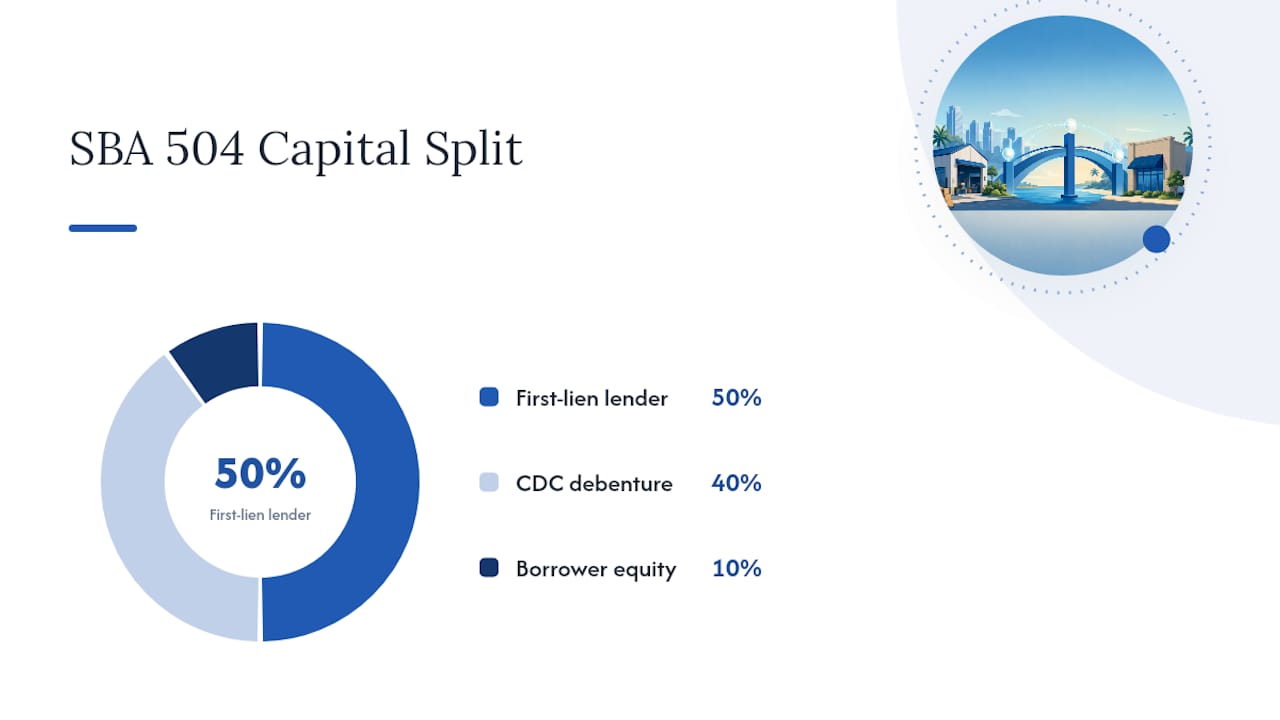
An SBA 504 project splits into three pieces: roughly 50% from a first-lien commercial lender, 40% from the CDC-backed debenture, and 10% from the borrower. That structure keeps down payments low, but it creates a timing problem. The CDC portion doesn’t fund at closing. It follows the SBA’s scheduled debenture pooling process, which typically takes a minimum of 45 to 60 days after your project is approved.
It gets repaid in full once the CDC debenture funds, usually within a few months.
Who provides this financing? A few options exist:
The interim second exists to solve closing certainty, not to serve as a standalone loan product. Coordinating payoff timing with your CDC is what keeps the bridge short and cheap instead of dragging on.
Bridging to a 504 loan is a tactical decision, and it’s not right for every deal. Here’s when it typically pays off:
Bridging is the wrong move when your SBA eligibility is genuinely uncertain, when occupancy requirements are in question, or when there’s no clear refinancing exit lined up. One common outcome: a Florida manufacturer wins a warehouse against a cash buyer using a bridge, closes in three weeks instead of three months, then refinances into 504 permanent financing and locks in a fixed rate for the life of the loan.
Short-term bridge financing isn’t cheap, and it’s not meant to be held long. Typical bridge pricing runs in the 9% to 12% interest-only range, with terms of 12 to 24 months and origination points due at closing. That premium buys you speed and certainty, nothing more.
SBA 504 permanent financing looks completely different once the CDC debenture funds. Borrowers get a long-term, fixed-rate debenture with amortization stretched out over 20 to 25 years, which is where the real savings show up.
Statistic Callout: A bridge held at 9% to 12% for even a full 12-months carries meaningful interest cost, but that same borrower converting into a 20 to 25 year fixed-rate 504 debenture can see substantially lower lifetime interest costs than a conventional commercial mortgage over the life of the asset.
The math generally works like this:
Before signing anything, check for prepayment penalties on the bridge note and confirm the origination fee structure. A bridge with a prepayment penalty that triggers before your CDC funding date can erase the savings you counted on. For a side-by-side look at long-term costs, our breakdown of commercial mortgages versus SBA 504 loans walks through the numbers in more depth.
None of the bridge math matters if your project doesn’t actually qualify for SBA 504 refinancing. The occupancy and eligibility rules are strict, and they’re worth confirming before you take on bridge debt, not after.
If you’re buying equipment rather than real estate, our guide on using SBA 504 loans for equipment purchases in Florida covers what qualifies and what doesn’t.
Executing a bridge-to-504 strategy well comes down to sequencing and documentation. Skip a step, and you risk sitting on bridge debt longer than planned.
Ask your bridge lender what happens if CDC funding is delayed past the bridge term, and ask your CDC directly about their current funding cadence and payoff coordination process. Get both answers in writing before closing.
Pro Tip: Run a prequalification conversation with your CDC before you ever apply for a bridge. It’s the fastest way to catch an occupancy or eligibility problem while it’s still fixable, instead of discovering it after you’ve already paid bridge interest for three months.
A hard money loan is a short-term, asset-based loan issued by private lenders or investor groups, secured primarily by the value of the property itself rather than the borrower’s creditworthiness or business financials. These loans exist in a completely separate lane from SBA-backed financing. Terms typically run 6 to 24 months, underwriting focuses heavily on the collateral’s loan-to-value ratio, and approval can happen in days rather than weeks.
Hard money lenders are usually private individuals, small investment funds, or specialty finance companies, not banks or CDCs. They don’t originate SBA paper, and they have no involvement with the SBA 504 program’s debenture funding process. Borrowers who use hard money are typically real estate investors executing fix-and-flip projects, rapid acquisitions, or deals that a conventional lender would never touch because of condition, timeline, or the borrower’s credit profile.
For an SBA 504 borrower, this matters mainly as a point of clarification: an SBA-aligned interim second is not a hard money loan, even though both are short-term and both bridge a funding gap. The interim second is structured around a known SBA refinancing exit and coordinated CDC timing. A hard money loan has no such built-in exit and no relationship to a government-backed permanent structure. Confusing the two can lead a borrower to price out the wrong product entirely, or worse, structure a deal that never qualifies for SBA refinancing because the interim financing wasn’t set up with that conversion in mind from day one.
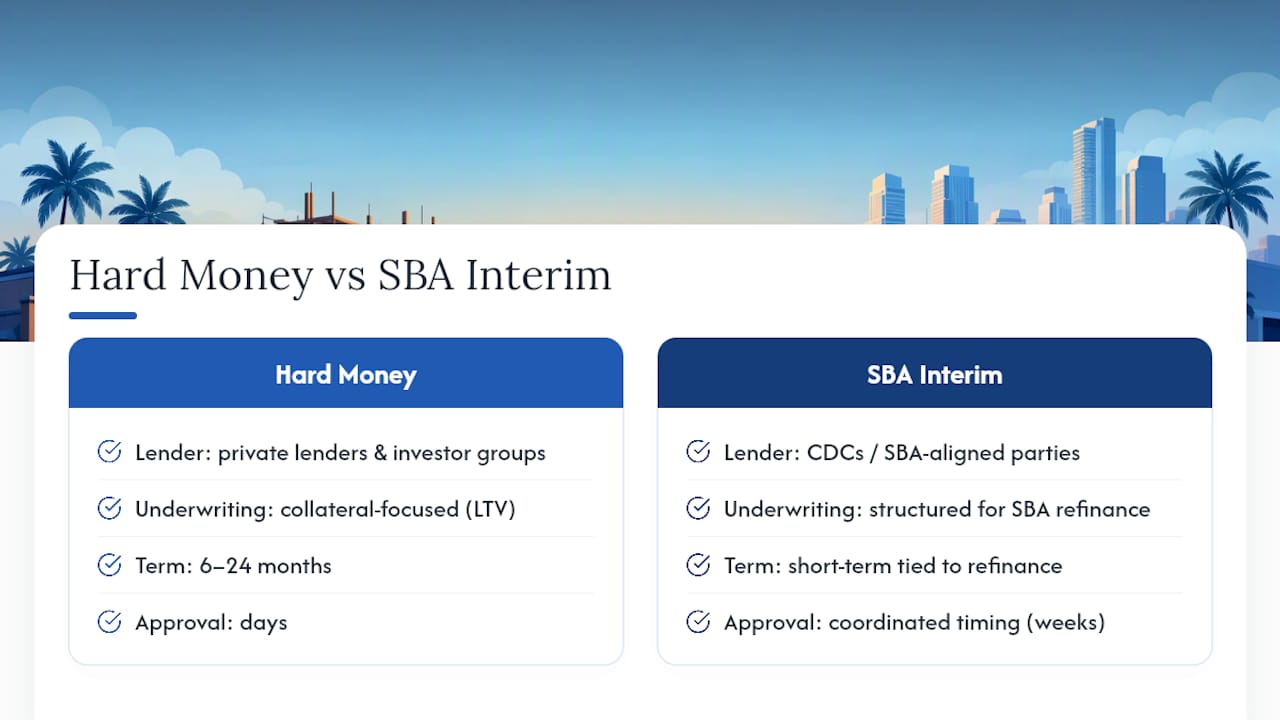
The core differences come down to who’s lending, why, and what happens at the end of the term.
| Factor | SBA-aligned bridge (interim second) | Private hard money loan |
|---|---|---|
| Typical lender | Commercial banks, CDC-aligned bridge programs like FBDC | Private investors, specialty finance firms |
| Exit strategy | Refinance into SBA 504 permanent debenture | Sale, cash-out refinance, or another short-term loan |
| Underwriting focus | SBA eligibility, occupancy, project documentation | Collateral value and loan-to-value ratio |
| Typical borrower | Owner-occupied small business needing a fixed asset | Real estate investor flipping or acquiring property |
| Rate structure | Interest-only, often 9% to 12%, tied to SBA timing | Often higher, priced for higher risk and faster turnaround |
The biggest practical difference is intent. An SBA-aligned bridge is a placeholder for financing that’s already been mapped out with a CDC. A hard money loan stands alone, with no government program on the other end of it. That changes everything about how each is underwritten, priced, and structured for payoff.
Hard money loan risks concentrate around cost and time pressure. Rates run higher than almost any other financing option, and terms are short enough that a delayed sale or refinance can put a borrower in a genuinely difficult position.
The biggest risks include:
For an SBA 504–eligible small business, these risks are largely avoidable. Choosing an SBA-aligned interim second instead of private hard money means the exit strategy, the CDC coordination, and the permanent rate are already part of the plan before the first dollar is ever borrowed.
Hard money financing tends to show up in situations an SBA-aligned bridge was never designed to handle. Real estate investors reach for it when they’re flipping a property with no intention of occupying it, acquiring distressed real estate too rough for conventional or SBA underwriting, or moving on a deal faster than any bank-adjacent process could support.
An SBA-aligned bridge, by contrast, belongs in a completely different use case: an owner-occupied small business that already qualifies, or expects to qualify, for SBA 504 financing and simply needs to close before the CDC debenture funds. The overlap between these two products is thinner than it looks. Both are short-term. Both bridge a gap. But the borrower profile, the exit strategy, and the underwriting standard are different from the start.
A Florida manufacturer buying its own production facility, with SBA eligibility confirmed and a CDC already engaged, is a bridge-to-504 candidate. An investor buying a rundown strip mall to renovate and resell within a year, with no intention of occupying it, is a hard money candidate. Mixing up which lane you’re in wastes time and, often, money.
The decision runs through a short set of questions, and most SBA 504 borrowers can answer them in one conversation with their CDC.
If yes, SBA 504 eligibility is on the table, and an SBA-aligned bridge is worth pursuing. If the property is purely an investment, SBA 504 isn’t an option, and hard money or another private product becomes the realistic path.
Second: is there a confirmed SBA refinancing exit, meaning a CDC has been engaged and preliminary eligibility looks solid? A bridge without a clear exit is just an expensive loan with extra risk attached. Third: how fast does the deal need to close, and does that timeline still leave room for CDC coordination? If a deal needs to close in 48 hours with no flexibility, that urgency alone may point away from any SBA-aligned structure, regardless of eligibility.
For the target audience of this article, for-profit small businesses planning an SBA 504 project, the answer is almost always the SBA-aligned bridge, provided eligibility is confirmed early and CDC coordination is locked in before signing.
Hard money underwriting looks nothing like SBA 504 documentation requirements, which is part of why the two products get confused despite serving different borrowers. Most hard money lenders focus on a narrow set of criteria centered on the property, not the business.
Typical requirements include a recent property appraisal or broker price opinion establishing current and after-repair value, a clear exit strategy such as a sale date or refinance plan, and a down payment or equity position, often 20% to 30% of the property’s value. Lenders also want proof of funds for any renovation or holding costs, and many skip detailed tax return or business financial review entirely, leaning instead on the deal’s loan-to-value ratio.
That lighter documentation load is exactly why hard money closes fast, sometimes in a week. It’s also why it costs more. The lender is pricing risk purely on collateral and timeline, with none of the government backing that keeps SBA 504 rates low. For an SBA 504–eligible business, meeting hard money’s requirements is rarely the goal. The real qualification checklist runs through occupancy rules, CDC eligibility, and documentation for a 504 project, covered earlier in this guide.
FBDC has spent over 35 years financing small businesses through SBA 504 lending across Florida, and that history shapes a strong opinion: an interim second should never be treated as a generic short-term loan bolted onto an SBA project after the fact. It should be structured from day one around your CDC’s funding schedule.
The 504 Velocity Bridge Loan Program exists because coordination risk, not interest rate, is usually what derails a bridge-to-504 deal. Borrowers who confirm eligibility and lock in CDC timing upfront convert smoothly. Those who treat the bridge as an afterthought often don’t.
— PHENYX
Speed to close matters, but it only pays off when the bridge is built to convert cleanly into permanent financing. FBDC’s 504 Velocity Bridge Loan Program is structured specifically around CDC funding timelines, so your interim second isn’t a separate risk from your SBA 504 loan. It’s the front half of the same plan.
If you’re weighing whether to bridge now and refinance later, start with the SBA 504 Loan Program page to confirm eligibility basics, then request a bridge quote directly through the Velocity Bridge program. Already carrying interim debt and ready to convert? The SBA 504 Refinance Program page walks through what that transition looks like. Either way, run your numbers first with the 504 Loan Calculator to see what long-term fixed-rate savings could look like once your CDC portion funds. The next step is a conversation with FBDC’s team about your specific timeline, before you sign anything with a bridge lender.
An SBA-aligned bridge (interim second) is short-term financing designed to close the gap before a CDC debenture funds, with a built-in exit into SBA 504 permanent financing. Hard money is private, collateral-based financing for investors with no SBA involvement and no government-backed refinancing exit.
Interim seconds commonly run up to about six months, timed to the CDC’s debenture funding schedule. The exact term depends on construction completion, appraisal timing, and your CDC’s current pooling cadence.
It depends entirely on whether the underlying property and use meet SBA occupancy and eligibility rules. If the funds were used for an eligible fixed asset and occupancy thresholds are met, conversion may be possible, but it’s far cleaner to start with an SBA-aligned bridge structured for that exit from the beginning.
You need to occupy at least 51% of an existing building or 60% of new construction as your operating business. Falling short of either threshold disqualifies the property from SBA 504 financing.
Yes. FBDC’s 504 Velocity Bridge Loan Program is built specifically to coordinate with CDC funding timelines for Florida small businesses pursuing SBA 504 financing. Pricing and terms are available directly through the lender rather than listed publicly, so borrowers should request a quote for their specific project.

