.svg)
.svg)
.svg)
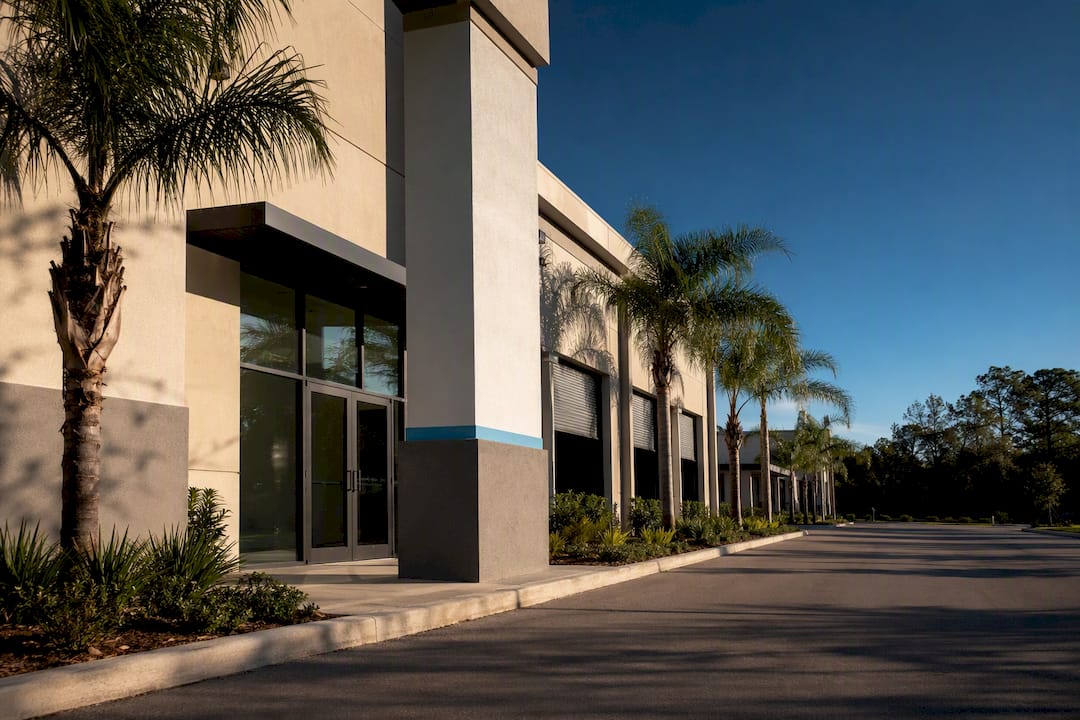
Yes, you can buy commercial property in Florida right now, and the market rewards buyers who move with a plan. Start by picking a target submarket, then confirm financing before you tour a single building. Growth data from the U.S. Census Bureau supports demand across most Florida metros, but wind-load standards under the Florida Building Commission and rising insurance costs will shape your real numbers more than any listing price. An SBA 504 program is worth a look if you’re an owner-user with limited capital for a down payment.
TL;DR:
- Growth-driven demand in Florida remains strong, but insurance premiums and impact fees significantly impact actual costs and returns in coastal counties.
- Building a relationship with a local broker and cross-checking pricing through comparable sales enhances your chances of finding off-market deals and accurate valuation.
- SBA 504 loans offer as little as 10% down for owner-users, with fixed long-term rates, making early prequalification essential to match financing timelines with your LOI.
- Due diligence must include current insurance quotes, impact fee estimates, and thorough review of liens, zoning, and permitted use to avoid costly surprises after closing.
- Florida-specific legal concerns, such as wind-load compliance and unpermitted work, require careful document verification to prevent liabilities developing post-purchase.
Florida’s population growth is the engine behind almost every commercial deal in the state. The U.S. Census Bureau has tracked sustained net migration into Florida for years, and that steady inflow of residents and businesses keeps demand for retail, industrial, and office space ahead of many other states. But growth alone doesn’t tell you where to buy.
Submarket choice changes your return profile more than almost any other decision you’ll make. Central Florida (Orlando, Lakeland, the I-4 corridor) tends to offer stronger risk-adjusted yields than South Florida, largely because inland insurance premiums run lower and institutional capital hasn’t bid up pricing as aggressively. South Florida, meanwhile, draws heavy international and institutional investment that compresses cap rates, especially in Miami-Dade and Broward, according to the Florida CRE Investor Guide.
A few things to weigh before narrowing your search:
Buyers looking specifically at Orlando or Dade County face very different underwriting math, which is why your financing strategy should follow your submarket pick, not the other way around.
Most searches for Florida commercial property listings start on major marketplaces, but the best deals often never make it there. Here’s how to work all three channels without wasting weeks on properties that don’t fit.
Financing shapes what you can actually afford, and Florida buyers generally choose between three routes: a conventional bank term loan, an SBA 504 loan, or a bridge/private lending arrangement for time-sensitive deals.
SBA 504 loans work differently: they’re built for owner-users purchasing the real estate their business operates from, and they typically require as little as 10% down, with a long-term fixed rate on the CDC portion of the loan. Bridge and private lenders fill the gap when a deal needs to close fast or doesn’t fit conventional underwriting boxes, usually at a higher rate in exchange for speed.
Lenders will ask for tax returns, financial statements, a business plan, and a purchase contract before they’ll issue terms. Getting these organized early shaves real time off underwriting.
Pro Tip: Order your insurance quote and your lender’s financial document checklist on the same day you submit an offer. Both take longer than buyers expect, and running them in parallel instead of sequence can save two to three weeks of closing time.
Due diligence in Florida carries a few line items that buyers from other states routinely underestimate. Skipping any of them can turn a good deal into a bad one after closing.
Start with the property itself: review the rent roll and existing leases, inspect the roof and mechanical systems, and confirm code compliance, including hurricane hardening. Then move to the paperwork: a title search, a survey, and Phase I (and, if warranted, Phase II) environmental review, plus zoning and entitlement verification to confirm your intended use is actually permitted.
Then come the costs that are easy to miss on a pro forma:
None of these show up on a listing sheet. All of them affect your real return.
Most Florida commercial deals move through a letter of intent (LOI) before a formal purchase contract, and that LOI should already spell out your financing, title, and environmental contingencies. Waiting until the contract stage to raise them gives sellers leverage you don’t need to give up.
Simple retail or office deals in established submarkets close faster. Deals involving new construction, rezoning, or coastal permitting take longer, almost always.
An experienced SBA 504 lender has worked in Florida’s SBA 504 lending space for more than 35 years, financing real estate and equipment purchases for small businesses across the state. That track record matters most for owner-users: businesses buying the building they’ll actually operate from, where a 10% down payment and a long-term fixed rate on the CDC portion make a real difference in preserving working capital.
If you fit that profile, the practical next step is prequalification. Have your tax returns, financial statements, and a business plan ready, and start that conversation early enough to align financing with your LOI timeline, not after you’re already under contract.
The purchase price is the smallest number on your closing statement in most Florida commercial deals. Closing costs typically run 2% to 5% of the purchase price, covering title insurance, recording fees, survey costs, and lender fees. Buyer’s agent commissions in commercial deals are frequently negotiated separately from the purchase price, sometimes paid by the seller, sometimes split, so confirm this in your LOI rather than assuming.
Ongoing ownership costs deserve just as much attention as the purchase price itself. Property taxes in Florida vary by county and are reassessed based on sale price, which means your first-year tax bill often jumps above what the seller was paying. Florida also charges sales tax on commercial rent, a cost landlords typically pass through to tenants, but one that affects your underwriting if you’re buying a leased investment property rather than occupying the space yourself.
Beyond taxes, budget for:
Add these up before you finalize an offer, not after. A property that looks like a strong deal on purchase price alone can turn mediocre once insurance and tax resets are factored into year-one cash flow.
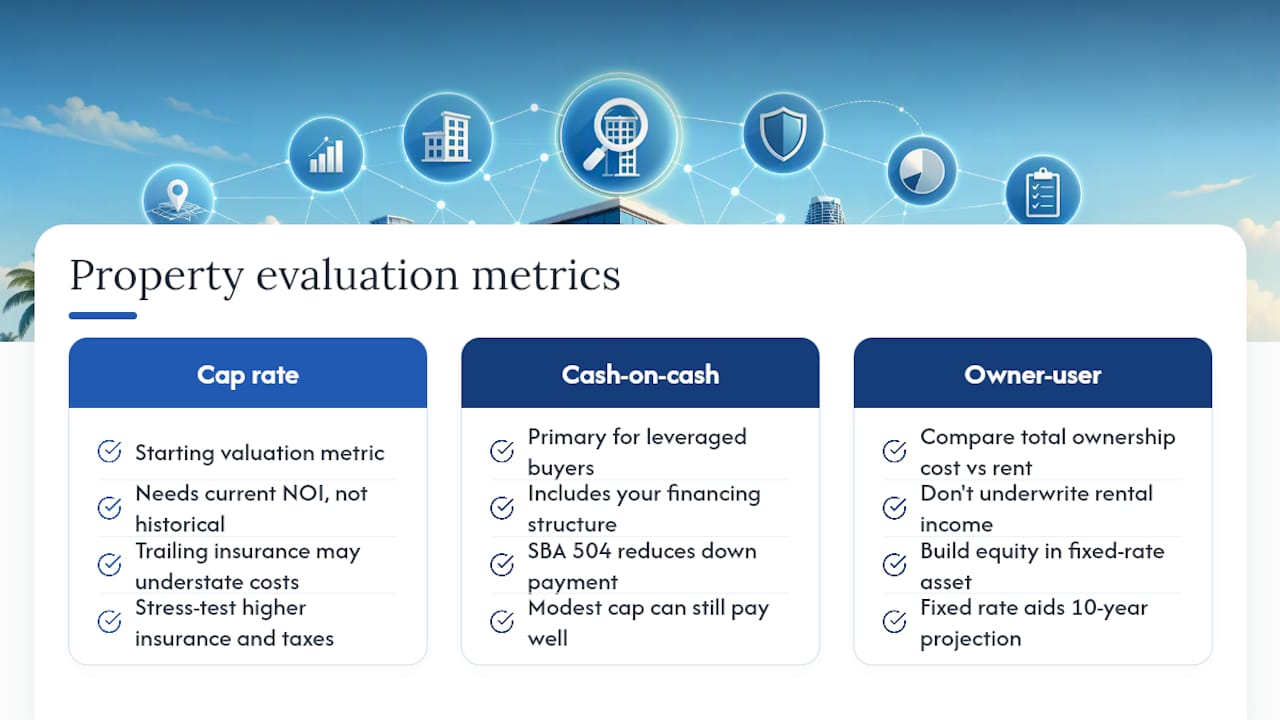
Cap rate is the starting point for evaluating any Florida commercial property, but it’s only useful when the net operating income behind it reflects current, not historical, expenses. A seller’s trailing twelve months of insurance costs, for instance, may be meaningfully lower than what you’ll actually pay after a policy reset, which quietly inflates the cap rate you’re being sold on.
Cash-on-cash return matters more than cap rate for leveraged buyers, since it accounts for your actual financing structure, including a lower down payment through a program like SBA 504. A property with a modest cap rate can still deliver a strong cash-on-cash return if your financing terms are favorable enough.
For owner-users, the calculation shifts entirely. You’re not underwriting rental income; you’re comparing the total cost of ownership against what you’d otherwise pay in rent, plus the long-term benefit of building equity in a fixed-rate asset instead of a lease that resets every few years. That comparison is where SBA 504 financing tends to shine, since a long-term fixed rate removes one of the biggest variables from your ten-year cost projection.
Whichever metric you lead with, always stress-test it against a higher insurance premium and a reassessed tax bill. Florida’s numbers move fast enough that a return calculated on old expense data can mislead you into overpaying.
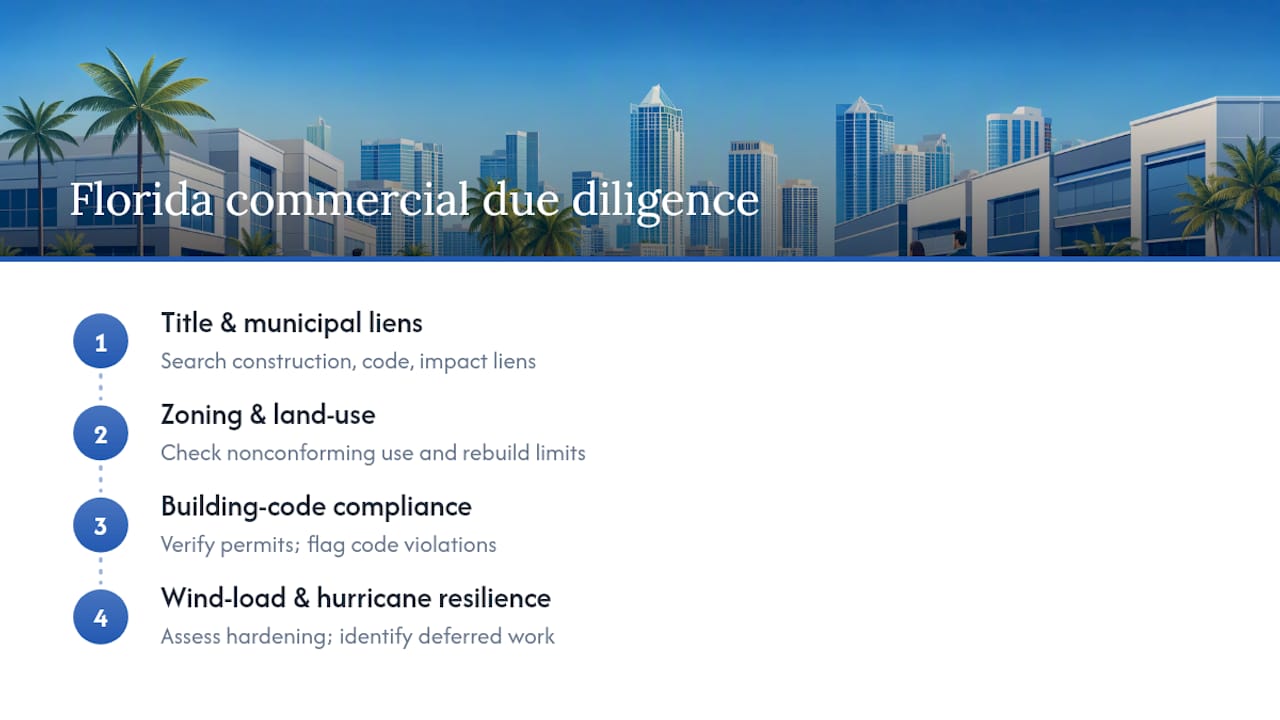
Florida has a handful of legal quirks that catch out-of-state buyers off guard. Title issues are the most common: confirm there are no outstanding construction liens, code enforcement liens, or unpaid impact fee assessments attached to the property before you close. These liens can survive a sale and become your problem, not the seller’s.
Zoning and land use compliance deserve the same scrutiny. A property’s current use might be legally nonconforming, meaning it’s allowed to continue operating as-is but can’t be rebuilt or expanded the same way if it’s ever damaged or demolished. That distinction matters enormously if you’re buying with renovation or expansion plans.
Florida also enforces strict building code compliance tied to its wind-load and hurricane-resilience standards. If a property has unpermitted work, code violations, or deferred hurricane hardening, that becomes your liability the day you close, not the seller’s. A title search and a municipal lien search should both be standard parts of your closing checklist, run through a Florida-licensed title company or real estate attorney rather than skipped to save a few hundred dollars.
The questions you ask before an offer often matter more than the questions you ask during diligence, because they tell you how reliable the seller and their broker actually are.
Ask for the trailing twelve months of actual operating expenses, not a pro forma projection. Ask directly whether the current insurance policy has been renewed recently or is up for renewal soon, since a policy about to reset can hide a major cost increase. Ask whether any impact fees, code violations, or liens are currently attached to the property, and ask for documentation, not just a verbal answer.
For leased properties, ask for copies of all active leases, not just a rent roll summary, and confirm whether any tenants have pending disputes, rent concessions, or upcoming lease expirations that aren’t reflected in the marketing materials. Ask why the seller is selling. A vague or evasive answer is worth noting.
Finally, ask the broker how long the property has been on market and whether the price has been reduced. A property that’s sat for months at the same price, in a market with the demand fundamentals Florida has, is telling you something the listing sheet won’t.
The right broker for a Florida commercial purchase specializes in your property type and submarket, not commercial real estate broadly. A broker who mostly moves retail strip centers in Tampa Bay isn’t necessarily the right fit for an industrial flex building in Central Florida, even though both fall under “commercial.”
Ask any broker you’re considering how many closed transactions they’ve handled in your specific submarket and property type over the past two years. Ask for references from past buyer clients, not just seller clients, since representing a buyer well requires a different skill set. And ask how they typically source off-market inventory, since that answer tells you whether they’re actively working a mandate or simply refreshing listing sites.
The same scrutiny applies to your lender and closing attorney. A lender unfamiliar with Florida’s insurance volatility or impact fee structures can underwrite a deal that looks fine on paper and falls apart during diligence. Choose professionals who’ve closed deals in your specific county, not just the state broadly.
The most expensive mistake in Florida commercial real estate is underwriting a deal using last year’s insurance premium. Wind and flood insurance costs have moved enough in recent years that a stale expense line can make a mediocre deal look like a great one, right up until your policy renews.
A few other red flags worth taking seriously:
None of these automatically kill a deal. They just mean you dig deeper before you commit capital.
Florida gets treated like a single monolithic growth story, and that’s the mistake. A thesis-driven approach, picking your submarket, your property type, and your financing structure before you start touring, consistently outperforms chasing whatever county made the latest headline. Local broker relationships and a realistic expense budget, especially on insurance, win more competitive deals than speed ever does.
— PHENYX
Once you’ve found the right property, financing is what turns a good deal into a closed one. A lender with more than 35 years’ experience in Florida SBA 504 lending can offer loans structured for as little as 10% down and a long-term fixed rate on the CDC portion. That structure keeps more capital in your business instead of tied up in a down payment.
If you’re an owner-user weighing a purchase against your available capital, the smart move is a prequalification conversation before you’re deep into a contract. Review FBDC’s proven process to see how the application and funding timeline works, or start with the SBA 504 loan program page to check eligibility against your specific deal. Getting this conversation started early means your financing timeline can actually match your LOI, instead of racing to catch up after you’re under contract.
This article is general information, not a substitute for advice from a qualified financial advisor. Consult a qualified financial professional about your own circumstances before acting on anything here.
Define your target submarket and budget, secure financing or a pre-approval, then search active listings while working a local broker for off-market inventory, followed by due diligence covering leases, title, environmental, and insurance before closing.
This isn’t a recognized Florida statute; such a specific timeframe is not standard in Florida real estate, so verify any particular claim with a Florida real estate attorney rather than relying on a single phrase.
Florida has reduced its commercial rent sales tax rate in recent years, and buyers should confirm the current rate directly with the Florida Department of Revenue before underwriting a leased investment property.
Population growth documented by the Census Bureau continues to support commercial demand statewide, but rising insurance costs and impact fees mean the right answer depends more on your submarket and financing structure than on timing the market broadly.

