.svg)
.svg)
.svg)
Buy when you expect to stay put for 7 or more years and can qualify for owner-occupant financing, since equity and fixed costs typically outweigh flexibility over that horizon. Lease when your space needs might shift within 3 to 5 years or when preserving cash matters more than building equity. For eligible small businesses, the SBA 504 loan program often tips the math toward buying by cutting the down payment to as little as 10%. The decision framework below turns that general rule into a specific recommendation for your business.
TL;DR:
- Purchasing becomes financially advantageous after about seven years of occupancy, especially with SBA 504 financing that offers low down payments and fixed rates.
- Leasing may be better if the business plans to stay for less than three to five years, need flexible space, or lacks sufficient credit or reserves for financing.
- SBA 504 loans can reduce the down payment to as low as 10%, making ownership more accessible for small businesses planning long-term use.
- Property type influences the decision: industrial and specialized-use spaces typically favor buying, while office and retail spaces often lean toward leasing.
- A detailed financial model considering cash flows, tax benefits, market value, and assumptions’ sensitivity is essential to accurately determine the break-even year.
Every buy vs lease commercial property decision comes down to how your business answers six questions. Most owners intuitively know two or three of these answers already. The rest require a harder look at your growth trajectory and your balance sheet.
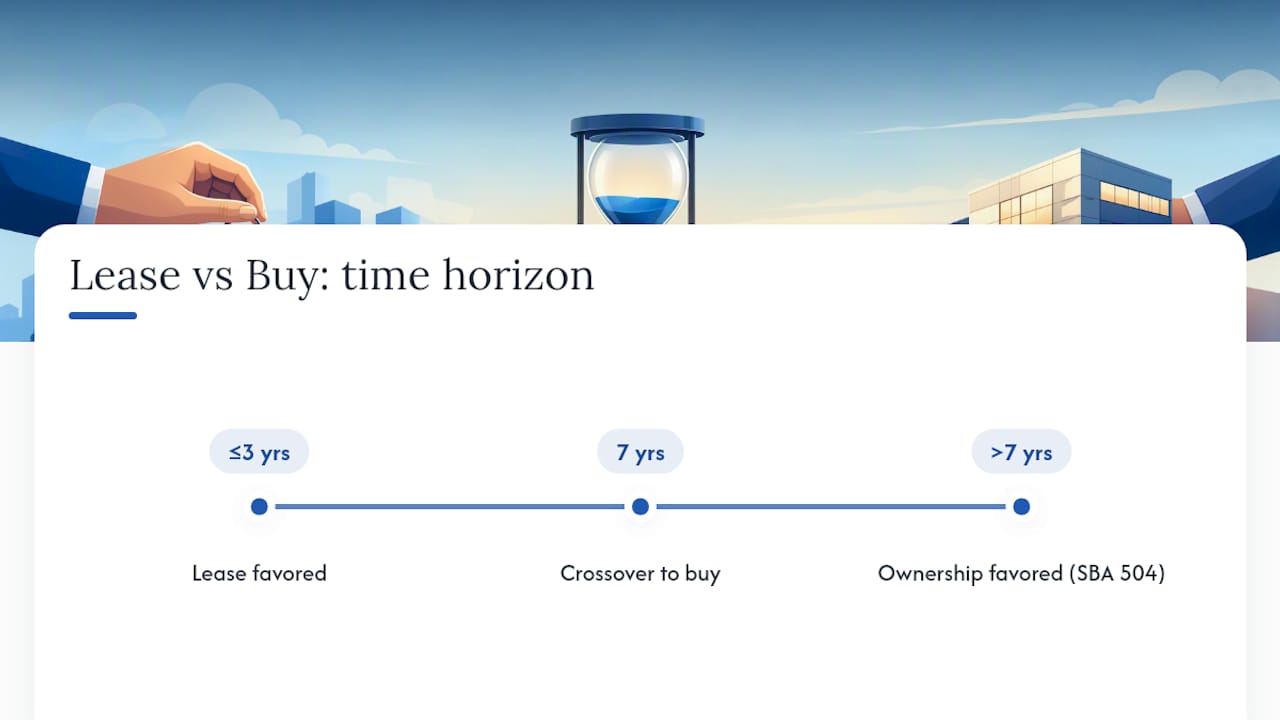
How long do you expect to occupy this space? Time horizon drives everything else in this decision. A business planning to stay 3 years or less almost always comes out ahead leasing, because transaction costs on a purchase (closing costs, loan fees, and the time spent finding a property) rarely get recovered that fast. Cross the 7 year mark and the math usually flips toward ownership, particularly once you factor in SBA 504 financing and its below-market fixed rate on the CDC portion.
What else could that down payment do for your business? A $150,000 down payment sitting in a building is a $150,000 down payment that isn’t funding inventory, hiring, or a second location. If your growth plans need that capital more than your real estate needs an owner, leasing keeps the option open. If the cash would otherwise sit idle or earn a modest return, buying converts it into equity instead.
How much control do you need over the physical space? Restaurants, manufacturers, medical practices, and specialty retailers often need structural changes, ventilation upgrades, or heavy equipment installations that a landlord may restrict or slow down with approval processes. Owning eliminates that friction entirely.
Is your business growing, shrinking, or holding steady? A business that might double its footprint in 3 years, or might need to downsize if a product line fails, benefits from a lease’s built in exit points. A business with a stable, predictable footprint loses little of that flexibility value and gains more from ownership.
Can you actually get financing, and on what terms? This one is binary. If your credit, time in business, or down payment reserves don’t clear the bar for conventional or SBA 504 loans, leasing may be the only realistic option today, regardless of what the long-term math says.
How much risk can your business absorb? Ownership adds a real estate asset to your balance sheet, along with real estate risk: vacancy costs if you downsize, maintenance surprises, and market value swings. Leasing transfers most of that risk to the landlord in exchange for rent that can climb with the market.
Run your business through these six filters honestly, and a leaning usually emerges before you open a single spreadsheet. The financial modeling in the sections ahead exists to confirm that instinct, or to correct it.
Commercial property leasing and ownership each carry a different risk profile, and the tradeoffs go well beyond the monthly payment. Small business guidance on buying vs leasing consistently frames the choice around capital preservation versus long-term wealth building, and that framing holds up.
Leasing keeps your upfront capital available for the business itself. A typical commercial lease requires first and last month’s rent plus a security deposit, a fraction of what a down payment demands. You also gain the ability to relocate when your lease term ends, which matters enormously if your customer base, headcount, or product mix might shift.
The hidden costs show up over time, not on day one:
Pro Tip: Before signing any multi-year lease, ask the landlord for the last 3 years of CAM reconciliation statements. If actual charges consistently run 15% or more above the estimated CAM figure quoted in the lease, negotiate a cap now, not after you’ve signed.
Ownership converts your rent payment into a mortgage payment that builds equity instead of disappearing into a landlord’s pocket. You get full control over renovations, tenant selection if you lease out surplus space, and protection from a landlord raising your rent or declining to renew. Depreciation and mortgage interest also generate real tax deductions that leasing doesn’t offer in the same way.
The burdens are real too. You’re responsible for every roof leak, HVAC failure, and parking lot repaving. If your business needs change and you outgrow or shrink out of the space, selling a commercial building takes months, not weeks, and vacancy while you carry a mortgage is a genuine risk. Property values can also decline, which converts what looked like an appreciating asset into a liability at the exact moment you need liquidity.
Office space tends to favor leasing for younger businesses that don’t yet know their headcount trajectory. Retail leans toward leasing too, since foot traffic patterns and local demographics shift, and a bad location becomes a sunk cost fast if you own it. Industrial and specialized-use properties (manufacturing, medical, cold storage, auto service) tip harder toward buying, because the improvements those businesses need are expensive, permanent, and rarely something a landlord will fund or approve without a long lease commitment anyway. If you’re going to make $300,000 in tenant improvements, you want to own the building those improvements sit inside.
The financial comparison between buying and leasing commercial property comes down to two numbers: net present value (NPV) and internal rate of return (IRR). NPV tells you which option costs less in today’s dollars once you discount future cash flows back to the present. IRR tells you the effective rate of return the purchase generates compared to leasing and investing the difference elsewhere. You need both, because NPV shows magnitude while IRR shows efficiency, and a purchase can win on one while losing on the other depending on your discount rate assumptions.
A full comparison should include these cash-flow items on both sides of the ledger:
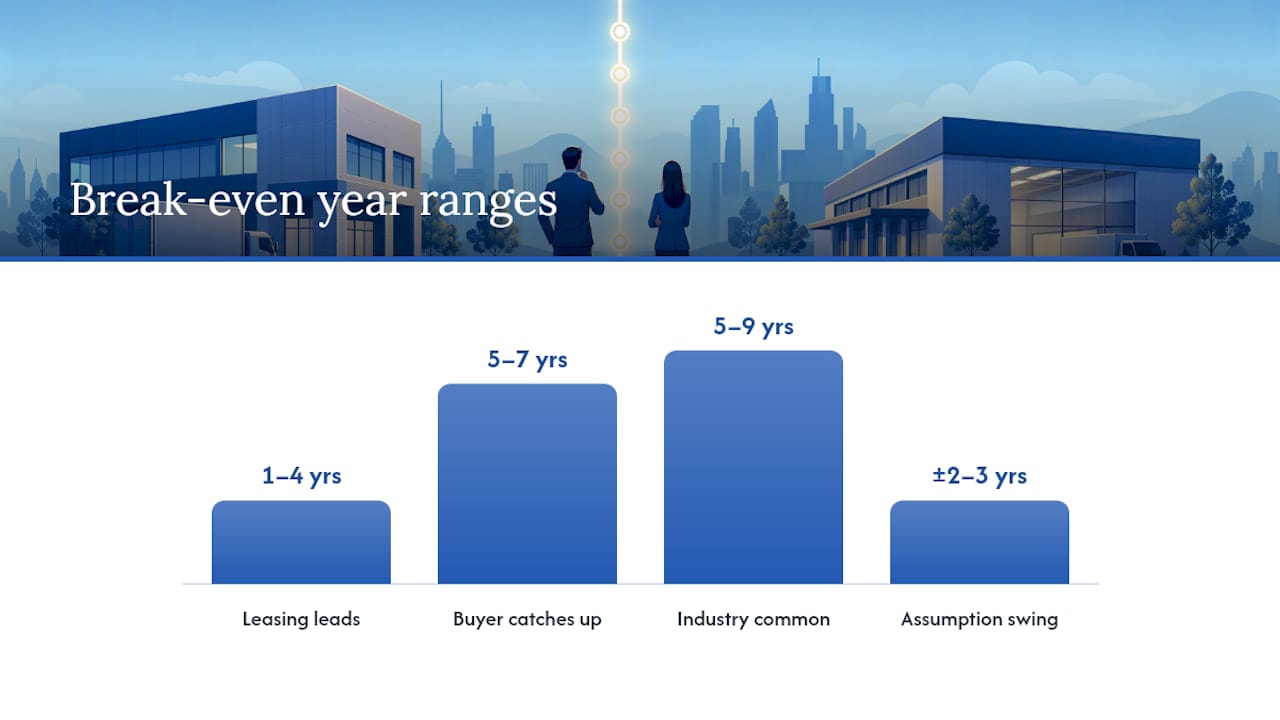
Here’s a simplified sketch. A business considering a $1.2 million property with a 10% SBA 504 down payment, versus leasing comparable space at a starting rent with 3% annual escalations, typically shows leasing ahead on cash flow in years 1 through 4, since the down payment and closing costs front-load the ownership side. By year 5 to 7, accumulated equity, the tax shield from depreciation, and a fixed loan payment (versus rising rent) usually close the gap. Modeling examples across the industry commonly put the break-even year somewhere between 5 and 9 years, though the exact year moves based on your assumptions.
That range isn’t fixed, and small changes to the inputs move it substantially. A dedicated lease-vs-buy calculator that models SBA 504 terms alongside TI allowances and free rent periods can shift the break-even point by 2 or 3 years in either direction. Bump your assumed property appreciation from 2% to 4% annually, and buying pulls ahead faster. Assume a vacancy period between tenants if you sublease, or a higher tax rate that reduces the value of your deductions, and the break-even year stretches out. Run the numbers with your actual tax rate, not a generic estimate, since that single input swings the comparison more than almost anything else.
Conventional commercial mortgages typically require 20% to 30% down, carry terms of 15 to 25 years, and price the interest rate based heavily on your personal and business credit profile. That down payment requirement alone puts ownership out of reach for a lot of profitable small businesses that simply haven’t accumulated six figures in reserve capital.
The SBA 504 loan program changes that equation directly for owner-occupants. Structured as two loans working together, a conventional lender covers roughly half the project through a first mortgage, a Certified Development Company (CDC) funds a second loan backed by an SBA debenture, and the borrower contributes the rest.
Key mechanics worth understanding before you apply:
The blended structure is the real advantage. Because the CDC portion locks in a fixed rate for the life of the loan, your monthly payment on that piece never moves, which makes long-term budgeting dramatically simpler than a lease with compounding annual escalations. SBA 504’s structure frequently changes the buy math for projects under $5.5 million, pulling the break-even year earlier than a conventional-financing scenario would produce.
SBA 504 isn’t the right tool for every purchase. Startups under 2 years old also face additional scrutiny and often need a larger down payment to qualify. Comparing how conventional mortgages stack up against SBA 504 over the long term is worth doing before you commit to either path.
A commercial lease looks straightforward until you read the operating expense clause. Most lease risk hides in provisions that seem administrative on the surface but compound into real dollars, or real restrictions, over a multi-year term.
Triple net (NNN) and CAM reconciliation. In a triple net lease, you pay base rent plus your share of property taxes, insurance, and maintenance, on top of common area maintenance charges. Landlords often estimate CAM monthly and reconcile against actual costs annually, and that reconciliation can produce an unpleasant surprise bill if the estimate ran low.
A 10 year lease with 4% fixed annual escalation raises your rent by nearly 48% by the final year, so negotiate for the lower, predictable structure whenever the landlord offers a choice.
Assignment and subleasing rights. If your business needs change, your ability to hand the lease to another tenant, or sublease part of your space, determines whether you have a real exit or you’re locked in until the term ends. Landlords frequently require consent for assignment, and some leases prohibit subleasing outright. Negotiate reasonable consent language (landlord “shall not unreasonably withhold” approval) rather than accepting an absolute prohibition.
Personal guarantees. Many commercial leases require the business owner to personally guarantee the full lease term, which means a lease default follows you personally even after the business closes. Ownership doesn’t erase this risk category entirely, since a mortgage often carries a personal guarantee too, but a lease guarantee typically has no offsetting asset behind it. Negotiating away or capping a personal guarantee is frequently worth more than a lower base rent.
Expansion and renewal options. If growth is even remotely plausible, negotiate a right of first refusal on adjacent space and a renewal option with a predetermined rate formula, so you’re not renegotiating from a position of weakness when your term ends.
Facility service contracts deserve the same scrutiny as the lease itself. Reviewing what to look for in a commercial vendor contract before signing helps you spot auto-renewal clauses and liability gaps that create ongoing costs regardless of whether you own or lease.
Ownership gives you full authority over renovations. Want to knock down a wall, add a loading dock, or install specialized ventilation? You do it on your own timeline, without a landlord’s approval process slowing you down. A tenant making the same request typically waits on landlord sign-off, and even then may be limited to changes that don’t reduce the property’s value to future tenants.
That freedom comes with a maintenance burden leasing doesn’t carry. Owners handle every roof repair, HVAC replacement, and parking lot resurfacing themselves, along with the capital planning that comes with an aging building. A lease typically shifts structural repairs to the landlord, though CAM charges recover some of that cost indirectly.
Before buying, verify zoning and permitted use match your business activity, not just its current use. A property zoned for general retail may not permit food service, and a light industrial building may restrict the hours or noise level of certain operations. Pull the zoning classification and confirm any required permits or variances before you sign a purchase agreement, not after.
Ownership also opens a revenue option leasing doesn’t: subleasing surplus space. If you buy a building larger than your current footprint, you can lease the extra square footage to another business and use that income to offset your mortgage payment, effectively lowering your real occupancy cost while building equity in the whole property.
Pro Tip: Call your local zoning office directly before making an offer. A quick 15-minute call can save you months of delay if the property’s current zoning doesn’t match how you plan to use it.
Building a credible buy vs lease commercial property comparison takes a specific set of inputs and a consistent sequence. Skipping steps, or plugging in optimistic assumptions, is how otherwise sound analyses produce misleading conclusions.
The pitfalls that derail this analysis are almost always omissions, not calculation errors.
You don’t need to build this model from scratch. A 504 loan calculator built for Florida small businesses can run SBA 504 scenarios directly, and a general lease vs buy calculator that incorporates SBA financing handles the TI and free rent adjustments automatically. Once the numbers are close, or once SBA 504 eligibility becomes a real question, loop in a CPA to confirm your tax assumptions, a commercial broker for realistic market comps, and a CDC to walk through actual loan terms before you commit either way.
SBA 504 financing frequently strongly influences buy versus lease decisions in favor of ownership for eligible businesses. Certified Development Companies (CDCs) have decades of experience helping small businesses structure these loans, and the pattern shows up consistently: businesses that assumed ownership was out of reach on a conventional down payment discover a materially different picture once the SBA 504 structure enters the analysis.
A few mechanics explain why:
The typical process runs through a fairly consistent timeline: a borrower assessment and eligibility check, document collection (financials, tax returns, business plan), lender and CDC underwriting, an SBA authorization stage, and closing. Most straightforward owner-occupant purchases move through FBDC’s proven process in a matter of weeks once documentation is complete, though projects involving new construction or complex partnership structures take longer.
SBA 504’s real advantage isn’t just the lower down payment. It’s the combination of below-market fixed-rate financing on the CDC portion and a structure specifically designed for owner-occupants, which together frequently pull the break-even year on a purchase several years earlier than a conventional-financing scenario would produce.
SBA 504 is the recommended path when a business plans to occupy the majority of the property long term, has stable financials, and wants to preserve capital while still building equity. In those cases, a conventional loan or a direct lending option may fit better.
The framework matters more than the spreadsheet. Every buy vs lease conversation should start with the model, not gut instinct, because NPV and IRR expose assumptions that emotion glosses over. But the model only tells you the financial answer. It doesn’t tell you whether your business can tolerate an illiquid asset if your plans change in year 3.
Liquidity and flexibility deserve more weight than most owners give them. A business still finding its footholds, still testing markets or product lines, usually benefits more from a lease’s exit options than from equity it might not stay around to enjoy. Stability changes that calculus entirely. A business with a proven model and a decade-long outlook leaves real money on the table by continuing to lease.
Run the sensitivity scenarios before you sign anything. Shift your occupancy horizon by 2 years, bump the rent escalation rate, and see whether your conclusion holds. If it doesn’t, you were closer to a coin flip than you realized.
— PHENYX
If the numbers above pointed you toward buying, the down payment is usually what’s holding a business back, not the desire to own.
The SBA 504 loan program works for owner-occupants purchasing, building, or renovating commercial property, or acquiring equipment with a useful life of 10 years or more. If you’re ready to see what your actual down payment and blended rate would look like, FBDC’s 6-step process starts with a straightforward eligibility conversation, not a mountain of paperwork. Reach out and find out what your numbers actually look like before you sign a lease renewal you might not need.
Run your own comparison using primary sources rather than secondhand summaries. The SBA’s official 504 loan page lays out current eligibility rules and program structure directly from the U.S. Small Business Administration, and it’s the definitive source when program caps or occupancy requirements change.
For the financial modeling itself, PropertyMetrics’ lease-vs-own framework walks through NPV and IRR methodology in more depth than fits here, and a lease vs buy calculator built around SBA 504 scenarios lets you test your own numbers directly. FBDC’s own 504 loan calculator is worth running alongside either tool to see the Florida-specific picture.
It depends primarily on your occupancy horizon and access to financing. Businesses planning to stay 7 or more years with access to SBA 504 financing typically come out ahead buying, while businesses under a 5 year horizon or facing growth uncertainty generally do better leasing.
It’s used more by real estate investors evaluating rental properties than by owner-occupants deciding whether to buy their own operating space, so treat it as a quick filter, not a substitute for a full NPV and IRR comparison.
Comparing that figure to your annual rent gives a quick directional read, though a full break-even analysis using NPV and IRR accounts for far more variables and produces a more reliable answer.
The right timing depends more on your business’s specific financials and occupancy plans than on broad market conditions. Businesses with stable cash flow, a long occupancy horizon, and access to SBA 504’s 10% down payment structure are generally well positioned regardless of short-term market shifts, since the fixed-rate CDC portion insulates a large piece of the loan from future rate volatility.
Eligibility requires the business to occupy at least 51% of the property, a restriction conventional financing doesn’t impose.

