.svg)
.svg)
.svg)

If you need to pull equity out of commercial property or equipment to cover payroll, rent, or other operating costs, a cash-out SBA 504 refinance is typically the better fit. If your main goal is a lower, more predictable monthly payment over the long term, a rate-and-term 504 refinance usually makes more sense. The U.S. Small Business Administration’s rule changes effective November 15, 2024 widened access to cash-out refinancing and eased the old payment-reduction test, so more Florida business owners now qualify for either path. Below, we walk through eligibility, documentation, costs, and a decision checklist to help you choose.
Fbdc
Explore SBA 504 Refinancing Options
FBDC helps Florida small businesses pursue SBA 504 financing for real estate, machinery, and equipment with expert guidance throughout the process.
A cash-out 504 refinance lets you tap the equity in your commercial real estate or equipment to cover what the SBA calls Eligible Business Expenses, or EBE. A rate-and-term 504 refinance restructures your existing debt into a long-term, fixed-rate loan without pulling out any equity. Both use the same 504 loan structure: a fixed-rate debenture typically covering 40% of the project, paired with a third-party lender portion, which preserves the program’s long-term rate stability either way.
Eligible Business Expenses in a cash-out refinance generally include:
Rate-and-term refinancing produces its benefit differently. Rather than releasing cash, it stretches your remaining balance across a longer amortization window, commonly 20 or 25 years under the 504 program, which lowers your installment and locks in a fixed rate for the life of the loan.
Regulatory impact estimates in the Federal Register’s analysis of the 2024 rule describe meaningful monthly and lifetime savings for some borrowers who refinance into 504 fixed-rate, long-term loans, though exact figures depend on loan size and current balances. Supporting analysis for the rule outlines the kind of savings ranges the SBA considered when drafting the change.
To compare the two paths on paper, use this simple DSCR Loans for Investors — David Mordue method:
A business carrying a $400,000 balance that refinances into a longer fixed term might lower its installment by a modest monthly amount, illustrative only, while a business needing $150,000 for payroll gaps would weigh that liquidity against any increase in its installment.
The Federal Register rule revising 13 CFR 120.882 separates debt refinancing into two paths: refinancing with expansion, where new financing is tied to a project that also expands the business, and refinancing without expansion, which covers standalone refinance transactions. The practical difference matters for sizing and documentation, since expansion projects can draw on the same eligibility rules that apply to new 504 financing.
The SBA’s own announcement confirms the rule removes the prior requirement that borrowers demonstrate a minimum reduction in their loan payment from refinancing, a shift that opens the door for owners who want liquidity rather than a lower payment. See the SBA’s announcement for the full context.
Other rules to keep in mind:
Work through these steps before you approach a Certified Development Company (CDC):
Pro Tip: If a prepayment penalty would wipe out your projected savings, ask your CDC whether financing that penalty into the new loan still produces a net monthly benefit over 20 or 25 years before you proceed.
Watch for red flags: a large prepayment penalty on your current loan, missing or unpaid invoices for EBE claims, or a mismatch between your available collateral and the cash amount you are requesting. Any of these should prompt a conversation with a CDC before you submit paperwork.
A 504 refinance application moves faster when you gather documents early:
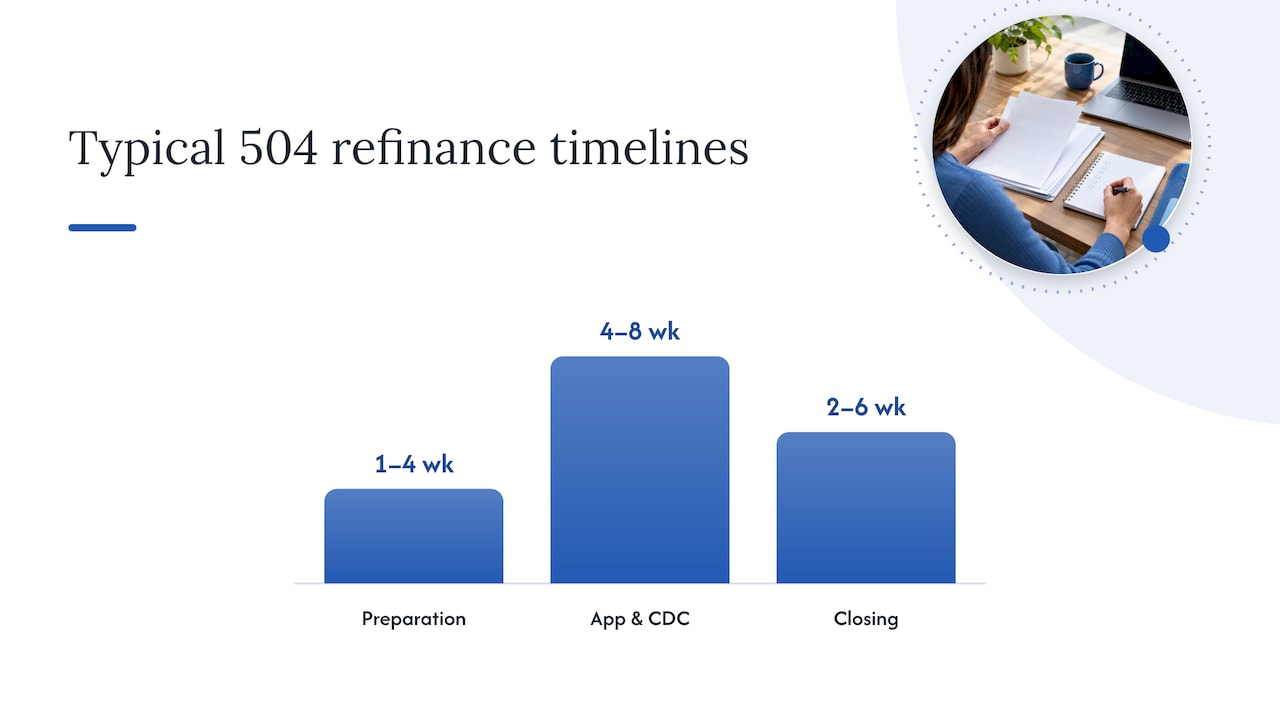
Timelines vary, but most 504 refinances move through four phases: preparation and scoping (1 to 4 weeks), application and CDC underwriting (4 to 8 weeks), SBA review (variable, depending on volume and documentation completeness), and closing (2 to 6 weeks). Delays usually trace back to incomplete EBE documentation or unresolved lien issues.
Budget for processing fees, appraisal costs, closing costs, and any prepayment penalty on your current loan. Many of these can be financed into the new loan rather than paid out of pocket, which changes your net-benefit math.
Pro Tip: Request a pre-application review with your CDC before you formally apply. It surfaces documentation gaps early and can shave weeks off underwriting.
We built our screening process around realistic eligibility checks rather than optimistic assumptions. We typically recommend cash-out refinancing when a business needs working capital tied up in fixed assets, faces a payroll gap, or carries other secured debt worth consolidating. We point owners toward rate-and-term when the priority is stabilizing cashflow or locking in a fixed rate before costs climb further.
Our support starts with pre-application scoping and continues through guidance on documenting Eligible Business Expenses.
Whichever path fits your business, we work with small business owners on SBA 504 refinancing, from cash-out requests tied to Eligible Business Expenses to straightforward rate-and-term restructuring. When timing is tight or approvals are pending, our FBDC 504 Velocity Bridge Loan Program can keep a project moving without losing momentum.
If you want a clear answer on which refinance path fits your numbers, request a pre-application review and we will walk through your eligibility and documentation together.
This article is general information, not a substitute for advice from a qualified financial advisor. Consult a qualified financial professional about your own circumstances before acting on anything here.
Eligible Business Expenses include payroll, rent, utilities, and certain other secured business debt, as defined in the Federal Register rule revising 13 CFR 120.882. These expenses must be itemized and documented with invoices or proof of payment rather than estimated.
A rate-and-term refinance generally lowers your installment by stretching the balance across a longer fixed-rate term, often 20 or 25 years, under the SBA 504 program. A cash-out refinance may raise your installment somewhat since you are borrowing additional funds, so the net effect depends on how much cash you draw.
Refinancing rules under the updated 504 regulation address both debt refinancing with expansion and without expansion, and eligibility depends on your specific loan type and current terms. We recommend a pre-application review with a CDC to confirm whether your existing debt qualifies.
Most 504 refinances move through preparation, underwriting, SBA review, and closing in phases that can vary in length, often from several weeks to a few months, depending on documentation completeness. Gathering your Eligible Business Expense proof and appraisal early tends to shorten the process.
Yes. The SBA’s September 2024 announcement removed the prior requirement that borrowers prove a minimum payment reduction, which previously limited cash-out options for many applicants. This change makes it easier to combine cash-out needs with a refinance that does not necessarily lower your payment.

