.svg)
.svg)
.svg)

Most commercial property loans require between 10% and 35% down, with conventional bank financing typically landing around 20%–30%. The main exception is the SBA 504 loan program, which allows eligible owner-occupants to close with as little as 10% down. Your actual number depends heavily on debt service coverage ratio (DSCR) math and the property type you’re buying. Not just the loan program’s advertised minimum.
TL;DR:
- SBA 504 loans require as little as 10% down for established owner-occupants, but special-purpose properties often need 15% or more.
- Typical down payments for conventional bank loans range from 20% to 30%, heavily influenced by the property’s loan-to-value ratio and debt service coverage ratio.
- Rising interest rates are now more likely to limit loan size through DSCR constraints, leading borrowers to contribute 25%–30% equity instead of the maximum LTV.
- Borrowers can sometimes use seller notes, retirement rollovers, or collateral pledges to reduce their initial cash outlay, but borrowed funds usually don’t count as equity.
- Working with an SBA 504 specialist can help structure the lowest possible down payment and streamline the documentation process, especially for complex exceptions.
The down payment you need swings widely based on which financing box your deal fits into. Owner-occupied purchases get the friendliest terms because programs like SBA 504 exist specifically to help small businesses buy the buildings they operate in. Investment properties, where you’re renting space to someone else, almost always demand more skin in the game because lenders see more risk in a landlord’s cash flow than in a business owner’s operating income.
Here’s how the ranges typically break down by program:
Special-purpose properties, think self-storage facilities, gas stations, or hotels, tend to require a higher down payment across every program. Lenders view single-use real estate as harder to resell if a deal goes sideways, and that caution shows up directly in your required equity.
Two numbers drive almost every down payment calculation: loan-to-value (LTV) and DSCR. LTV caps how much a lender will lend against the property’s appraised value. DSCR measures whether the property’s net operating income comfortably covers the proposed loan payment, and it’s increasingly the number that actually decides your loan size.
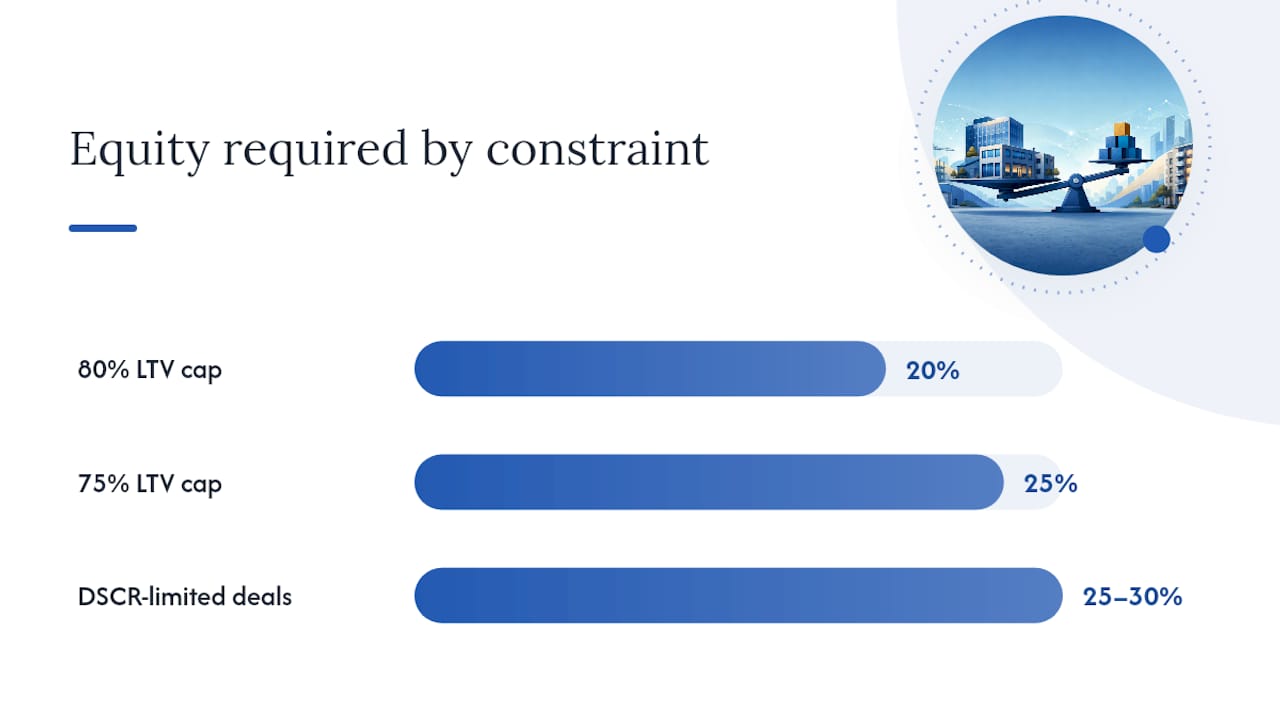
Here’s the shift worth understanding: rising interest rates have made DSCR the real constraint in most deals, even when a program’s LTV cap sits at 75% or 80%. A higher rate means a bigger monthly payment on the same loan amount. This can push the DSCR below a lender’s minimum threshold, typically 1.20x to 1.25x. When that happens, the lender simply reduces the loan amount until the math works, and you cover the gap with more cash.
Statistic Callout: Many lenders that once comfortably financed deals at 80% LTV are now sizing loans that leave buyers contributing 25%–30% in equity, purely because DSCR math, not the stated LTV cap, is the binding constraint.
Beyond LTV and DSCR, lenders weigh a set of borrower-specific factors before finalizing your number:
A thin liquidity cushion after closing can sink an otherwise strong application, even when the down payment itself meets the minimum.
SBA 504 loans use a distinctive three-part structure that makes the low down payment possible. A typical deal splits into a 50% first mortgage from a bank, a 40% debenture from a Certified Development Company (CDC), and a 10% equity injection from the borrower. That structure is what lets 504 undercut nearly every other commercial financing option on cash required at closing.
SBA 7(a) works differently. It’s a single loan rather than a split structure, and SOP 50 10 8 reinstated a minimum 10% equity injection requirement for higher-risk transactions, specifically startups and complete changes of business ownership, effective June 1, 2025. Lenders document that injection carefully: they’ll accept bank statements and a completed SBA Form 413 showing verified funds, but they generally won’t accept an unsupported promissory note as proof of equity.
You don’t have to fund the entire down payment from your own checking account. A seller note structured as full-standby debt for the life of the SBA loan can cover up to half of your required equity injection, provided it’s properly subordinated and documented.
Other legitimate sources worth exploring:
Pro Tip: Never assume borrowed money automatically counts as your equity injection. Lenders trace the source of every dollar, and money borrowed against the business you’re buying usually doesn’t qualify, even if it clears your bank account 30 days before closing.
The biggest pitfall isn’t finding the cash. It’s draining your liquidity so thin that you fail the lender’s post-closing reserve test even after meeting the down payment number on paper.
Two quick examples show how the math actually plays out.
Add earnest money, typically 1%–10% of purchase price, into the mix early, since it’s usually credited toward your down payment rather than stacked on top. Run your own numbers with a 504 loan calculator before you write an offer, not after.
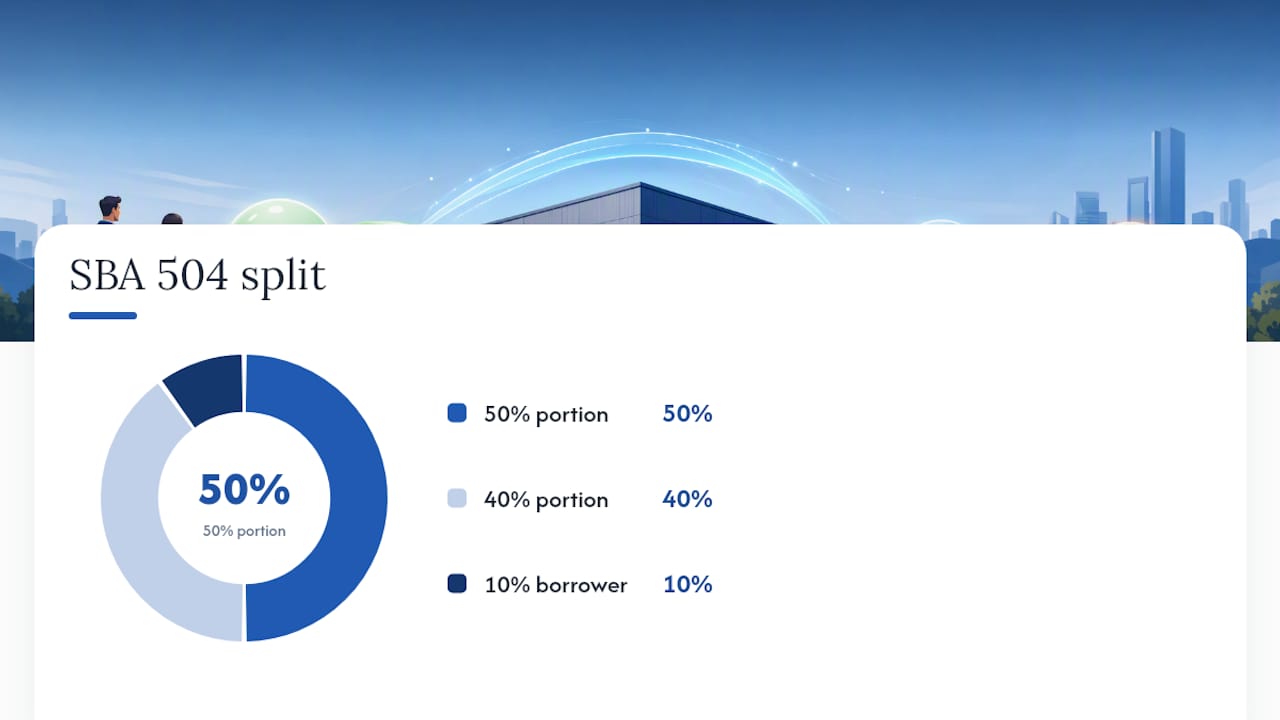
Fbdc has spent more than 35 years focused exclusively on SBA 504 lending, which means structuring the 50/40/10 split isn’t a side service. It’s the core business. That specialization matters most at the documentation stage, where SBA reviewers scrutinize every dollar of your equity injection.
Borrowers working with Fbdc typically get:
That kind of program-specific depth is what separates a smooth 504 closing from one that stalls over paperwork.
Model your DSCR before you make an offer, not after. Borrowers who verify their equity sources early and keep real post-closing liquidity close far more often than those chasing the lowest number on paper.
— PHENYX
Fbdc has spent over three decades structuring these deals specifically for Florida small businesses, which means the paperwork, timelines, and documentation quirks that trip up first-time borrowers rarely catch us off guard. Start by running your numbers through the 504 loan calculator to see what your actual cash-to-close might look like. From there, Fbdc’s proven six-step process walks you through eligibility, documentation, and closing without the guesswork. If you’d rather talk specifics first, the SBA 504 loan program page breaks down eligibility criteria in plain terms, and reaching out for a consultation costs you nothing but a few minutes.
This article is general information, not a substitute for advice from a qualified financial advisor. Consult a qualified financial professional about your own circumstances before acting on anything here.

