.svg)
.svg)
.svg)

DSCR, or debt service coverage ratio, measures whether a property’s income covers its loan payments: divide net operating income by total annual debt service. Most commercial lenders look for a DSCR of roughly 1.20x to 1.35x, while 1.0x marks the break-even point where income exactly matches payments. Before you approach a lender, pull your NOI and debt service figures and run the math yourself.
TL;DR:
- Most lenders require a DSCR between 1.20x and 1.35x, with 1.0x being the break-even point where income just covers debt payments.
- Lenders adjust your NOI downward by applying vacancy stress and capital reserve allowances, which can be reduced with thorough documentation.
- Loan-to-value, debt yield, and lease stability influence DSCR acceptance, with lower LTV or longer leases potentially offsetting weaker ratios.
- Strengthening your DSCR presentation involves providing three years of reconciled statements, a clear stabilization plan, and considering structural loan options like longer amortization or interest-only periods.
The formula is simple: DSCR equals net operating income divided by total annual debt service. In plain terms, it answers one question: for every dollar you owe on the loan this year, how many dollars of property income do you have to cover it?
Net operating income includes rental revenue and other property income minus operating expenses, but it excludes debt service and income taxes. Items like property management fees, reserves for replacement, insurance, and routine repairs count against NOI, while the mortgage payment itself does not factor in until the DSCR calculation.
Lenders also distinguish between two versions of the ratio:
A value-add deal with thin current cash flow might still qualify if the stabilized projection, supported by a credible plan, shows a healthy ratio once renovations are complete.
Most set their floor in a band from 1.20x to 1.35x, and the Comptroller’s Handbook on commercial real estate lending confirms this is the standard underwriting range, with 1.0x treated as the break-even floor rather than an acceptable target.
A DSCR floor in a moderate range above break-even gives lenders a cushion against vacancy, rising expenses, and interest-rate shifts, according to OCC underwriting guidance, which also notes that lenders apply conservative vacancy and expense assumptions when they underwrite a deal rather than taking a borrower’s pro forma at face value.
Exceptions exist. A property leased to a government tenant or backed by a long-term, investment-grade lease might clear underwriting at a lower ratio because the income stream carries less risk. On the other end, a lender may push the required DSCR higher for a single-tenant industrial building with a short lease term, because the cash flow could disappear entirely at renewal.
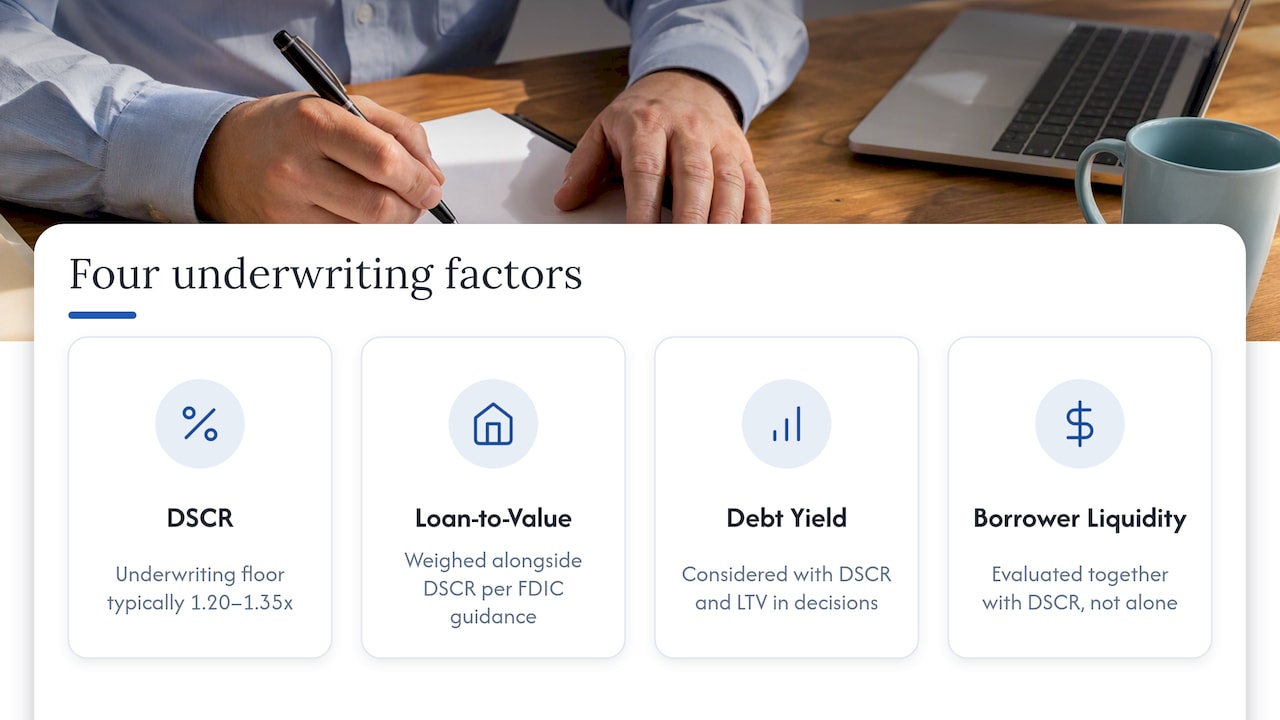
FDIC risk management guidance directs banks to set minimum DSCR guidelines and to weigh the ratio alongside loan-to-value, debt yield, and borrower liquidity rather than in isolation. That combination, not DSCR alone, ultimately shapes the loan decision.
Building a lender-ready NOI starts with your gross scheduled rent, then works down through every real cost of operating the property.
Lenders commonly adjust your submitted NOI downward. They may impose a 5% to 10% vacancy stress even if your property is fully leased, and they often add or increase a capital reserve allowance beyond what you budgeted, according to OCC guidance on income property lending. The gap between your number and the underwriter’s number usually comes down to documentation: a thin paper trail invites a conservative haircut, while clean historical statements, signed leases, and a market rent study narrow the adjustment.
Pro Tip: Bring three years of reconciled operating statements to your first lender meeting: it often shrinks the vacancy and expense stress the underwriter would otherwise apply by default.
Here is a simplified version of a worked example found in federal examiner guidance on income property lending: a property generates $694,000 in net operating income against $528,606 in total annual debt service.
| Metric | Value |
|---|---|
| Net operating income | $694,000 |
| Annual debt service | $528,606 |
| DSCR (NOI ÷ debt service) | 1.20x to 1.35x |
The breakeven ratio, which adds operating expenses and debt service together and divides by gross income, tells you how far income can fall before the property stops covering its obligations entirely, a complementary check recommended in the same examination handbook.
Run a quick sensitivity check on any deal you’re underwriting yourself.
DSCR never stands alone in a lender’s decision. It gets weighed alongside loan-to-value and debt yield, and a strong number on one metric can offset a weaker one elsewhere.
You can influence how a lender treats your DSCR before the underwriter ever runs the numbers.
Each option carries a trade-off. Longer amortization or interest-only terms often come with a slightly higher rate or a shorter fixed-rate period, so weigh the DSCR benefit against the total cost of the loan.
Pro Tip: If your DSCR lands just under a lender’s floor, ask about a partial interest-only period before assuming the deal is dead: it’s a common fix for borrowers close to the threshold.
We’ve spent over 35 years focused on SBA 504 lending for small businesses acquiring real estate, heavy machinery, and equipment, which gives us a close view of how DSCR plays out for owner-occupied and income-producing commercial properties. We work with for-profit small businesses that traditional lenders often turn away due to stringent criteria, and our streamlined process is designed to get eligible borrowers to a decision without unnecessary delay.
Treat your DSCR target as a planning tool, not a box to check. Pair DSCR with a realistic look at loan-to-value and your reserve position, and stress-test before a lender makes you do it.
— PHENYX
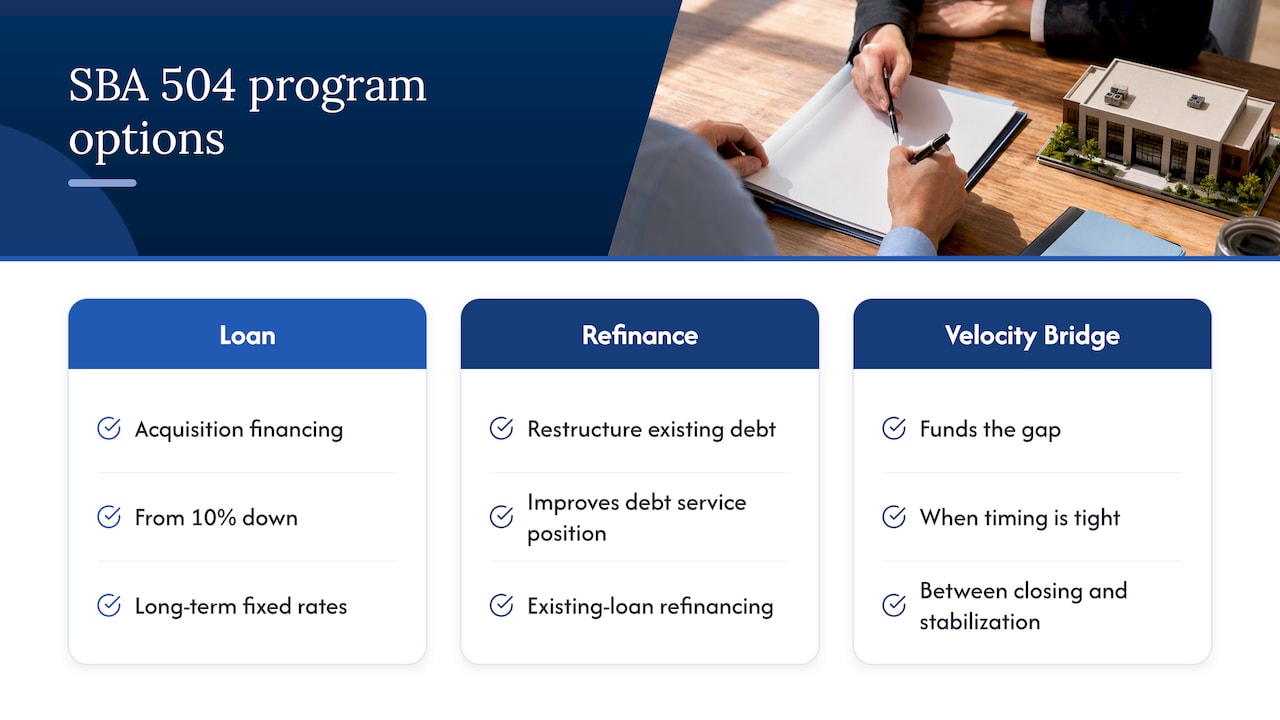
If your property’s DSCR supports long-term, fixed-rate debt but a traditional bank wants a larger down payment than you can justify, SBA 504 financing offers a different path to the same acquisition. Our SBA 504 Loan Program provides down payments from 10% with long-term fixed rates built for cash-flow-positive commercial real estate, and our SBA 504 Refinance Program restructures existing debt to improve your debt service position. When timing is tight between closing and stabilization, our 504 Velocity Bridge Loan Program can fund the gap.
Reach out to us to find out whether your project meets SBA 504 eligibility requirements and what documentation will move your application forward fastest.
This article is general information, not a substitute for advice from a qualified financial advisor. Consult a qualified financial professional about your own circumstances before acting on anything here.
Yes, DSCR is a standard underwriting metric for commercial property loans and applies to office, retail, industrial, and multifamily properties alike. Lenders calculate it by dividing the property’s net operating income by its total annual debt service, regardless of asset type.
Loan availability at smaller amounts depends on the individual lender’s minimums and the property’s income relative to that debt load, since qualification hinges on DSCR math rather than loan size alone. Some direct lending programs, including smaller commercial loans outside the standard SBA 504 structure, are built specifically for lower loan amounts.
SBA 504 financing, for comparison, can require down payments as low as 10% for qualifying small business borrowers.
A DSCR between 1.20x and 1.35x is the typical minimum most commercial lenders look for, based on OCC underwriting guidance.
Build a lender-ready pro forma using reconciled historical operating statements, a current rent roll, and market comparables, since thin documentation tends to invite more conservative vacancy and expense assumptions. For deals that need an independent feasibility check, a third-party due diligence review can strengthen your NOI claims before a lender scrutinizes them.

