.svg)
.svg)
.svg)
For small businesses planning to keep equipment long-term and build equity, an equipment loan (or an SBA 504 loan when you qualify) usually delivers the better long-term value. If you need to preserve cash or upgrade equipment every few years, leasing typically wins. Tax treatment and end-of-term terms can shift that math, so read past the headline before you sign anything.
TL;DR:
- Loans that hold the equipment as an asset generally have higher upfront costs but become cheaper over the long term if the asset has a long useful life.
- Leases typically offer lower monthly payments but can lead to higher total costs if the equipment is renewed or leased repeatedly without ownership transfer.
- End-of-term options differ: loans give outright ownership, while leases may require return, renewal, or a final buyout based on residual value assumptions.
- Tax advantages favor leasing payments as deductible operating expenses, whereas loans allow depreciation and upfront expensing through Section 179 or bonus depreciation.
- SBA 504 loans are best suited for long-lasting equipment or projects combining real estate and equipment, with low down payments and fixed rates that can beat leasing costs over time.
An equipment loan lets you borrow money to buy the asset outright. The lender usually holds a lien on the equipment until you pay off the balance, but ownership sits with you from day one. A lease works differently: the leasing company owns the equipment, and you pay for the right to use it over a set term.
That ownership split drives almost everything else in the loan vs lease comparison, including who’s responsible for upkeep and what happens when the term ends.
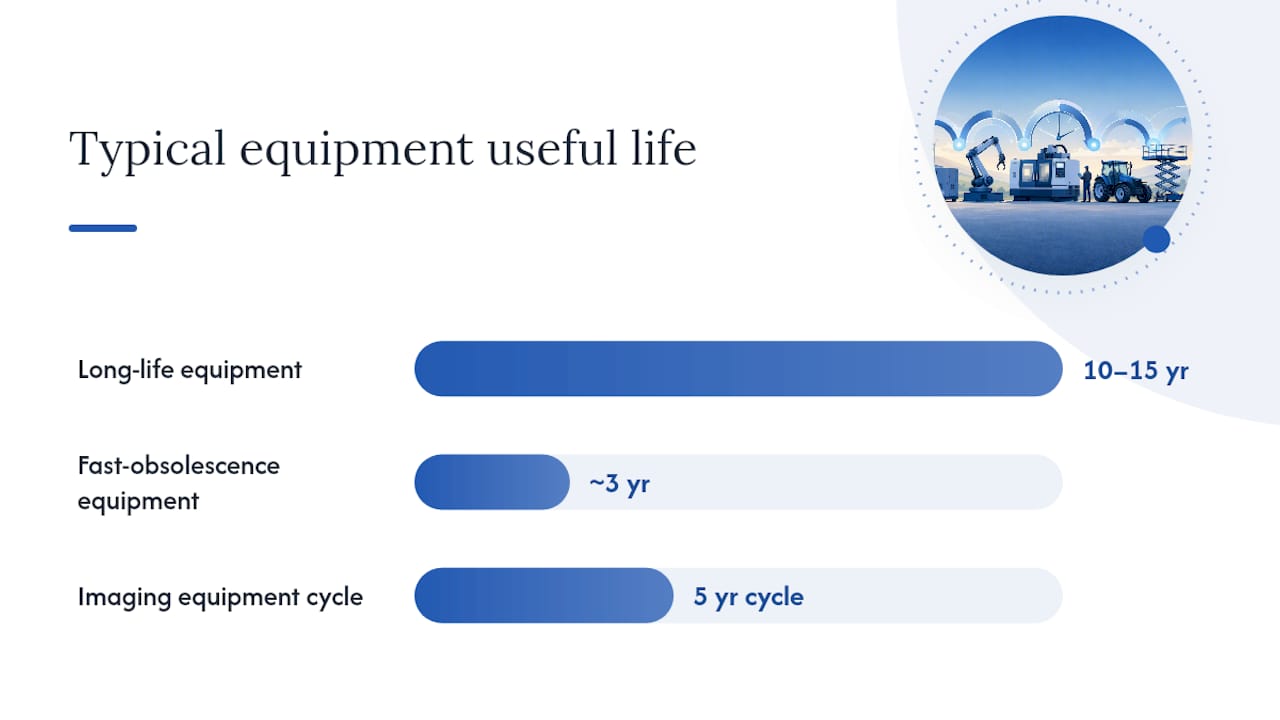
Construction firms buying an excavator they’ll run for 15 years look very different from a dental practice cycling through imaging equipment every three years. The right structure follows the asset’s shelf life.
Leases almost always carry a lower monthly payment than a comparable loan. That’s the pitch, and it’s often true in the short run. Over the full life of the equipment, though, financing frequently ends up cheaper because you stop paying once the loan is retired, while a lessee who keeps renewing or leasing new equipment every cycle never stops.
Quick math: the equipment finance industry now supports more than $1.3 trillion in financed and leased equipment across the U.S. economy, a sign of how many structures and price points are competing for your business.
Here’s what actually moves the total cost:
Say a landscaping company needs a $60,000 skid steer. Financed over five years, they might pay it off and own a machine with resale value left. Leased over the same period with a renewal built in, they could pay less monthly but never stop paying, and never own anything. PNC’s small business guidance frames this exact tradeoff as liquidity versus equity, and it’s the right way to think about it.
Ownership outcomes diverge sharply once the term ends, and this is where a lot of business owners get surprised.
Residual value assumptions baked into a lease directly affect your monthly payment. A lessor betting the equipment will hold high resale value can offer lower payments; if that assumption is wrong, you’ll feel it in a steep buyout price. Before signing anything, ask what residual value the lease assumes and how it compares to real-world resale data for that asset class.
Lease payments are generally deductible as an operating expense in the year you pay them, which keeps your accounting simple and your tax timing predictable. Loans work differently: instead of deducting payments, you depreciate the asset, and Section 179 or bonus depreciation can let you expense a large chunk of the purchase price immediately rather than spreading it over years.
For 2026 purchases, Section 179 remains one of the sharpest tools in the buy decision. A qualifying equipment purchase can be expensed in the year it’s placed in service instead of depreciated over five or seven years, which changes the cash-tax picture dramatically for a profitable business.
A few things trip up business owners every year:
Run both scenarios by your CPA before you commit. The difference between leasing and financing often comes down less to sticker price than to how each option lands on your tax return and balance sheet.
The decision usually comes down to five factors: how long you’ll use the equipment, how fast it will become outdated, how much cash you can spare right now, your tax position, and whether you want maintenance built into the payment.
A construction company buying a bulldozer almost always leans loan. A restaurant leasing point-of-sale hardware that gets replaced every few years almost always leans lease. A medical practice financing an exam table might buy, while leasing its imaging equipment on a five-year cycle to stay current. IT firms often lease servers and workstations for the same reason.
Pro Tip: Before comparing a single quote, ask your CPA one question: “Would Section 179 or bonus depreciation meaningfully reduce my tax bill this year if I bought instead of leased?” The answer often decides the whole comparison before you look at a single rate sheet.
Equipment loans from banks and credit unions typically run 2 to 7 years, with the term length tied to the equipment’s expected life and resale value. Rates and down payment requirements shift based on your credit profile and how established your business is.
Once you’re holding actual quotes, the comparison gets more concrete and more important to get right.
Pro Tip: Bring three things to every quote conversation: your last two years of financials, a realistic usage projection for the equipment, and the exact make and model specs. Lenders and lessors both price faster and more fairly when you show up prepared.
SBA 504 loans are built for durable equipment with a long useful life, or projects that combine equipment with real estate. The 504 structure uses low down payments and long fixed terms, which can make buying financially comparable to leasing on a monthly basis while you still build equity.
Fbdc has worked with small businesses across Florida for more than 35 years, structuring SBA 504 loans with down payments as low as 10% and long-term fixed rates. A Florida manufacturer buying a $500,000 CNC machine with a 20-year useful life, for example, is a textbook case where SBA 504 financing tends to beat leasing on total cost. If you’re exploring this route, gather your financials, a purchase quote, and your business tax returns before you apply.
The real decision here isn’t loan versus lease. It’s liquidity versus equity, and most owners underweight how much their tax position should drive that call. A business sitting on strong taxable income and a long-life asset is often leaving money on the table by leasing out of habit rather than running the Section 179 numbers first.
Talk to a CPA before you sign anything, and price both structures against your specific equipment, not a generic rule of thumb.
— PHENYX
If your business is buying equipment built to last, rather than something you’ll swap out in three years, Fbdc’s SBA 504 program is designed for exactly that math.
Leasing still makes sense for plenty of assets, especially anything that becomes outdated fast or requires bundled maintenance you can’t staff in-house. But when the asset has a decade or more of useful life ahead of it, run the numbers through the 504 loan calculator to see what your monthly payment and down payment would look like. If it pencils out, Fbdc’s proven six-step process walks you through everything from eligibility to closing.
For deeper detail beyond this guide, review Forbes Advisor’s equipment lease vs loan breakdown, J.P. Morgan’s equipment financing overview, and Bankrate’s guide to equipment financing types. Florida businesses evaluating loan providers can also compare terms through Prominence Bank’s business banking resources.
This article is general information, not a substitute for advice from a qualified financial advisor. Consult a qualified financial professional about your own circumstances before acting on anything here.
The 90% rule refers to an accounting test where a lease is classified as a capital (finance) lease rather than an operating lease if the present value of lease payments equals 90% or more of the equipment’s fair market value. Once that threshold is met, the lease is treated more like a purchase for accounting purposes.
It depends on the asset’s useful life and your cash position: buying with a loan (or SBA 504 when eligible) tends to cost less over time for durable equipment you’ll use for many years, while leasing preserves cash and fits equipment you’ll need to upgrade frequently.
Leasing often costs more over the equipment’s full life than financing, may include usage restrictions and end-of-term fees, and never builds equity since the lessor retains ownership until any buyout is exercised.
Yes. Lease payments are generally deductible as an operating expense in the year paid, though a $1 buyout lease is typically reclassified as a purchase for tax purposes and depreciated instead.
Both loans and many capital leases can appear on your business credit report and affect your borrowing capacity, since lenders factor existing debt obligations into future credit decisions; operating leases typically have a lighter footprint since they usually stay off the balance sheet as debt.

