.svg)
.svg)
.svg)

Choose fixed if you need predictable payments and plan to hold the loan for years; choose variable if you expect to refinance, sell, or pay off the balance quickly and want a lower starting rate. The right answer depends on your loan type, how long you’ll carry the debt, and how much payment swing you can absorb without losing sleep.
TL;DR:
- Fixed-rate loans offer stability for long-term borrowers, but often come with higher initial rates that include an inflation premium.
- Variable-rate loans start lower butcarry the risk of rising payments if interest rate benchmarks like SOFR or prime increase during inflation periods.
- Borrowers planning to hold debt for many years, such as homeowners or business owners with long-term assets, benefit from fixed rates to maintain consistent payments.
- Shorter-term borrowers or those expecting to refinance or sell quickly tend to favor variable rates to capitalize on lower initial interest costs.
- Stress-testing variable loans against potential rate jumps of 200 to 400 basis points helps determine if payment volatility could jeopardize financial stability.
A fixed-rate loan locks your interest rate for the entire term. Your payment on day one looks the same as your payment in year ten, aside from changes to taxes or insurance on a mortgage. A variable-rate loan moves with the market: the lender ties your rate to a benchmark index, then adds a fixed margin on top. When the index moves, your rate moves with it.
Most lenders now use the Secured Overnight Financing Rate (SOFR) or the prime rate as that benchmark, since LIBOR was phased out. Your loan agreement should spell out which index applies, how often the rate resets, and whether caps limit how far it can climb. A 5/1 ARM, a common adjustable-rate mortgage structure, holds a fixed rate for five years, then adjusts annually after that, usually with a periodic cap on any single adjustment and a lifetime cap on the total increase.
You’ll see fixed rates dominate:
Variable rates show up more often in:
Reading the adjustment schedule before you sign tells you exactly when and how much your payment can change, which matters more than the headline rate a lender advertises.
Fixed rates win when certainty matters more than squeezing out the lowest possible starting number. Your payment doesn’t change, which makes budgeting simple for households on a set income and for businesses that need predictable debt service to plan cash flow months or years out.
Fixed rates also protect you against rising markets. If benchmark rates climb after you close, your payment stays exactly where it was. The tradeoff is timing risk in the other direction: if rates fall significantly after you lock in, refinancing becomes your route to a lower payment, and that means paying closing costs and absorbing some delay while the new loan processes.
Fixed rates tend to suit:
Pro Tip: If you’re on the fence, ask your lender for the fixed rate’s total interest cost over your expected holding period, not just the monthly payment. A slightly higher fixed rate often beats a variable rate once you add up interest over a decade or more.
Variable-rate products commonly start lower than their fixed counterparts, which makes them attractive if you don’t plan to keep the loan long. If you expect to sell your home in four years, refinance once your credit improves, or pay off a balance ahead of schedule, the introductory savings can outweigh the risk of a future rate increase.
Variable rates also make sense when your income is rising, when you expect market rates to fall, or when you simply need lower payments right now and can adjust later.
The catch is payment volatility. Once the fixed introductory period on a product like an ARM ends, your rate resets to the index plus margin, and if the index has climbed, so has your payment. Caps limit the damage: a periodic cap restricts how much the rate can jump at any single reset, and a lifetime cap sets the ceiling for the life of the loan.
To manage that risk:
Running the numbers beats guessing. Here’s a practical process to work through before you sign anything.
Pro Tip: Stress-test the variable option by modeling a 200 to 400 basis-point jump in the index. If that worst-case payment would break your budget, the “savings” from the lower starting rate aren’t worth the risk.
Comparing both figures side by side, rather than just eyeballing the initial rate difference, is what separates a good decision from a lucky one.
The right choice often depends less on personal preference and more on which product you’re actually shopping for.
Capital projects, buying a building, or purchasing equipment with a decade or more of useful life, favor fixed rates for the same reason a 30-year mortgage does: you’re carrying the debt for years, and a locked payment lets you plan cash flow without guessing at future rate moves.

This is where SBA 504-style financing earns its reputation among small-business owners. Fbdc has specialized in SBA 504 lending for more than 35 years, structuring loans with down payments as low as 10%, and long-term fixed rates that protect your debt service from market swings. If you’re weighing a long-term real estate or equipment purchase, talk to an SBA 504 specialist and run a direct comparison between a variable commercial loan and a fixed 504 structure using your own numbers.
Your credit profile shapes which rate type you can even qualify for, not just what rate you’ll pay. Lenders generally reserve their best fixed-rate offers, and the lowest margins on variable products, for borrowers with strong credit histories and stable income documentation. A thin credit file or a recent late payment can push you toward variable-rate products by default, since some lenders price fixed-rate risk more conservatively for borrowers they view as higher risk.
Business borrowers face a parallel dynamic. Time in business, revenue consistency, and collateral all factor into whether a lender offers fixed-rate commercial terms or steers you toward a variable structure with a lower qualifying bar but more payment risk. Programs like SBA 504 loans exist partly to solve this: by pairing a conventional lender with a Certified Development Company, the structure can extend long-term fixed rates and low down payments to businesses that might not qualify for the best terms from a bank alone.
If your credit score sits in a gray zone, it’s worth asking each lender directly how their fixed and variable pricing differs at your specific tier. The gap between the two can be a full percentage point or more for borrowers just below a lender’s top tier, which changes the math on which option actually saves money.
Inflation drives the benchmark rates that variable loans are tied to. When inflation runs hot, central banks typically raise the federal funds rate to cool spending, and that increase flows through to SOFR and prime, the same indexes lenders use to reset variable loans. If you’re holding a variable-rate loan during an inflationary stretch, expect your payment to rise as those resets hit.
Fixed-rate loans work differently. Your rate was set at closing based on where the market and inflation expectations stood then, and it stays there regardless of what inflation does afterward. That’s the appeal during high-inflation periods: you’re insulated from further increases. It’s also the risk during a disinflationary period, when rates might fall and a fixed borrower is stuck paying more than a new borrower would.
This is why lenders price fixed rates with an inflation premium built in from the start. They’re estimating average inflation over your loan term and pricing accordingly, which is part of why fixed rates often start higher than variable rates. You’re paying for certainty upfront rather than gambling on where inflation lands over the life of the loan.
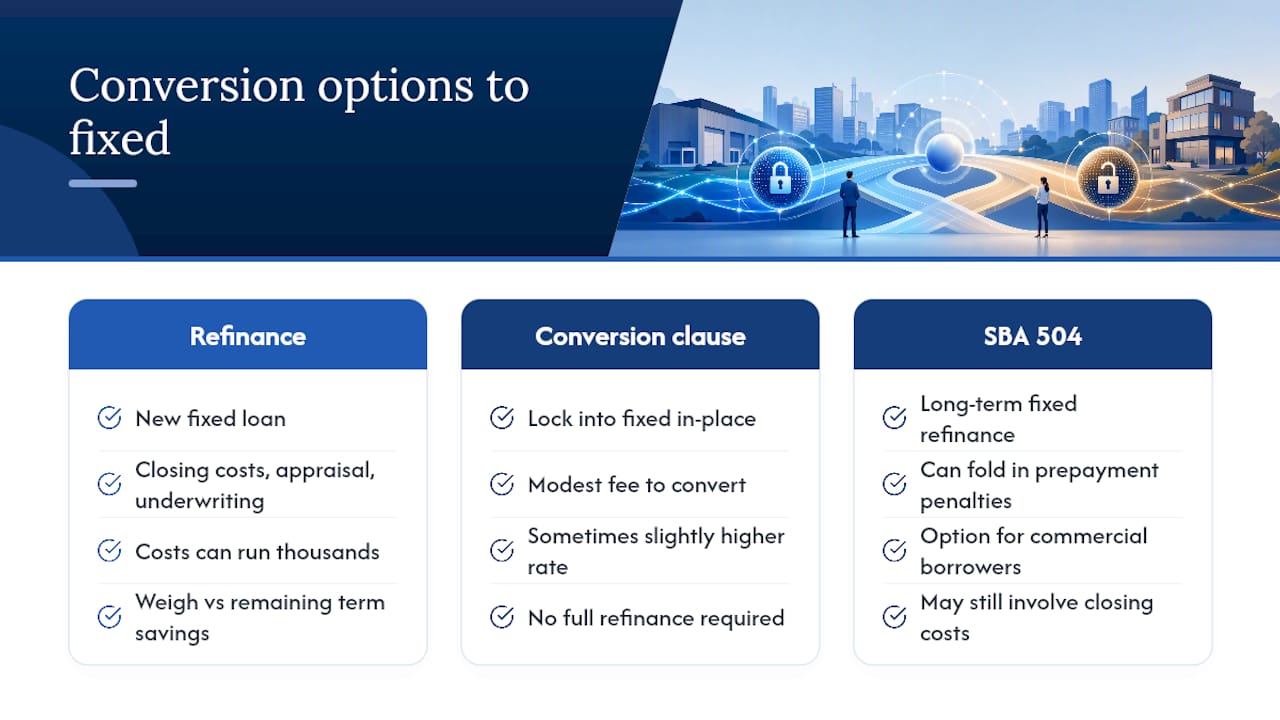
If you’re sitting on a variable-rate loan and rates start climbing, you generally have two paths to fixed: refinance into a new fixed-rate loan, or, for some ARMs and business loans, convert under a rate-lock provision built into your existing agreement.
Refinancing means taking out a new loan to pay off the old one, which typically involves closing costs, an appraisal on real estate, and underwriting all over again. Those costs can run into thousands of dollars depending on loan size and property type, and they need to be weighed against how much you’d actually save with a fixed rate over your remaining holding period. If you’re planning to sell or pay off the loan within a year or two anyway, refinancing costs may exceed the savings.
Some ARMs include a conversion clause allowing you to lock into a fixed rate at a specified point without a full refinance, though usually at a modest fee and sometimes a slightly higher rate than a fresh refinance would offer. Business borrowers with commercial variable-rate debt often have a similar option: refinancing into a long-term fixed structure like an SBA 504 loan, which can also fold in prepayment penalties from the original loan into the new financing package.
Whichever route you take, get the full fee schedule in writing before committing. A rate reduction that costs more upfront than it saves over your remaining term isn’t a win.
A young professional buying a starter condo she expects to sell within four years is a textbook variable-rate candidate. A 5/1 ARM at a lower initial rate saves her money during the years she’ll actually own the property, and she’s out before the adjustment period begins.
Compare that to a retired couple downsizing into a home they plan to keep for the rest of their lives. A 30-year fixed mortgage costs more upfront but removes any risk of a payment spike eating into a fixed retirement income. For them, certainty is worth the premium.
On the business side, a manufacturer buying a warehouse it intends to operate from for 20 years fits the same logic as the retired couple. Financing that purchase with a long-term fixed structure, such as an SBA 504 loan, locks in predictable debt service for the life of the building, which matters when you’re forecasting payroll and operating costs years into the future. A startup that expects rapid revenue growth and plans to refinance into better terms within three years might instead accept a variable rate now, betting that early flexibility outweighs the risk of a rate increase before it refinances.
None of these scenarios has a universally “better” answer. Each one hinges on how long the borrower plans to hold the debt and how much payment uncertainty they can tolerate.
Most people treat this decision as a math problem when it’s really a risk-tolerance problem wearing a math costume. The lowest total-interest number on a spreadsheet isn’t automatically the right choice if a variable payment spike would force you to sell an asset early or miss other obligations.
Lending experience tends to surface the same pattern: borrowers who pick variable rates to save a percentage point rarely model the worst-case scenario before they sign, then panic when the first reset lands. Run both numbers, the expected case and the stress case, before you decide, and talk to a lender who will walk through the caps and index with you rather than just quoting a starting rate.
— PHENYX
If you’re a small-business owner financing commercial real estate or equipment with a decade or more of useful life, the variable-rate gamble rarely makes sense, and Fbdc is built specifically for that situation. Rather than pushing you toward a conventional loan with a floating rate and unpredictable debt service, Fbdc structures SBA 504 financing with down payments as low as 10%, long-term fixed rates locked for the life of the loan, and guidance from a team with more than 35 years specializing exclusively in this program.
That combination matters most for owners who need to forecast payroll, operations, and growth without wondering what their loan payment will look like in five years. If a fixed structure sounds like the right fit for your next real estate or equipment purchase, start by reviewing FBDC’s 6-step SBA 504 process to see exactly what documentation and timeline to expect before you apply.
For mechanics and worked examples, Investopedia and Citi’s learning center are solid starting points. Experian breaks down APR comparisons well. Pair those with an amortization calculator to stress-test your own scenario before you sign.
This article is general information, not a substitute for advice from a qualified financial advisor. Consult a qualified financial professional about your own circumstances before acting on anything here.

