.svg)
.svg)
.svg)
For most franchise buyers purchasing or building owner-occupied property, an SBA 504 loan is the better fit, while an SBA 7(a) loan covers franchise fees and working capital that 504 financing excludes. This guide walks through fit, budgeting, required documents, timelines, and backup financing paths.
TL;DR:
- SBA 504 loans are ideal for purchasing owner-occupied real estate with low down payments and fixed rates, but are not suitable for working capital or inventory needs.
- Pairing a 504 loan for property with a 7(a) loan for franchise fees and initial operating costs is common, especially for projects requiring both long-term real estate funding and working capital.
- The franchise’s listing on the SBA Franchise Directory and the project occupying at least 51% of the building are critical eligibility factors that can delay or block financing.
- Early planning should include stress-testing budgets with multiple scenarios, verifying franchise costs with current franchisees, and ordering appraisals and reports promptly to avoid delays.
- Alternative financing options like seller financing, bridge loans, or ROBS carry tradeoffs and legal risks, making independent professional advice essential before proceeding.
Franchise real estate financing rarely comes from a single source. Most buyers combine two or three products, each matched to a specific category of cost.
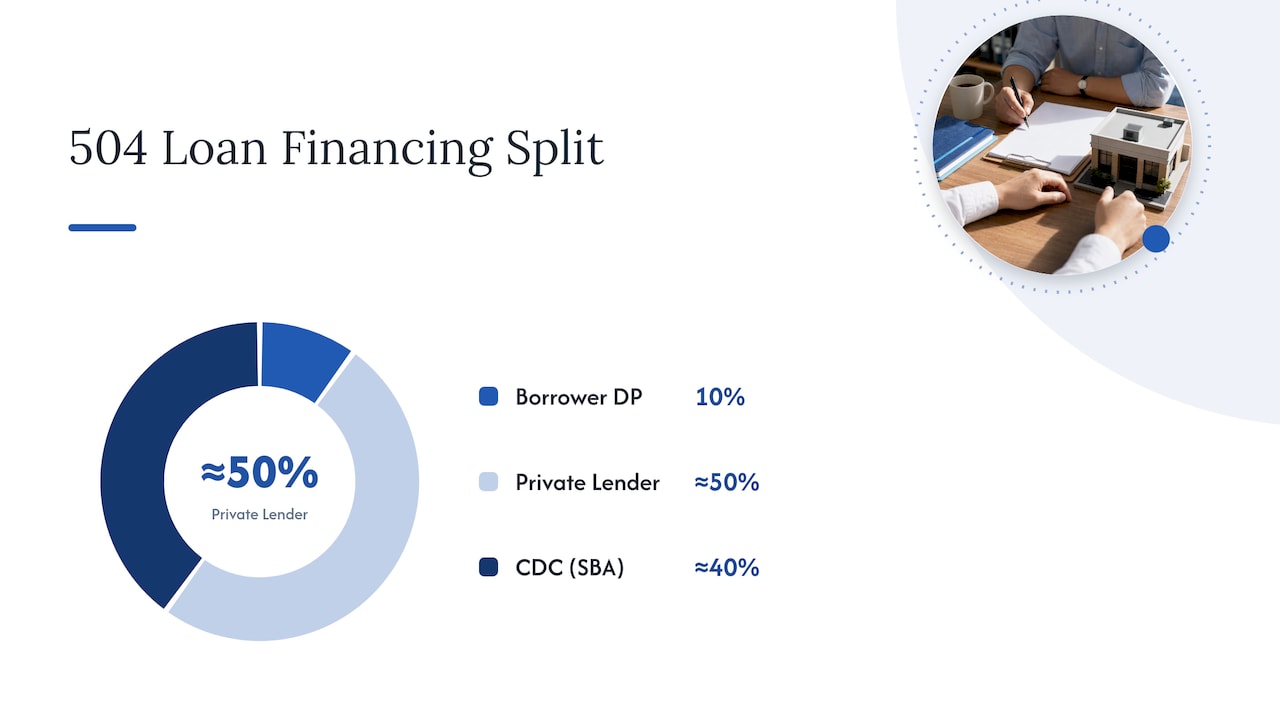
The SBA 504 loan program is built for major fixed assets: land, buildings, ground-up construction, and long-term equipment. It typically splits into three layers: a 10% borrower down payment, a private lender contribution of roughly half the project, and a Certified Development Company (CDC) portion funded through an SBA-guaranteed debenture. The payoff is a long-term, fixed-rate loan with a lower down payment than most conventional commercial mortgages demand.
SBA 7(a) loans fill the gap 504 leaves open. They allow up to $5 million in financing and cover a wider range of uses, including franchise fees, working capital, inventory, and refinancing, according to the SBA’s 7(a) program page. A 504 loan cannot fund working capital or inventory, which is why many franchise owners pair 504 for the building with 7(a) for everything that keeps the business running in its first year.
Beyond the two SBA programs, several other tools come up often in franchise deals:
Each option solves a different problem. The question is which combination fits your specific project.
Matching financing to project type saves weeks of back-and-forth with lenders. Three scenarios cover most franchise real estate deals.
A few constraints can override these defaults. If your franchise brand is not listed on the SBA Franchise Directory, any SBA-backed loan, 504 or 7(a), will need additional eligibility review before it can close. If your business will occupy less than 51% of the building, 504 is off the table entirely and you will need a conventional or private loan instead. Loan amount matters too: 504 debentures have practical minimums that make them inefficient for very small projects, where a direct loan or equipment loan closes faster and with less paperwork.
Lease versus purchase decisions also shape the choice. A franchisee locked into a long-term lease with a franchisor-dictated layout has less flexibility to use 504 financing for the shell of the building, but can usually still finance the interior buildout and fixtures.
Franchise buyers routinely underestimate total capital needs because they budget only for the numbers printed in the Franchise Disclosure Document (FDD). The FDD’s Item 7 estimate is a useful starting point, not a finished budget.
Build your number from these categories:
FTC guidance on reviewing the FDD recommends treating Item 7 and Item 21 figures as a baseline and verifying them against real experience. Item 21 contains the franchisor’s audited financial statements, which can hint at how well-capitalized the brand itself is. Neither item substitutes for calling existing franchisees directly and asking what they actually spent to open and what their first-year cash flow looked like.
Once you have your line items, build three scenarios: best case, expected case, and conservative case, with the conservative version assuming slower ramp-up and higher-than-quoted construction costs. Lenders respond better to a funding request that shows you have stress-tested your numbers rather than one that simply repeats the FDD.
Pro Tip: Call at least three current franchisees in markets similar to yours before finalizing your budget. The FDD gives you averages; franchisees give you reality.
Franchise real estate deals carry eligibility rules that do not apply to independent small businesses, and missing them is the most common cause of financing delays.
The SBA Franchise Directory lists brands the SBA has already reviewed for program eligibility. If your franchise is listed, lenders can move through underwriting without extra SBA review. If it is not listed, your lender has to submit documentation to SBA for a case-by-case determination, a process that can turn a routine closing into one that stretches for months.
SBA directory listing is an operational gating factor: when a brand is not listed, SBA eligibility review can add weeks or months to a closing that would otherwise take a few weeks.
The 504 program’s 51% owner-occupancy rule is the other major checkpoint. Lenders and CDCs require documentation proving the franchise business will occupy at least 51% of the building’s rentable space, per SBA’s 504 loan guidance. That typically means:
CDCs exist specifically to package and underwrite the 504 portion of these deals. A CDC works alongside your private lender, assembles the SBA debenture application, and coordinates the closing schedule so the bank’s loan and the CDC’s debenture fund at the same time. Picking a CDC with franchise experience early in the process tends to prevent surprises on the occupancy and directory issues above.
Lenders and CDCs work from a defined list of exhibits, and understanding DSCR loans for investors can help in validating franchise financial assumptions before seeking real estate financing. Having them ready before you apply shortens the underwriting timeline meaningfully.
Appraisals and environmental reports in particular tend to be the slowest items to obtain, since they require scheduling a third-party inspection. Ordering them as soon as you have a property under contract, rather than waiting for the rest of your file to be complete, keeps them from becoming the bottleneck.
Down payment and fee expectations differ by program. For SBA 504 loans, the standard structure has the borrower contributing 10% of the project, with the private lender funding roughly 50% and the CDC funding roughly 40% through the SBA-guaranteed debenture. For 7(a) loans, SBA guidance allows financing up to $5 million, with down payment and fee terms set by the individual lender within SBA parameters.
Expect your financing to move through several stages:
SBA directory status is the single most common source of delay in franchise real estate deals. When a brand is not on the SBA Franchise Directory, the required eligibility review converts a routine multi-week closing into a multi-month process.
To reduce delay risk, check your brand’s directory status before you sign a lease or purchase agreement, order appraisals and environmental reports as soon as a property is identified, and ask your franchisor early whether they can provide the eligibility certification your lender will need.
When SBA timing or eligibility does not work for your project, several alternatives can bridge the gap, each with real tradeoffs.
Franchise real estate deals have their own set of red flags worth watching for: franchisor lease terms that lock you into above-market rent or restrictive subletting clauses, earnings claims in marketing materials that are not backed by the FDD’s Item 19 disclosures, and inconsistencies between what a franchise sales representative tells you and what the written agreement states.
Before accepting any nonstandard financing structure or signing a lease with unusual terms, FTC guidance on reviewing franchise disclosures recommends bringing in an independent franchise attorney and accountant who have no financial relationship with the franchisor.
A Certified Development Company does the packaging work behind every SBA 504 loan: assembling your exhibits, coordinating the CDC’s debenture advance with your private lender’s closing, and scheduling SBA debenture funding so the deal closes on one timeline instead of two.
The Florida Business Development Corporation (FBDC) specializes in SBA 504 lending and describes itself as drawing on more than 35 years of experience in the program.
Pro Tip: Before contacting a CDC, have your property under contract or identified, your FDD and franchise agreement ready, and a draft budget covering one-time and ongoing costs. It shortens the first conversation considerably.
If you take one thing from this guide, make it this: financing delays in franchise real estate almost always trace back to something that could have been checked in week one. Confirm your brand’s SBA Franchise Directory status before you sign anything. Build a stress-tested budget using three scenarios, not just the FDD’s Item 7 estimate. Contact a CDC or lender early enough that appraisals and environmental reports are not the last thing holding up your closing.
None of this replaces independent advice. Bring your franchise agreement and financial projections to an accountant and attorney who work for you, not the franchisor, before you commit.
— PHENYX
If the 504 path fits your franchise real estate project, FBDC packages it for you from the first call. The firm’s SBA 504 Loan Program is built around low down payments, long-term fixed rates, and more than three decades of experience closing these deals for Florida small business owners.
Depending on your situation, FBDC also offers:
Before reaching out, gather your property details, FDD, and a draft budget. From there, FBDC walks you through which program fits and what your CDC exhibits will need. Start the conversation on the SBA 504 Loan Program page.
This article is general information, not a substitute for advice from a qualified financial advisor. Consult a qualified financial professional about your own circumstances before acting on anything here.
There is no single answer, since the right franchise depends on your industry interest, local market, and how much of that $100,000 is available after working capital reserves. A franchise consultant or accountant can help you match your budget against FDD Item 7 estimates for brands you are considering.
Very few franchises can be opened with no capital at all, since franchisors require a franchise fee plus startup costs disclosed in Item 7 of the FDD. Financing tools like SBA 7(a) loans, seller financing, or ROBS can reduce upfront cash needed, but each carries its own eligibility rules and risks.
Very low-investment franchises exist, typically service-based models with minimal real estate or equipment needs, but $10,000 rarely covers the full franchise fee plus working capital for most brands. Review a brand’s Item 7 estimate directly and confirm it against conversations with current franchisees before assuming a low headline fee covers your total cost.
Not strictly, but if your brand is not listed on the SBA Franchise Directory, your lender must submit the franchise agreement for SBA review before an SBA-backed loan can close. This adds time to the process and is worth checking before you commit to a specific brand or location.

