.svg)
.svg)
.svg)

If you’re buying commercial real estate, heavy equipment, or another business outright, the right fit is usually an SBA 504 loan, an SBA 7(a) loan, a conventional term loan, dedicated equipment financing, a commercial real estate loan, or, for venture-backed startups, venture debt. Asset purchases with a long useful life favor SBA 504 or equipment financing; working capital needs point toward SBA 7(a) or a conventional term loan; startups with equity backing should look at venture debt. The sections below break down eligibility, rates, and how to apply for each.
TL;DR:
- Long-term financing, typically over five years, is best suited for assets with a productive life of a decade or more, such as real estate or heavy equipment.
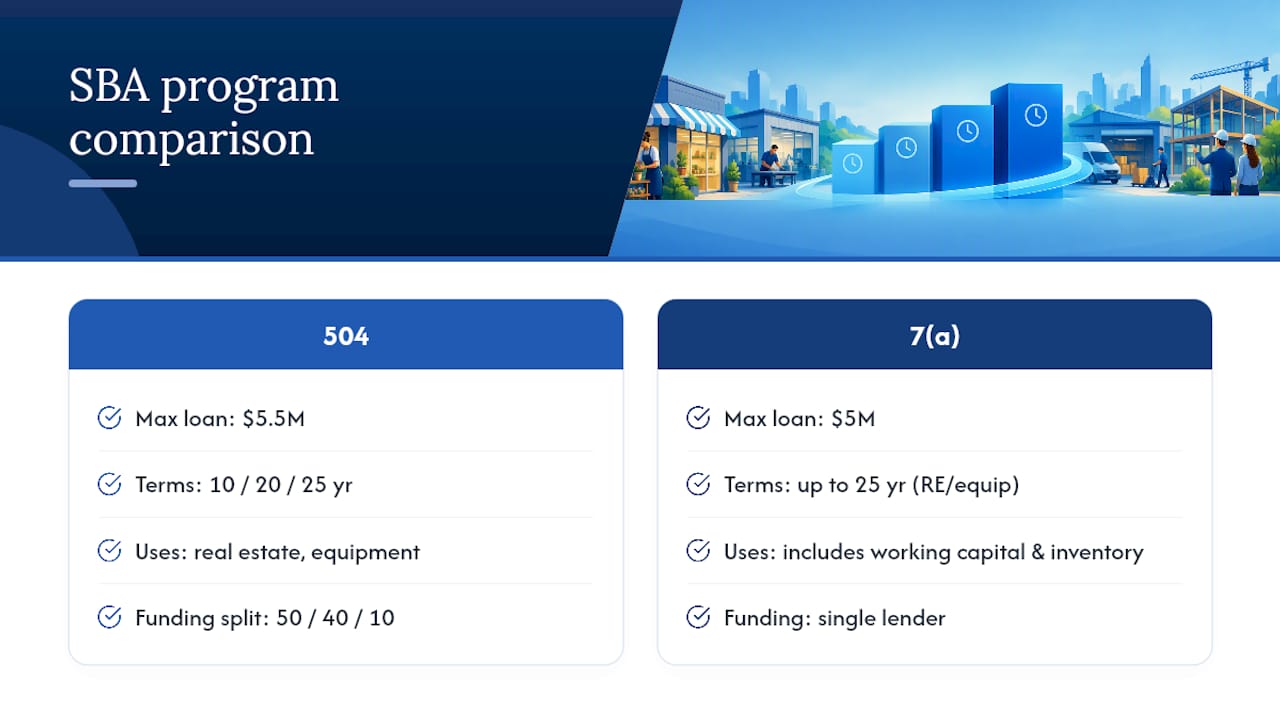
- SBA 504 loans focus on fixed assets with low down payments and fixed rates, up to $5.5 million, but cannot fund working capital or inventory.
- SBA 7(a) loans offer more flexibility, covering assets plus working capital, with maximums of $5 million and terms up to 25 years for real estate and equipment.
- Conventional term loans and equipment financing usually have shorter durations and require collateral or strong credit, often with narrower eligibility.
- Borrowers should ensure a debt service coverage ratio above 1.20 and at least two years of operating history for approval, especially on SBA programs.
Long-term business financing means any loan with a repayment schedule stretching past five years, usually financing something that will still be generating value for your business a decade from now. The core principle is term matching: the loan’s payoff period should roughly mirror how long the asset keeps producing revenue. Finance a piece of equipment with a 15-year working life using a 7-year loan, and you’re stacking heavy payments onto years when that machine hasn’t yet paid for itself.
Long-term financing typically covers:
Compare that to a line of credit, which handles short-term cash gaps like payroll timing or seasonal inventory, or equity, which trades ownership for capital with no repayment schedule at all. Long-term loans reduce monthly debt service compared with shorter alternatives, since lenders spread the risk over more years and typically price it lower as a result.
The SBA 504 program is purpose-built for major fixed assets. Loans max out at $5.5 million and stretch across 10, 20, or 25-year terms, with eligibility tied to a tangible net worth under $20 million and average net income under $6.5 million over the prior two years, according to the SBA’s 504 loan program page. A typical 504 deal splits three ways: a bank covers roughly 50% of project costs, a Certified Development Company (CDC) funds about 40% through an SBA-backed debenture, and the borrower puts down the remaining 10%.
SBA 504 fact check: The program cannot fund working capital or inventory, and every 504 loan must be originated through a CDC. Some business owners assume any SBA lender can process a 504 deal. Only CDCs can.
SBA 7(a) loans work differently. The maximum loan size sits at $5 million, and while standard terms run shorter, 7(a) loans can extend to 25 years when the proceeds go toward real estate or equipment with more than 10 years of useful life. Unlike 504, 7(a) covers working capital, debt refinancing, and inventory, which makes it the more flexible option for a business that needs both an asset purchase and operating cash in the same package.
Pick 504 when you’re buying a building or major equipment and want the lowest possible down payment with a fixed rate locked in for decades. Pick 7(a) when your project mixes real estate or equipment with working capital, or when your loan amount falls under the 504 minimum threshold most CDCs prefer.
Not every long-term project fits neatly into an SBA box. A handful of other products cover the gaps:
Lenders judge long-term loan applications against a fairly consistent set of benchmarks, regardless of which product you’re pursuing.
Rates on long-term financing track a base index, usually prime or a treasury benchmark, plus a spread tied to your risk profile and collateral strength. SBA loans cap that spread by statute, while conventional and CRE loans leave more room for lender discretion.
Prepayment warning: SBA 7(a) loans with maturities of 15 years or longer carry prepayment fees if you pay down more than 25% of the balance voluntarily within the first three years, 5% in year one, 3% in year two, 1% in year three. Budget around that if you expect a cash windfall or refinance early.
Conventional term loans can close in 2 to 4 weeks. SBA loans, particularly 504, typically run 45 to 90 days given the multi-party structure. CRE loans often stretch longer due to appraisal scheduling.
Pro Tip: Order your commercial appraisal the same week you submit your application, not after preliminary approval. Appraisal backlogs are the single biggest bottleneck in SBA and CRE closings.
Run through these before you apply:
| Financing Type | Typical Term | Best For |
|---|---|---|
| SBA 504 | 10, 20, or 25 years | Real estate and major equipment purchases |
| SBA 7(a) | Up to 25 years (RE/equipment) | Mixed asset purchase plus working capital |
| Conventional term loan | 3 to 10 years | Established businesses with strong credit |
| Equipment financing | Matched to asset life | Machinery purchases |
| Commercial real estate loan | 10 to 25 years | Owner-occupied or investment property |
| Venture debt | ~48 months total | VC-backed startups extending runway |
A red flag worth noting before you apply: if your projected DSCR sits below 1.0, meaning your cash flow can’t cover the new debt payment, no amount of paperwork polish will fix that at underwriting.
Some lenders have specialized in SBA 504 lending for many years, working the CDC side of the bank/CDC/borrower structure. That coordination role is what lets a business put down as little as 10% while still locking in a long-term fixed rate, because the CDC manages debenture issuance and keeps the deal compliant with SBA program rules on the borrower’s behalf.

Debt keeps your ownership stake intact when equity financing would dilute it, and matched-term borrowing keeps payments aligned with the asset’s actual productive life. The mistake I see most often is short-term borrowing propping up a long-lived investment. Run your cash-flow projections carefully before signing anything.
— PHENYX
If you’ve been weighing SBA 504 against a conventional term loan or an SBA 7(a), Fbdc’s SBA 504 Loan Program is built around exactly the low down payment and fixed-rate structure this article just walked through, with approximate fees listed on the program page rather than buried in fine print.
Already own the property or equipment and want to restructure existing debt instead? The SBA 504 Refinance Program applies the same fixed-rate structure to debt you’re already carrying. Need funding to move faster than a standard 504 timeline allows? The 504 Velocity Bridge Loan Program covers that gap, and the Direct Lending Program handles smaller loan amounts that don’t fit the standard 504 structure. Veterans should also check VetLoan Advantage Plus for its specific processing fee terms. Before you apply anywhere, run your numbers through the 504 loan calculator and see how the fixed rate compares to what you’re weighing elsewhere. If your financials need tightening up first, a resource like E-Accounts’ small business accounting services can help get your projections underwriting-ready before you submit anything.
This article is general information, not a substitute for advice from a qualified financial advisor. Consult a qualified financial professional about your own circumstances before acting on anything here.
Long-term financing is a business loan with a repayment period typically longer than five years, used to fund assets that generate value over many years, like real estate or heavy equipment. The goal is matching the loan’s payoff schedule to how long the asset stays productive, which reduces monthly debt service compared to shorter-term alternatives.
Difficulty depends heavily on the product and your financial profile. For an SBA 504 or 7(a) loan at that size, lenders typically want at least two years in business, a credit score near 680 or higher, and a debt service coverage ratio between 1.20 and 1.35, according to Crestmont Capital. Meeting those thresholds with clean financials and adequate collateral makes approval realistic; falling short on DSCR or time in business is the most common reason applications stall.
SBA 504 loans are capped at $5.5 million and restricted to fixed assets like real estate and equipment, with terms of 10, 20, or 25 years and no working capital allowed, per the SBA’s 504 program page. SBA 7(a) loans cap at $5 million, allow working capital alongside asset purchases, and can reach 25-year terms for real estate or long-life equipment.
Yes, though venture debt specifically requires existing VC investment to qualify. Startups without that backing typically rely on SBA loans, equipment financing, or conventional term loans, assuming they can meet standard time-in-business and credit thresholds.

