.svg)
.svg)
.svg)

LTV (loan to value) measures a loan against a property’s market value, while LTC (loan to cost) measures it against the total cost of a project. Lenders lean on LTV for stabilized acquisitions and on LTC for construction or rehab deals, and they often check both, along with DSCR and your equity contribution, before setting final loan terms.
TL;DR:
- Lenders typically cap loans on construction projects based on LTC, since no stabilized value exists, while LTV caps are used mainly for stabilized income properties.
- Most deals are limited by whichever ratio—LTV or LTC—yields the smaller loan amount after calculations using appraised value or total project cost.
- Rising material costs and soft costs can increase total project cost, potentially raising LTC caps and requiring careful contingency planning.
- When appraised value lags behind project cost, LTC typically becomes the binding ratio, especially in ground-up construction or rehab projects.
- Borrowers should run calculations on both ratios before applying, ensuring documentation on appraisals, costs, and equity to avoid loan rejections or higher interest rates.
LTV equals the loan amount divided by the property’s market or appraised value. A borrower seeking a $800,000 loan on a property appraised at $1,000,000 has an 80% LTV.
U.S. appraisers assign value differently depending on the project stage. The Federal Reserve’s guidance on appraisal and LTV calculation explains that construction and tract development appraisals must deduct holding and marketing costs, and may rely on as-completed or as-stabilized values rather than current as-is value.
Lenders apply LTV most heavily on purchases of stabilized, income-producing property, and supervisory guidance from the Comptroller’s Handbook on commercial real estate lending sets category-specific LTV ceilings that examiners expect banks to follow.
LTC equals the loan amount divided by total project cost. A borrower financing a $900,000 project with a $720,000 loan has an 80% LTC.
Project cost is broader than a purchase price. Lenders typically total these components before calculating LTC:
Rising material costs make contingency planning more important. The NAHB’s reporting on building material price inflation tracks how material cost swings can erode a project’s budget cushion, which is part of why lenders scrutinize contingency lines closely. LTC governs most construction, rehab, and ground-up development loans because there is no stabilized asset yet to appraise against. Interest reserves set aside to cover debt service during construction are usually folded into total project cost, which raises the loan amount needed and can push LTC higher even when the finished asset’s value stays constant.
LTV and LTC measure different things, and that difference decides which ratio actually caps your loan.
| Ratio | Numerator | Denominator | Typical use case |
|---|---|---|---|
| LTV | Loan amount | Market or appraised value | Stabilized acquisitions, refinances |
| LTC | Loan amount | Total project cost | Construction, rehab, ground-up development |
Most commercial lenders calculate both ratios on a construction or rehab deal, then enforce whichever one produces the smaller loan amount. Suppose a project costs $1,000,000 to build but appraises at only $900,000 as-completed. An 80% LTC cap would allow an $800,000 loan, but an 80% LTV cap on the lower appraised value would cap the loan at $720,000. The lender funds $720,000, the lesser of the two.
Many U.S. commercial banks set internal real estate lending limits that mirror federal supervisory guidance, according to the interagency guidelines on real estate lending policies, which require banks to adopt written lending policies and keep internal LTV limits at or below supervisory thresholds. Those supervisory limits vary by category: raw land, land development, construction, and improved property each carry their own ceiling, and banks are expected to recalculate LTV whenever collateral is substituted or released.
Ratios alone rarely decide a loan. Lenders also weigh:
A higher LTV or LTC often means a higher interest rate, added reserve requirements, or stricter covenants, and a take-out loan on a construction project may be conditioned on hitting a target DSCR once the property stabilizes.
Predicting which ratio controls your deal starts with the transaction type.
Before approving a commercial real estate loan, most lenders request:
Lenders flag thin contingency reserves, optimistic as-completed valuations, and insufficient borrower equity as red flags that typically force a lower loan offer or require more cash up front. A DSCR calculator can help you stress-test cash flow assumptions before a lender does it for you.
Pro Tip: Run your numbers against both the as-is and as-completed value before you apply. A gap between the two is exactly where lenders will push back.
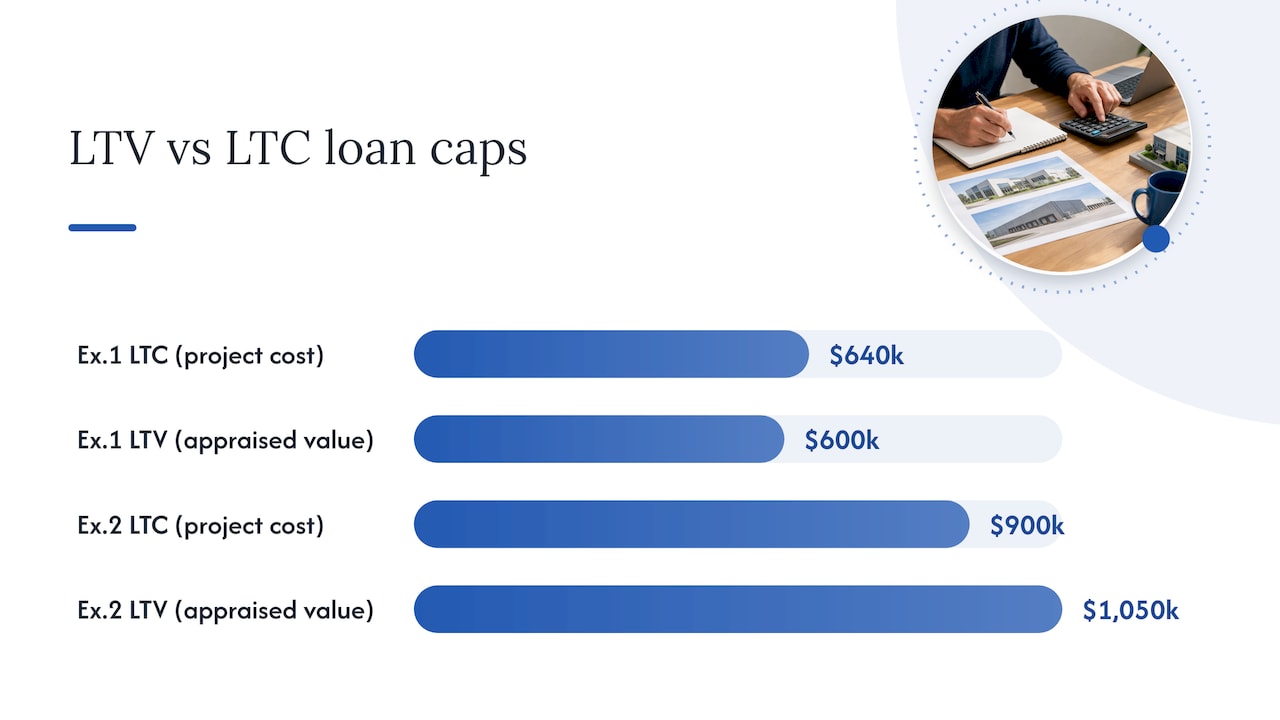
Working through both ratios on one deal shows exactly where a lender’s cap will land.
Example 1: Purchase plus renovation. Say you buy a property for $500,000 and budget $300,000 for renovation, for a total project cost of $800,000. The property appraises as-completed at $750,000.
Example 2: Ground-up construction. Say total project cost is $1,200,000, and the as-stabilized appraisal comes in at $1,400,000.
Either ratio can bind, depending on whether appraised value outpaces or lags project cost, and existing senior liens on the property would reduce the loan proceeds available under either cap.
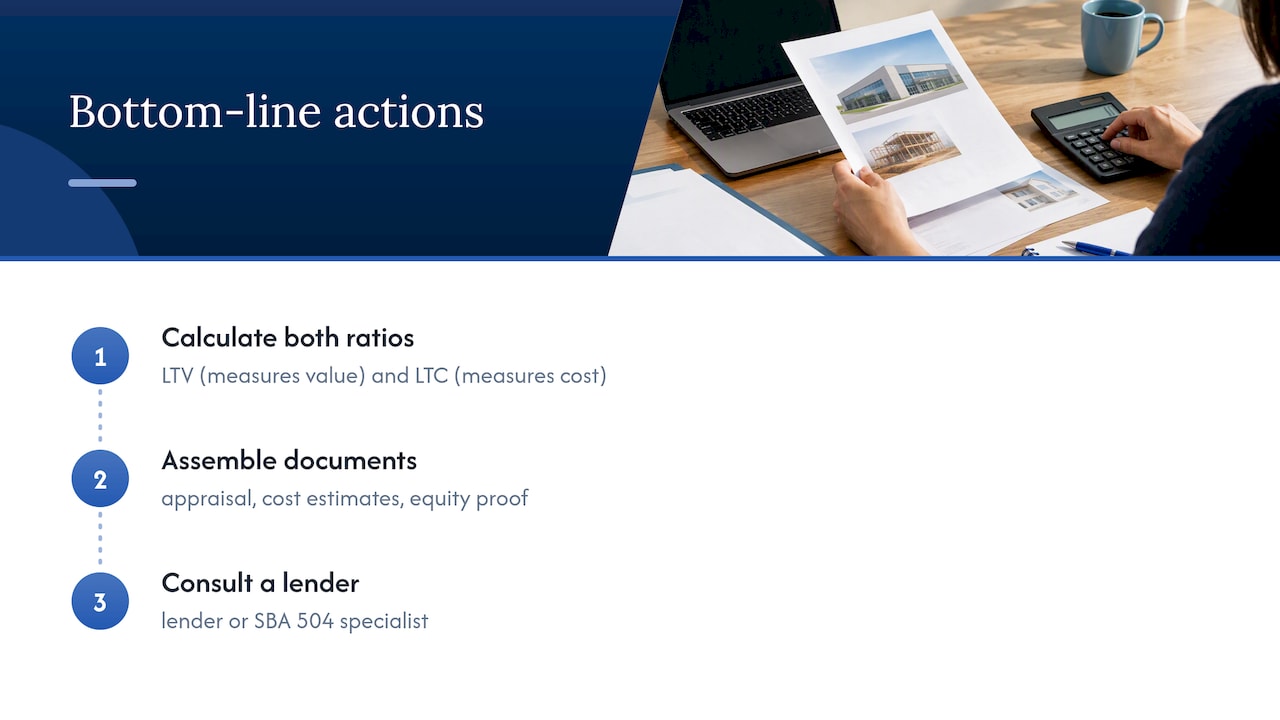
LTV measures against value, LTC measures against cost, and lenders will enforce whichever produces the smaller loan. Calculate both ratios on your deal now, then gather your appraisal, cost estimates, and equity documentation and talk with a lender, or an SBA 504 specialist if your project qualifies.
We have extensive experience structuring SBA 504 financing for small businesses, and that history shapes how we think about LTV and LTC on real-world deals. SBA 504 projects, particularly owner-occupied acquisitions and long-term fixed-rate financing, tend to fit this structure more naturally than conventional ground-up construction, where cost overruns make LTC the harder constraint.
— PHENYX
If your project is an acquisition, renovation, or expansion of owner-occupied commercial real estate, or a heavy equipment purchase, SBA 504 loans may offer advantages such as lower down payments and long-term fixed rates compared to some conventional commercial financing.

When your project needs interim capital while an SBA 504 package comes together, a bridge loan can cover that gap without stalling your timeline. Specialized financing programs exist to address these situations:
Reach out through any of these pages to see which structure fits your numbers.
No. LTV compares the loan amount to a property’s market or appraised value, while LTC compares it to the total cost of a project, including construction and soft costs. They often produce different numbers on the same deal, and lenders typically check both.
LTV figures well below supervisory limits outlined in the Comptroller’s Handbook on commercial real estate lending for most property categories are generally considered conservative. Whether it counts as “good” depends on the lender’s specific category limit and the strength of your DSCR and equity position.
An 80% LTC means the loan covers 80% of total project cost, with the borrower funding the remainder through cash equity. On a project costing $800,000, that translates to a maximum loan of $640,000.
A good LTC ratio depends on the lender’s category limits and the project’s risk profile, but many construction and rehab lenders cap LTC within a range generally between moderate to high percentages, depending on the project risk. The interagency guidelines on real estate lending policies list supervisory limits by category that inform where individual banks set their internal ceilings.

