.svg)
.svg)
.svg)

Use a bridge loan when you need short-term, senior-secured capital to cover a timing gap with a clear near-term exit. Use mezzanine financing when you need longer-term subordinate capital to close an equity gap without bringing in a new common-equity partner. Bridge loans solve timing problems and typically cost less; mezzanine solves leverage problems and typically costs more because it sits closer to the equity in the capital stack. If you are still not sure which one your deal calls for, the distinctions below will settle it.
TL;DR:
- Bridge loans are short-term, senior-secured loans typically lasting 6 to 36 months, used mainly for timing gaps like acquisitions or lease-ups, with lower costs and interest-only payments.
- Mezzanine financing is longer-term, subordinate debt placed behind senior loans, with higher costs and returns, mainly used to fill leverage gaps without diluting ownership.
- A bridge lender holds a first lien on the property and can foreclose directly, while a mezzanine lender pledges ownership interests and forecloses through equity interests, governed by intercreditor agreements.
- Market price spreads usually make mezzanine debt significantly more expensive than bridge loans, with pricing reflecting higher risk and subordinate claim status.
- SBA 504 loans can replace mezzanine and bridge options for owner-occupiers through low down payments and long-term fixed rates, avoiding ownership dilution, especially when refinancing or purchasing.
A bridge loan is a short-term, senior-secured facility that gets a property from one condition to another, whether that’s from acquisition to stabilization, or from a maturing loan to permanent financing. Lenders extend bridge capital against the real estate itself, and the Comptroller’s Handbook on commercial real estate lending notes that these loans typically underwrite to a specific, identified exit rather than long-term cash flow.
Tenors commonly run 6 to 36 months. Banks, debt funds, and specialty CRE lenders all compete in this space, but they underwrite differently: banks lean on sponsor relationship and balance sheet strength, while debt funds move faster and tolerate more transitional risk for a higher rate.
Bridge financing makes sense for acquisition closings on a tight timeline, lease-up periods before a property qualifies for permanent debt, or short-term refinancing when a loan matures before the asset is fully stabilized.
Pro Tip: Before you sign a bridge term sheet, map out your refinance path on paper. Lenders will ask for it anyway, and regulators specifically flag weak exit assumptions as a top underwriting risk on transitional CRE loans.
Mezzanine financing sits behind senior debt in the capital stack, filling the gap between what a senior lender will provide and what the sponsor is willing to contribute in equity. Unlike a bridge loan, mezzanine debt is usually secured by a pledge of the borrower entity’s equity interests, not a direct lien on the real estate, according to a guide on preferred equity vs mezzanine debt.
That structural position drives everything else about mezzanine capital uses:
Mezzanine debt characteristics make it a leverage tool, not a bridge to anywhere. It’s priced like near-equity because, structurally, it behaves like near-equity when things go wrong.
Priority of claims is where bridge and mezzanine financing diverge most sharply. A bridge lender typically holds a first lien on the real estate and can foreclose directly on the asset if the loan defaults. A mezzanine lender holds a pledge over the ownership entity, which means its remedy on default usually runs through Uniform Commercial Code foreclosure on the equity interests, not the property itself, according to insight from Trowers & Hamlins on subordinated capital structures.
When both a senior lender and a mezzanine lender sit in the same deal, an intercreditor agreement governs how they interact:
Negotiate cure periods and standstill length early. Small differences in that language often decide who actually controls the asset after a default.
Sizing and pricing differ enough between the two products that running the numbers side by side changes how a sponsor structures the whole stack. Bridge loans generally size to a loan-to-value range tied to as-is or as-stabilized value, with senior lenders comfortable extending further than they would on a permanent loan because the exit is imminent. Mezzanine debt then layers on top, pushing combined leverage higher without adding a new equity partner.
Market-level return spreads vary by deal quality and collateral strength, but the pattern holds broadly: mezzanine is priced meaningfully above senior bank debt to compensate for its subordinate position and higher loss exposure if a deal underperforms.
Repayment shape is often the first thing sponsors overlook when comparing quotes, and it matters as much as the headline rate.
Pro Tip: Run your model at your projected exit date and again six months later. If the mezzanine equity kicker balloons or the bridge extension fee erases your margin, renegotiate the term sheet now, not after closing.
The decision usually comes down to four questions: how soon is your exit, how confident are you in it, how much equity can you contribute, and how much does dilution actually cost you.
Sponsors frequently layer both products in a single deal: senior bridge debt covers the bulk of acquisition or construction cost, while mezzanine capital fills the remaining gap above what the sponsor wants to fund with equity. According to AAY Investments Group’s comparison, bridge solves a timing problem and mezzanine solves a structural leverage problem, and combining them works when each layer’s role stays distinct.
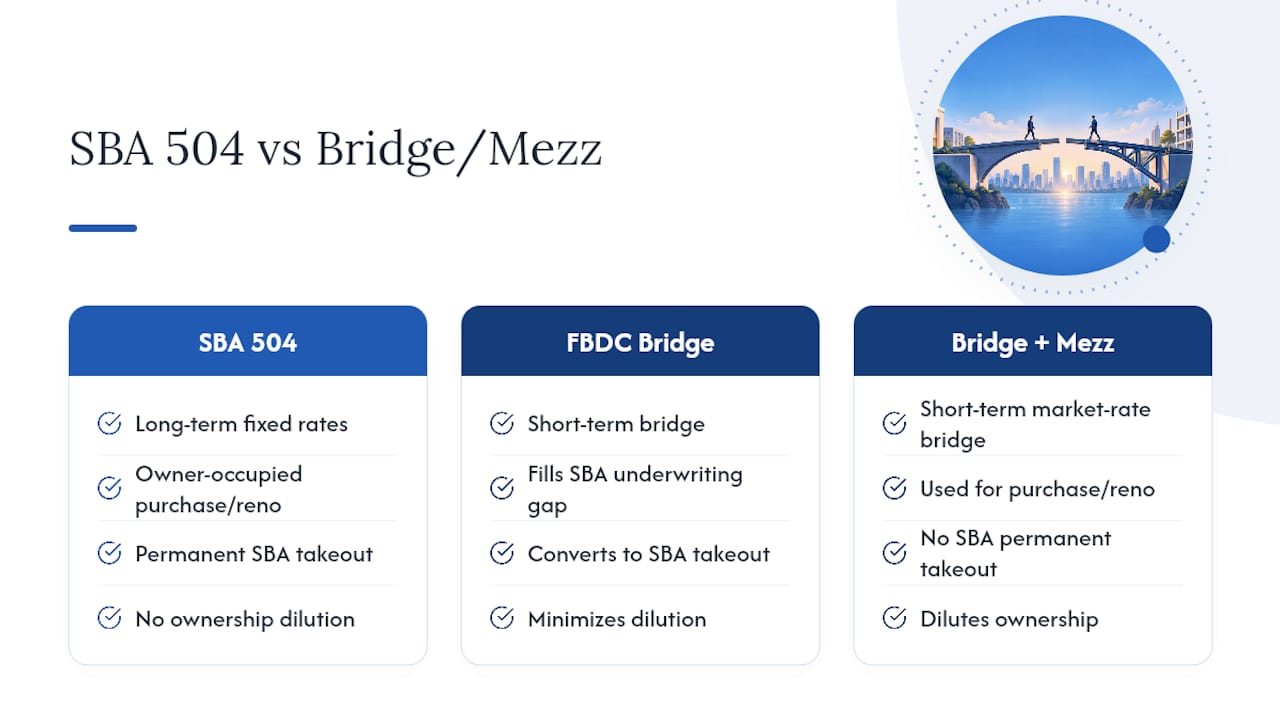
For qualifying small-business owners occupying their own commercial real estate, an SBA 504 loan often replaces the need for mezzanine debt entirely. Fbdc has over 35 years of experience structuring SBA 504 financing, and the program’s low down payment options as low as 10% and long-term fixed rates give owner-occupants a permanent takeout without an equity kicker or subordinate debt layer.
The FBDC 504 Velocity Bridge Loan Program fills the short-term gap while a full SBA 504 package gets underwritten, functioning much like a conventional bridge loan but built specifically to convert into the long-term SBA takeout. For an owner-occupied purchase or renovation, that combination frequently beats stacking a market-rate bridge loan under a mezzanine layer, since the SBA structure avoids diluting ownership. It’s worth comparing against a conventional commercial mortgage before assuming market debt is the only path.
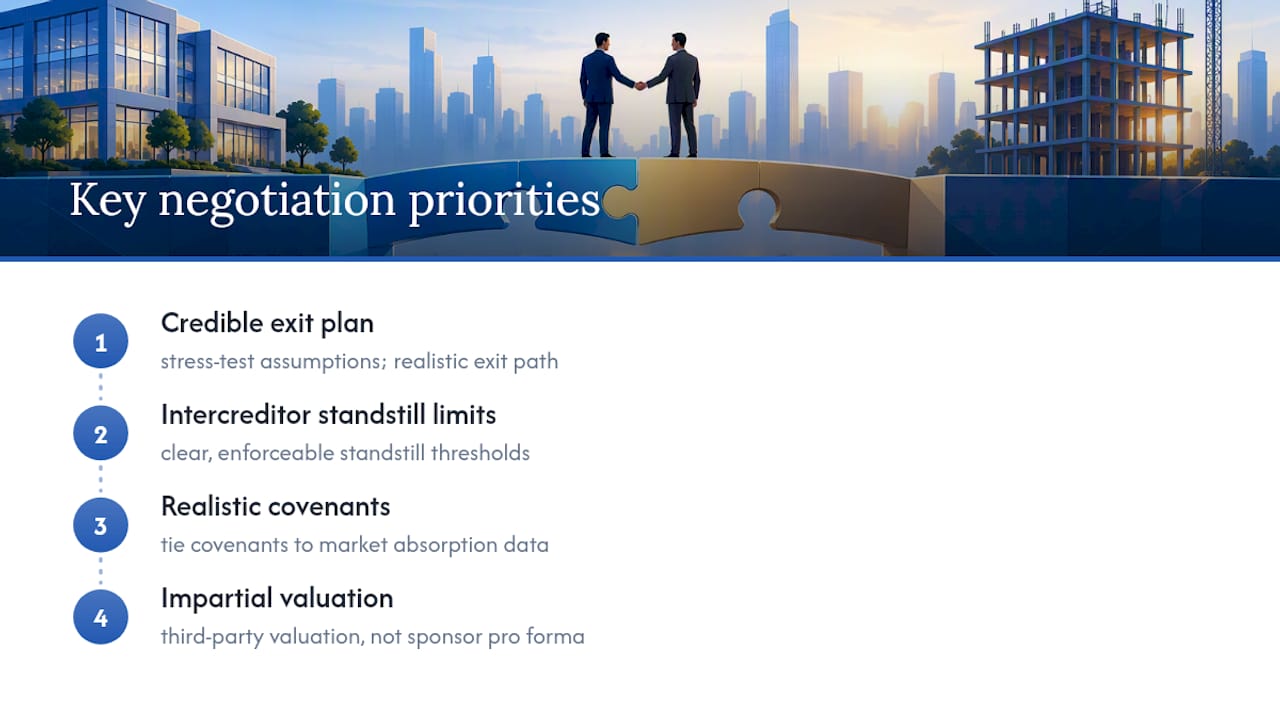
The deals that go sideways almost always share the same root cause: an exit assumption nobody stress-tested hard enough. My priority list for any bridge or mezzanine negotiation starts with a credible exit plan, clear intercreditor standstill limits, realistic covenants tied to actual market absorption, and an impartial valuation, not the sponsor’s own pro forma.
Regulatory guidance on commercial real estate lending backs this up directly: weak exit assumptions are the underwriting failure examiners flag most often.
— PHENYX
If your project involves acquiring, building, or renovating owner-occupied commercial real estate, and you’re weighing a costly mezzanine layer against a simpler path, Fbdc’s SBA 504 program deserves a look before you sign anything. Fbdc combines low down payments as low as 10%, long-term fixed rates, and expert guidance through a process built specifically to avoid the equity dilution that comes with mezzanine capital.

Before reaching out, prepare trailing financial statements, a purchase or renovation budget, and equipment or property specifics if machinery is involved. Sponsors who need short-term capital while a full 504 package gets underwritten can look at the FBDC 504 Velocity Bridge Loan Program as the bridge into that permanent structure. If you’re planning to refinance an existing commercial mortgage instead, the SBA 504 Refinance Program may fit better. Start by reviewing the SBA 504 Loan Program details and approximate fees, then request a consultation to see which structure fits your project.
For direct regulatory language, review the OCC’s Comptroller’s Handbook on commercial real estate lending and FDIC guidance on high-volatility commercial real estate. For structural distinctions between mezzanine and preferred equity, see Trowers & Hamlins’ analysis.
No. A bridge loan is a senior-secured, short-term facility tied to real estate collateral, while mezzanine financing is subordinate debt secured by a pledge of ownership interests. They solve different problems: bridge addresses timing, mezzanine addresses a leverage or equity shortfall, according to AAY Investments Group.
Dave Ramsey’s general guidance leans against borrowing against short-term timing gaps, favoring paying cash or selling first rather than relying on bridge debt for personal home purchases. That advice targets consumer home buying, not the sponsor-level commercial bridge and mezzanine financing discussed here, where short-term secured debt is standard practice for transitional CRE deals.
Mezzanine financing typically appeals to sponsors who’ve hit their senior debt limit but don’t want to raise additional common equity and dilute ownership. It’s common in acquisitions, recapitalizations, and value-add projects where enterprise value supports the higher leverage.
The biggest downside is cost. Mezzanine debt carries returns well above senior bank debt, often including an equity kicker that reduces the sponsor’s upside at exit. It also typically requires giving up an equity pledge as collateral, which means a default can shift control of the ownership entity to the lender rather than triggering a simple foreclosure.
For owner-occupied commercial real estate, yes, in many cases. Fbdc’s SBA 504 program offers down payments as low as 10% and long-term fixed rates, which can eliminate the need for a subordinate mezzanine layer entirely for qualifying small businesses.

