.svg)
.svg)
.svg)

An owner occupied loan under the SBA 504 program works best for a profitable small business that will use most of the property or equipment itself, not lease it out. With as little as 10% down, a fixed rate on the CDC portion, and terms up to 25 years, it’s built for owners ready to stop renting and start building equity. If your business occupies the majority of an existing building (or meets the higher threshold for new construction), you likely qualify, and Fbdc can walk you through the loan calculator to see real numbers.
TL;DR:
- Borrowers typically need at least a 10% down payment, with higher requirements for startups and special-use properties, often up to 20%.
- The fixed CDC debt portion’s rate is set at auction based on Treasury yields and remains unchanged over the loan term, usually up to 25 years.
- The property must be primarily owner-occupied, with over half of the space used by the business, and eligible uses include real estate, equipment, and refinancing related assets.
- The full approval process takes 60 to 90 days, with delays common if appraisals, environmental reviews, or legal documents are not coordinated early.
- Prepayment penalties exist only on the CDC portion, decreasing over the first half of the loan’s term, and business financial health heavily influences approval chances.
An owner occupied commercial mortgage through SBA 504 splits the financing three ways. A conventional bank covers roughly 50% of the project as a first mortgage. A Certified Development Company (CDC), a nonprofit partner that issues SBA-backed debentures, covers up to 40%. You, the borrower, typically contribute the remainder, usually around 10%.
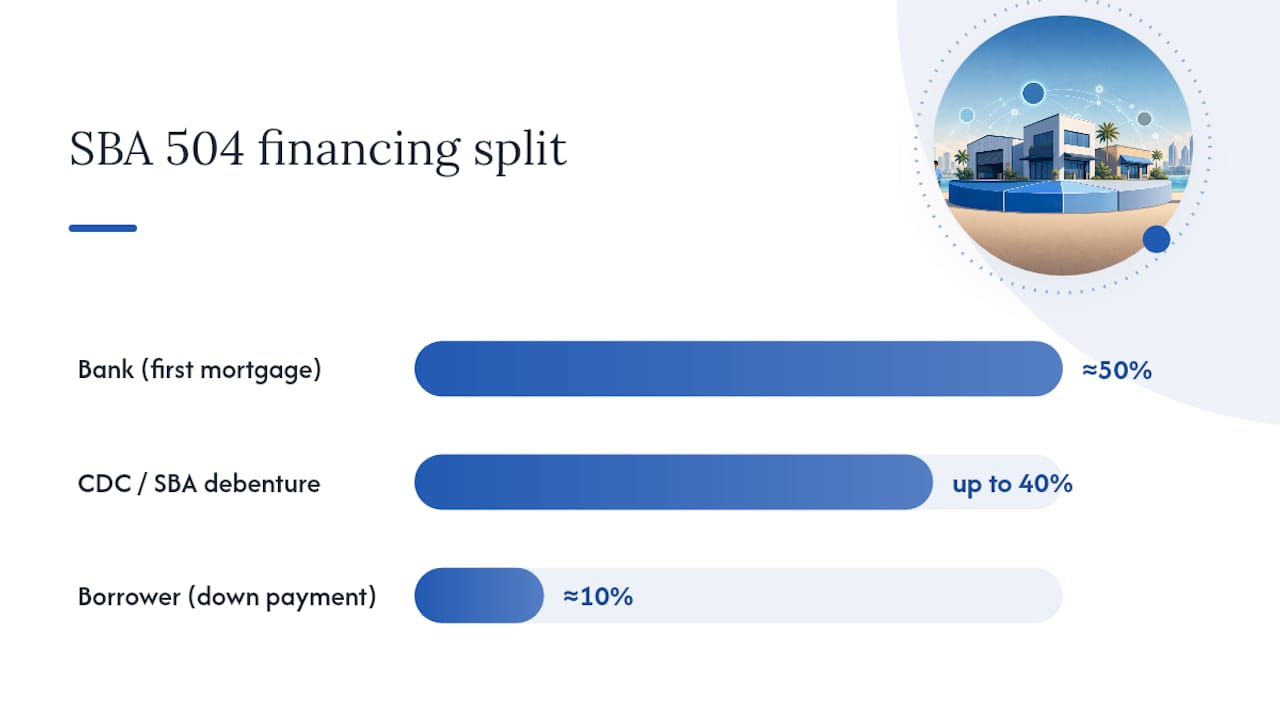
The CDC/SBA portion generally has maximum limits for most projects, with higher limits available for manufacturing or certain energy-efficient projects, according to SBA’s own program page. You choose a 10, 20, or 25-year term on the CDC debenture, and the rate structure locks in at the time of the debenture auction.
Eligible uses are specific: buying, building, or renovating owner-occupied real estate, purchasing heavy machinery or equipment with a useful life of at least 10 years, and refinancing qualified existing debt tied to those assets. What’s off the table is just as important. You cannot use 504 funds for working capital, inventory, or a property you plan to lease out as a passive investment. This is owner-occupied financing for businesses that run their own operations, not landlords.
Eligibility for this owner-occupied property loan runs through three checkpoints: the business itself, the property, and how much of it you’ll actually use.
Business-level tests start with for-profit status. Nonprofits don’t qualify. Your business must also meet SBA size standards, which set limits on tangible net worth and average net income after taxes for the prior two years, varying by industry.
Occupancy rules are where a lot of applicants stumble. For an existing building, you need to occupy at least just over half of the rentable square footage yourself. New construction requires a higher initial occupancy, with a plan to increase occupancy over time as your business grows into the space.
Exclusions and exceptions matter too. Passive businesses, ownership structures where a third party holds sole operational control, and pure real estate holding companies without an operating business generally don’t qualify, based on SBA policy guidance. And a few situations raise your equity requirement above the standard 10%:
Most established businesses put down 10% on an owner occupied loan, with the bank and CDC financing the rest. That contribution can climb to 15% or 20% for startups and special-use properties, since lenders view both as higher-risk categories regardless of how strong the owner’s personal credit looks.
The CDC portion is where the “fixed rate” promise actually lives. That rate gets set at a monthly SBA debenture auction, tied to 10-year Treasury yields at the time of pricing, and once it’s locked, it stays locked for the full term. No resets, no surprises five years in. The bank’s first-mortgage portion is a different story. It can be fixed or variable depending on the lender, and terms vary more than the CDC side, so ask directly what your bank offers before assuming both halves behave the same way.
Beyond the down payment, budget for closing costs on both the bank and CDC sides, third-party fees for appraisals and environmental assessments, an SBA guarantee fee built into the debenture, and title and legal costs typical of any commercial real estate closing. None of these are hidden. They just don’t show up until you’re deep into underwriting, so ask your CDC for an all-in estimate before you sign a purchase agreement.
A typical SBA 504 project runs 60 to 90 days from a complete application to a funded, simultaneous close, according to SBA’s own timeline guidance. Bank underwriting and CDC processing happen in parallel, which is why choosing the right partners upfront saves weeks later.
Fbdc’s step-by-step process guide walks through exactly what to have ready before your first meeting.
Pro Tip: Order your appraisal and environmental review the same week you submit your CDC application, not after bank approval. These reports often take longer than underwriting itself, and running them in sequence instead of parallel is the single most common reason a 90-day close turns into 120.
Most rejected or delayed applications trace back to a handful of preventable problems.
Catching these early, ideally during prequalification, keeps your timeline intact.
Lenders on an owner occupied commercial mortgage require adequate insurance coverage before closing, and they’ll verify it stays in place for the life of the loan. Standard commercial property insurance covering the building’s replacement value is non-negotiable on both the bank and CDC portions.
If the property sits in a designated flood zone, flood insurance becomes mandatory, not optional, and the coverage amount typically needs to match either the outstanding loan balance or the maximum available under the National Flood Insurance Program, whichever is lower. Your lender will pull a flood zone determination early in underwriting specifically to flag this requirement before you’re too far into the process to adjust.
Beyond property and flood coverage, expect requirements for general liability insurance, and if your business involves specialized equipment financed under the same 504 package, equipment or business personal property coverage protecting those assets. Life insurance on key owners is sometimes requested for smaller, owner-dependent businesses, though this varies by CDC and bank policy rather than being a universal SBA rule.
One detail catches borrowers off guard: your lender will typically require they be named as loss payee or additional insured on every policy tied to the financed property. This isn’t unusual for commercial lending generally, but it does mean you can’t simply carry your existing policy; it needs to be updated to reflect the new loan structure before closing can happen. Build this into your closing checklist rather than leaving it as an afterthought.
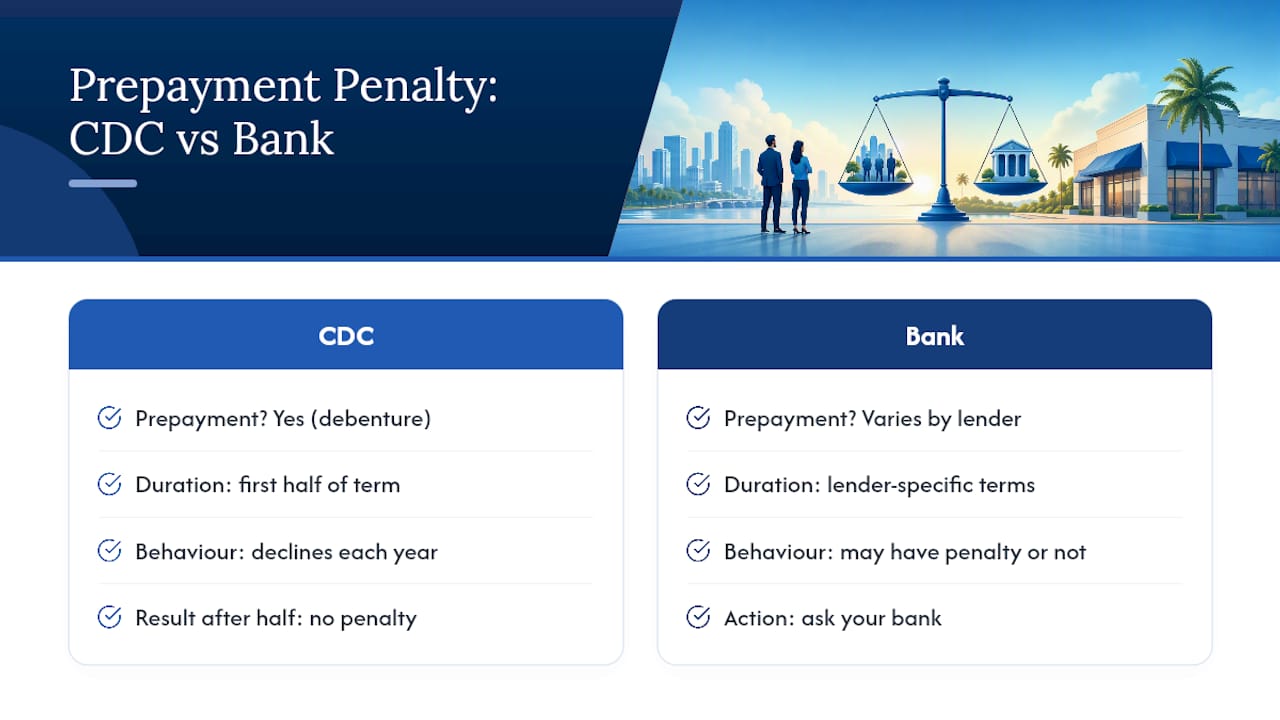
Yes, but the penalty applies only to the CDC debenture portion, and it phases out over time rather than lasting the full loan term. The declining prepayment penalty typically runs for the first half of the debenture’s term, meaning a 20-year debenture carries a penalty for roughly the first 10 years, decreasing incrementally each year until it disappears.
This structure exists because the debenture is sold to investors as a fixed-income security, and early payoff disrupts the return those investors expected when they bought it. The penalty compensates for that disruption. Once you’re past the halfway mark of your term, you can typically pay off the CDC portion without any penalty at all.
The bank’s first-mortgage portion follows separate terms set by that individual lender, and prepayment rules there vary considerably. Some banks build in their own penalty structure, others don’t, so this is a direct question to ask your bank during the application process rather than assuming it mirrors the CDC side.
If you’re considering a property you might sell or refinance within the first decade of ownership, factor this into your decision. A 504 refinancing later in the loan’s life carries far less friction than one attempted in year three or four, when the declining penalty is still substantial.
Your business’s financial health carries more weight in a 504 approval than most first-time applicants expect, because both the bank and the CDC are underwriting the same deal independently, each looking for evidence you can service the debt from operating cash flow, not just collateral value.
That ratio measures whether your business generates enough cash flow to comfortably cover the new loan payment on top of existing obligations. A business with thin or negative cash flow, even with strong collateral, faces a harder path.
Tax returns matter as much as bank statements here. Underwriters reconcile what you report to the IRS against what you claim in cash flow, and inconsistencies, even legitimate ones tied to depreciation or one-time expenses, slow the process while lenders request clarifying documentation.
Fixed-rate CDC financing rewards businesses planning to stay in one place for a decade or more. That said, if your equipment needs change fast or you need working capital alongside real estate, a 7(a) loan or conventional loan may fit better than forcing a 504 structure that wasn’t designed for that flexibility.
— PHENYX
Fbdc gets you a fixed-rate 504 loan closed in roughly a third of the time some CDCs need, backed by over 35 years of Florida-based SBA lending experience and a process built specifically around owner-occupied real estate and equipment deals. Where a generic bank loan officer might see one 504 application a year, Fbdc’s team coordinates the CDC, the bank, and the SBA debenture on these deals routinely, which is exactly why the paperwork moves faster and the surprises are fewer.
That experience shows up in the details: down payments as low as 10%, fixed-rate CDC terms up to 25 years, and a six-step process that keeps bank underwriting, CDC review, and appraisal work moving in parallel instead of stacking delays on top of each other. Fbdc also offers direct lending for smaller loans and dedicated support for refinancing existing commercial debt.
Run your numbers on the 504 loan calculator to see what a 10% down payment looks like on your specific project, then reach out through the SBA 504 loan program page to start prequalification.
Confirm current program terms directly through SBA’s 504 loan overview and SBA’s local assistance directory to locate a CDC in your area before starting an application.

