.svg)
.svg)
.svg)

If your business occupies at least 51% of an existing building, or 60% of new construction with a plan to reach 80% within 10 years, you meet the SBA’s owner-occupancy test and can pursue a 504 loan. Fall short of those numbers and the deal shifts into investment-property territory, where DSCR loans or conventional commercial real estate financing become your realistic path. SBA 504 loans are structured around exactly this threshold, and the documentation you gather now decides which lane you end up in.
TL;DR:
- To qualify for an SBA 504 loan, at least 51% of an existing building or 60% of new construction must be owner-occupied, with a credible plan to reach 80% within 10 years.
- Rentable square footage calculations must be precise, supported by assessor records and lease abstracts, and exclude shared, leased, or affiliated-space areas to avoid delays.
- Missed occupancy thresholds preclude SBA 504 financing, shifting the deal to alternative loans such as DSCR or conventional commercial mortgages.
- Leases to third parties can cover up to 49% of existing buildings and help support debt, but rental income cannot be the primary reason for property purchase.
- A typical 504 loan takes 60 to 90 days to close, with most borrowers ready to contribute 10% to 20% of the project cost as down payment depending on property type and business history.
The SBA doesn’t ask whether you “mostly” use a building. It asks for a specific rentable-square-footage calculation, and that number either clears the bar or it doesn’t. Rentable square footage counts the space your operating business physically uses for its own operations, and it excludes space leased out to unrelated third parties, common areas shared with tenants, and space occupied by affiliated entities that don’t count as the actual borrower.
The thresholds themselves are fixed:
Lenders verify this math against paperwork, not your best guess. Expect to produce county assessor records, stamped floor plans showing usable square footage per floor, lease abstracts for any tenants, and a written occupancy calculation that ties the numbers together. The most common trip-up isn’t fraud. It’s sloppy math: counting shared hallways as your own space, treating a temporary lease as permanent, or forgetting that a lease to an affiliated company under common ownership often doesn’t count toward the owner-occupied side of the ledger. Underwriters routinely re-verify these figures against assessor records during due diligence, so getting the calculation right the first time saves weeks later.
Occupancy isn’t a soft guideline. It’s the gate. Miss the threshold and underwriting stops before it starts, regardless of your credit profile or business revenue.
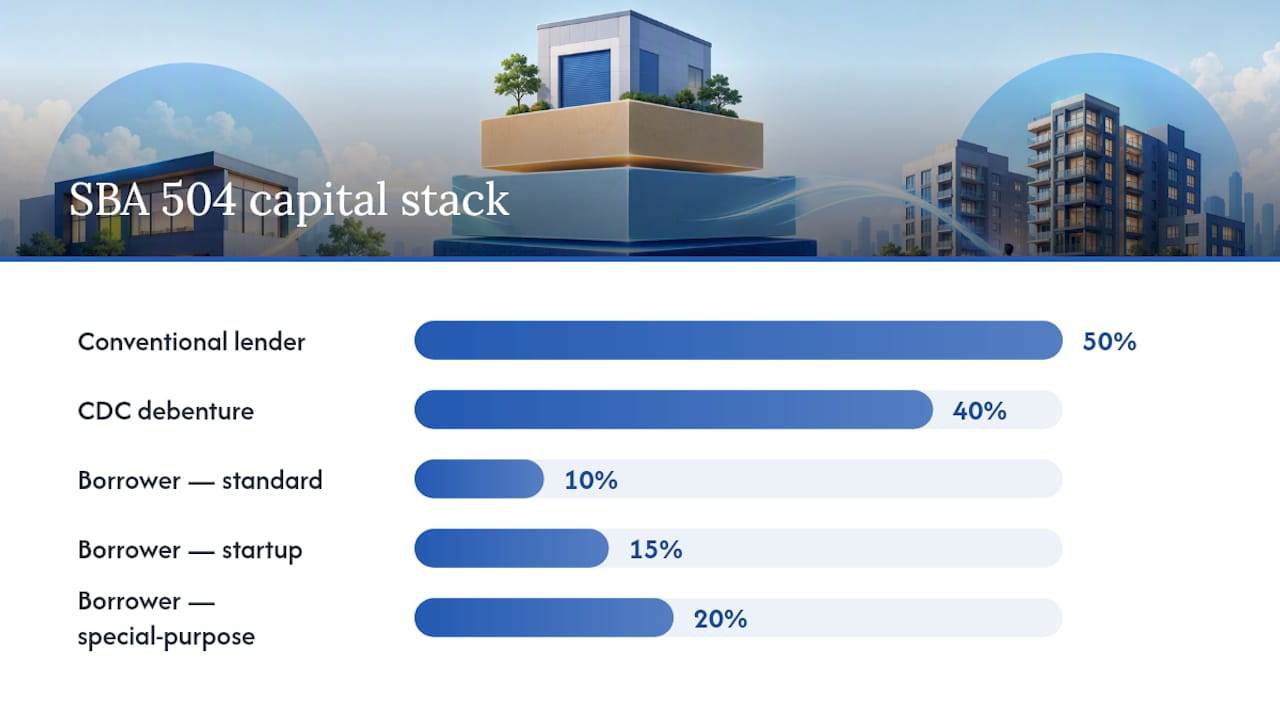
Clear the gate, and the standard 504 capital stack kicks in:
That 50-40-10 split is what makes 504 attractive compared to conventional commercial real estate loans, which typically demand 20 to 30% down. The CDC portion carries a long-term fixed rate, which protects your occupancy costs from rate swings over a 10, 20, or 25-year term. Rent collected from the leased portion of an owner-occupied building can offset debt service in the lender’s eyes, but it can’t become the primary reason for purchasing the property. Conventional CRE financing generally moves faster and carries fewer eligibility hurdles, but you’ll pay for that speed with a bigger down payment and, often, a variable or shorter-term rate.
Real buildings rarely fit textbook definitions. Here’s how the SBA handles the situations that trip up most first-time applicants.
SBA 504 financing exists to help a business own the building it operates from, not to fund a landlord’s rent roll. If your goal is buying a property specifically to lease it out for income, SBA financing isn’t available to you no matter how strong your business credit looks.
Your realistic alternatives:
Before you approach any of these lenders, pull your rent rolls, recent operating statements for the property, and a market rent comparison. That homework speeds up conversations with conventional or DSCR lenders considerably.
Lenders reject far more applications for missing paperwork than for bad business fundamentals. Here’s the documentation set that keeps a 504 application moving.
Pro Tip: Order your county assessor record before you submit anything else. It’s free, it’s fast, and it’s usually the first thing an underwriter checks against your floor plan.
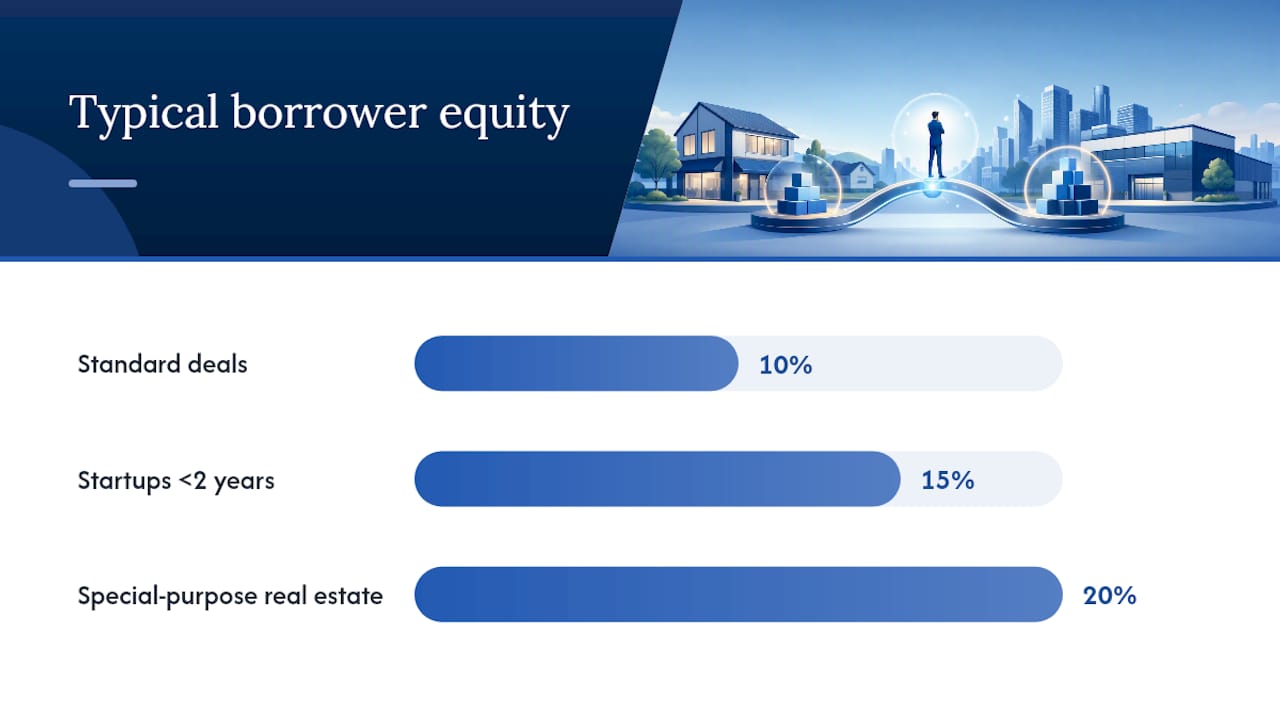
Timeline matters as much as paperwork. A 504 loan typically takes 60 to 90 days or longer to close, compared to 30 to 45 days for a conventional commercial mortgage. That gap exists because two separate approvals, your bank and the CDC, have to line up. Borrower equity commonly starts at 10%, climbing to 15% for startups under two years old and 20% for special-purpose real estate. Approximate processing fees apply on top of the CDC debenture fee, which is typically financed into the loan rather than paid out of pocket.
Occupancy verification isn’t paperwork theater. It’s the difference between a deal that closes in nine weeks and one that stalls for months while a borrower scrambles to fix a miscount. Rentable square footage calculations are reviewed against assessor records and floor plans before a file reaches the CDC, catching affiliated-tenant and common-area errors that cause most delays.
Where a business wants to hold title separately from its operating entity, lenders walk through whether an Eligible Passive Company structure fits, then coordinate the lease terms with both the bank and the CDC so the file is clean the first time. Years of SBA 504 lending experience show that early coordination keeps marginal but qualifying deals from getting rejected over documentation gaps rather than real eligibility problems.
— PHENYX
Some lenders offer a direct-lending alternative to piecing together your own occupancy calculation and hoping it holds up under review. Borrowers working with these lenders get checks of rentable-square-footage math, assessor records, and lease structure before files go to underwriting, where many 504 applications lose weeks.
If your business clears 51% occupancy on an existing building, or 60% on new construction with a credible path to 80%, the SBA 504 Loan Program is worth a real conversation, not just a calculator exercise. Already own a qualifying building on less favorable terms? The SBA 504 Refinance Program can restructure that debt. Worried about the gap between bank funding and CDC closing? The 504 Velocity Bridge Loan Program exists specifically for that timing problem. Start by running your own numbers on the 504 loan calculator, then walk through Fbdc’s proven process to request a pre-qualification conversation.
Check your own county assessor’s office for property-use records before finalizing your occupancy calculation.
This article is general information, not a substitute for advice from a qualified financial advisor. Consult a qualified financial professional about your own circumstances before acting on anything here.
You need at least 51% owner-occupancy for an existing building at closing. New construction requires 60% initial occupancy with a documented plan to reach 80% within 10 years.
Yes. Existing buildings can lease up to 49% of the space to unaffiliated third parties, and that rental income can help support debt service in underwriting.
No. SBA 504 financing is restricted to owner-occupied fixed assets and cannot fund a property bought solely for rental income. Investors typically need a DSCR loan or conventional commercial mortgage instead.
A 504 loan typically takes 60 to 90 days or longer, compared to 30 to 45 days for conventional commercial financing, because both a bank and the CDC must approve the deal separately.
Most borrowers put down 10%, but startups under two years old and special-purpose properties like hotels usually need 15 to 20%. Fbdc’s Down Payment Assistance Program can help borrowers who need extra flexibility on the equity side.
Yes, through an Eligible Passive Company structure, as long as your operating company signs a compliant lease and occupies the required percentage of the space. This structure requires careful documentation to pass underwriting.

