.svg)
.svg)
.svg)
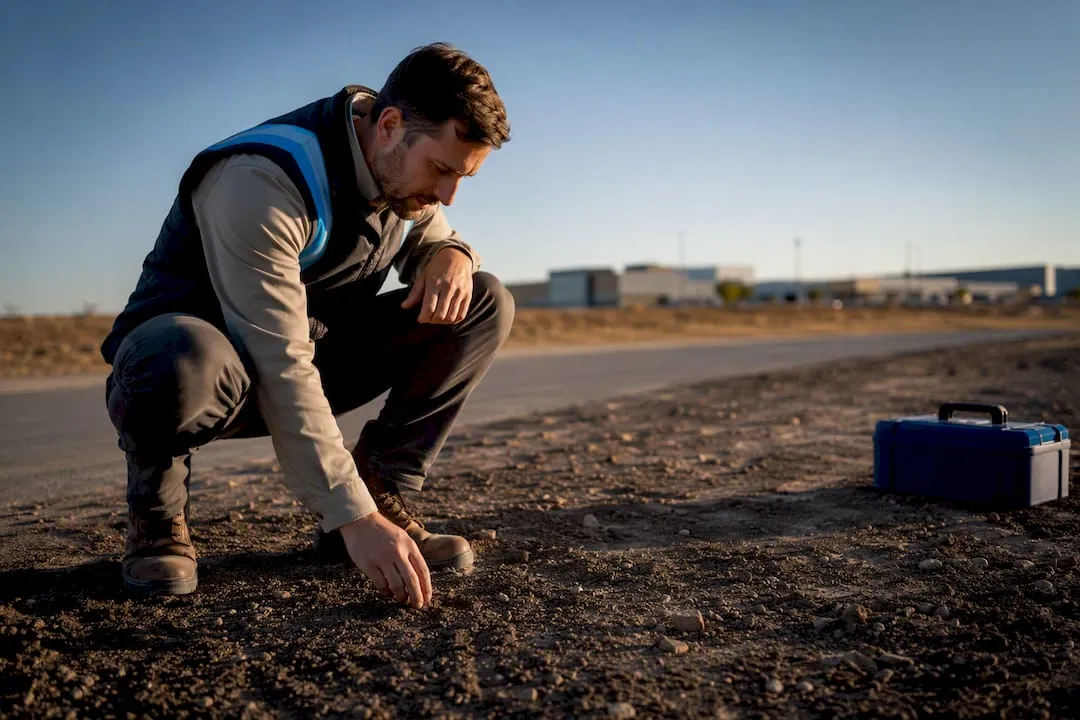
A Phase I Environmental Site Assessment identifies whether a property carries potential contamination risk through records review and site inspection. A Phase II ESA follows only when Phase I turns up a red flag, using soil and groundwater sampling to confirm or rule out contamination. Buyers, sellers, or lenders typically order Phase I first, and Phase II gets triggered by specific findings, not as a routine second step.
TL;DR:
- A Phase I Environmental Site Assessment is essential for legal protection and must be recent, typically within 180 days, with any older assessment needing updating before reliance.
- Common red flags triggering a Phase II include underground storage tanks, stained soil, chemical odors, adjacent industrial uses, or documented contaminant plumes.
- Phase II sampling involves targeted soil, groundwater, or vapor testing designed based on Phase I REC locations, with results directly influencing remediation or deal continuation.
- Costs for Phase I range from $1,500 to $4,000 and take about two to four weeks, while Phase II can cost $5,000 to over $25,000 and take three to six weeks or longer.
- Proper chain of custody documentation and adherence to ASTM standards are critical for legally defendable Phase II results and accepted by lenders.
A property transaction’s environmental due diligence usually follows a set sequence: records research, a site walk, interviews with current and past owners, then a written report. That’s Phase I, and it’s the step every commercial buyer or lender expects before closing.
Phase I earns its importance from federal law, not just industry habit. When a licensed Environmental Professional completes the work correctly, it satisfies EPA’s All Appropriate Inquiries (AAI) requirements, which gives buyers a legal defense against cleanup liability under CERCLA, the federal Superfund law. Skip AAI or perform it sloppily, and that liability shield disappears even if you never caused the contamination yourself.
The process doesn’t always move in a straight line. A few common deviations:
Phase I is deliberately non-intrusive. Nobody drills, digs, or samples anything. Instead, an Environmental Professional builds a picture of the property’s environmental history and current condition using three main information sources.
The report’s central job is to identify Recognized Environmental Conditions, or RECs: evidence of a release or threatened release of hazardous substances. A Controlled REC (CREC) is a known issue that’s already been addressed under a regulatory closure with residual restrictions. A Historical REC (HREC) is a past issue that’s been fully resolved and meets current standards, with no further action needed.
ASTM E1527 sets the technical standard nearly every commercial Phase I follows, and it also defines who qualifies as an Environmental Professional: someone with a specific combination of state licensure (as a geologist or engineer, for example) and years of relevant experience.
Pro Tip: A “no REC” finding doesn’t mean the site is pristine. It means the assessor found no evidence requiring further investigation under the ASTM criteria. That’s a meaningfully narrower claim than “clean,” and lenders read it that way.
A meaningful share of commercial Phase I assessments turn up at least one REC serious enough to warrant a closer look. When that happens, the report will typically recommend a Phase II investigation rather than issue a final opinion on contamination.
Not every REC leads to drilling and lab work, but certain findings almost always do. Environmental Professionals and lenders watch for a recognizable set of red flags:
Lenders often set their own thresholds beyond what ASTM technically requires. A bank financing a former dry cleaner, for instance, may insist on Phase II sampling as a closing condition regardless of how the Phase I report characterizes the risk. Data gaps, incomplete historical records, or a report that’s crossed the 180 day shelf life can also push a lender to require fresh testing before funding.
Where Phase I asks “is there a reason to worry,” Phase II answers “is something actually there, how much, and how far does it reach.” This is intrusive work, and it’s where the science gets specific.
Sampling locations aren’t random. The Phase I report’s RECs dictate exactly where borings go: near a former UST location, downgradient from a suspected release, or adjacent to a documented spill site. A licensed geologist or engineer typically designs this sampling plan before anyone touches a drill rig.
Once samples reach the lab, technicians run analyses tailored to the suspected contaminant, commonly petroleum hydrocarbons, chlorinated solvents, heavy metals, or pesticides depending on the site’s history. Results get compared against state and federal screening levels, numeric thresholds that determine whether a concentration poses unacceptable risk to human health or the environment.
Pro Tip: Ask your Environmental Professional which screening levels they’re using before sampling begins. Florida’s cleanup target levels differ from EPA regional screening levels in some categories, and knowing the benchmark in advance avoids confusion when results come back.
Three outcomes typically follow a completed Phase II. Clean results close the loop and let the deal proceed without further conditions. A confirmed but limited release usually triggers delineation, additional borings to map exactly how far contamination extends. Confirmed contamination above screening levels moves the property into remediation planning, which can range from a simple soil removal to a multi-year groundwater treatment program depending on severity.
Not every REC that reaches Phase II ends in bad news. Many investigations come back clean, and confirmed issues more often lead to price renegotiation, escrow holdbacks, or a targeted cleanup plan than to a collapsed deal.
Budget and scheduling expectations differ sharply between the two phases, and complexity within each phase swings the numbers further.
| Factor | Phase I ESA | Phase II ESA |
|---|---|---|
| Typical cost range | $1,500 to $4,000 for a standard commercial property | $5,000 to $25,000 or more, scope-dependent |
| Typical timeline | 2 to 4 weeks | 3 to 6 or more weeks, including lab turnaround |
| What drives cost up | Rural site with sparse records, multiple past owners | Number of borings or wells, breadth of lab panels, site size |
| Rush options | Expedited records pulls, limited availability | Priority lab turnaround, often at a premium |
A small retail building with a clean use history sits at the low end of Phase I pricing. A larger industrial parcel with gaps in the historical record, or one requiring interviews across several past tenants, pushes toward the higher end. Phase II costs vary even more widely because every boring, monitoring well, and lab panel adds line items. A site needing only three or four soil samples costs far less than one requiring a dozen borings plus groundwater monitoring across multiple quarters.
Two ASTM standards do the heavy lifting here: E1527 governs Phase I methodology, and E1903 covers Phase II sampling-based investigations. Following them isn’t optional if you want a report a lender will actually accept.
The reason traces back to CERCLA liability. A buyer who completes AAI properly before closing can claim protection as an “innocent landowner” or under the “bona fide prospective purchaser” defense, even if contamination is later discovered. Skip AAI, and that protection is gone regardless of intent.
Reports also have a shelf life. EPA guidance treats assessments as stale past roughly 180 days, and most lenders enforce that window strictly. A deal that drags past that mark often needs a Phase I update, sometimes just a records refresh, sometimes a full re-inspection, before funding proceeds.
Environmental due diligence isn’t a formality lenders tolerate. It’s underwriting evidence they rely on directly, and several federal loan programs, including SBA 7(a) and SBA 504, commonly require a compliant Phase I before closing.
A clean Phase I with no RECs generally lets an SBA 504 application proceed on schedule. A REC that surfaces mid-underwriting, though, can add weeks to closing while a Phase II gets scheduled, completed, and reviewed. That’s the scenario every borrower wants to avoid, and it’s avoidable with the right timing.
A few practical steps make the difference:
At Fbdc, working through 504 financing means seeing this pattern repeat: the borrowers who order environmental due diligence early rarely face closing delays, while those who treat it as a last-minute checkbox often do. Our six-step SBA 504 process builds environmental review into the timeline rather than bolting it on afterward.
Both assessment types answer specific questions well and leave other questions unanswered, and understanding that gap matters as much as understanding what each phase does cover.
Phase I is a paper and visual investigation. It relies on the quality and completeness of historical records, which are sometimes incomplete, mislabeled, or simply missing for older properties. An Environmental Professional can only report what the available sources show; a contamination source with no documented history and no visible surface evidence can pass through a Phase I undetected. This is a known limitation of the standard, not a failure of the assessor.
Phase II carries its own uncertainty. Sampling is inherently a snapshot: a boring placed five feet from a plume’s actual edge can return a clean result even though contamination exists nearby. Groundwater conditions shift seasonally, meaning a single sampling event might miss a contaminant that would show up during a different time of year. That’s part of why delineation, additional sampling around a confirmed hit, exists as a distinct step rather than being folded into the initial investigation.
Neither phase guarantees certainty. A thorough Phase I paired with a well-designed Phase II gets you a defensible, professionally supported opinion about site conditions. It doesn’t get you an absolute guarantee that no contamination exists anywhere on the property, and any Environmental Professional who claims otherwise is overselling their own work.
A soil or groundwater sample is only as good as the paperwork that follows it from the ground to the lab bench. Chain of custody documentation tracks every hand that touches a sample: who collected it, when, how it was preserved, and who received it at the laboratory.
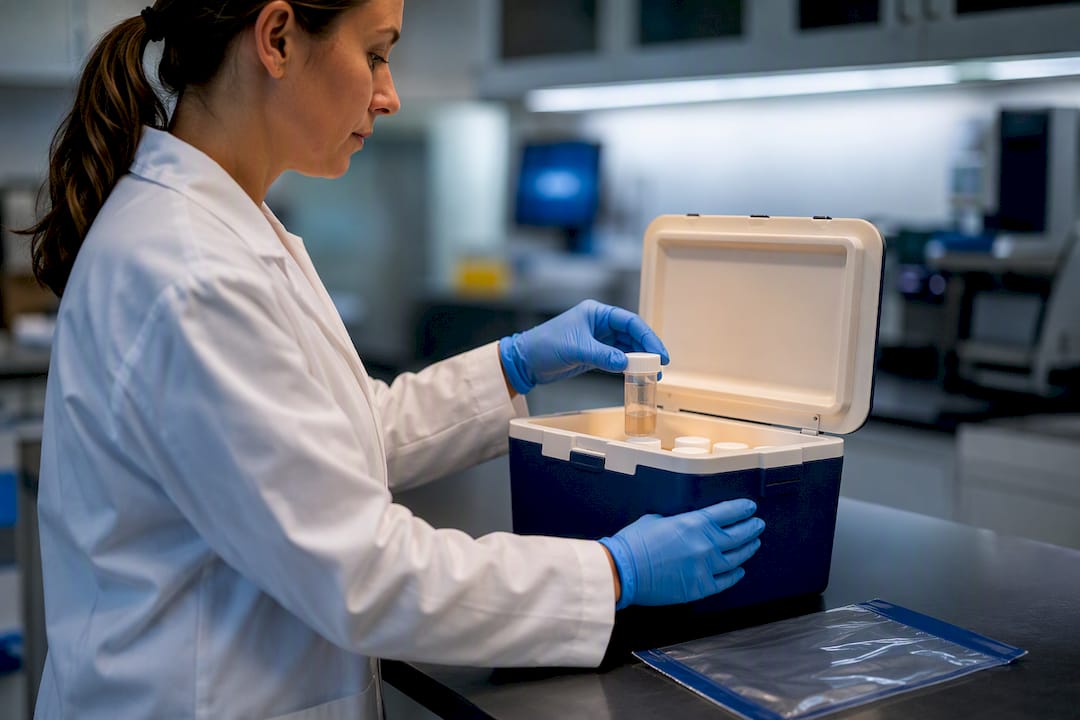
Break that chain, a missing signature, an unlogged temperature check, a gap in transport time, and a lab result can become legally indefensible even if the underlying chemistry is accurate. This matters enormously in a transaction context, because a buyer, seller, or lender relying on a Phase II report needs to trust that the numbers reflect the actual site, not a compromised sample.
Reputable labs and field teams follow strict protocols: samples go into specific containers with preservatives matched to the contaminant being tested, get stored at controlled temperatures, and travel with signed custody forms at every transfer point. Analytical results also go through quality control checks, duplicate samples, blank samples, and calibration standards, that catch errors before a report ever reaches a client.
If you’re reviewing a Phase II report as part of a purchase or loan decision, ask whether the lab holds relevant accreditation and whether the chain of custody documentation is available for review. A well-run environmental consulting firm won’t hesitate to share it, and a firm that hedges on the question is worth a second look before you rely on their numbers.
An ESA report hands you information, not a verdict on whether to proceed. The decision that follows should weigh the severity of what’s found against the cost of addressing it and the value of the deal itself.
A confirmed low-level contaminant well under the applicable screening level often just needs documentation and a monitoring plan, not a renegotiated purchase price. A confirmed release requiring active remediation is a different calculation entirely: get a remediation cost estimate before deciding whether to walk away, negotiate a price reduction, or ask the seller to complete cleanup before closing. Escrow holdbacks are common here, money set aside at closing specifically to cover remediation once a scope and cost are known.
Risk tolerance varies by buyer type. A cash buyer purchasing at a discount might accept more contamination risk than a bank financing 90% of the purchase price ever will. Lenders, by design, tend to be the most conservative party in the room, which is exactly why their REC thresholds often run stricter than what ASTM technically requires.
The practical rule: treat every Phase II result as an input to a cost-benefit conversation, not an automatic green light or red light. A property with a documented, bounded contamination issue and a clear remediation price tag is often a more predictable investment than one with an ambiguous Phase I data gap nobody has bothered to resolve.
ASTM standards govern how an assessment gets conducted, but they don’t cover everything a property owner might be legally required to do once contamination turns up. Several separate regulatory layers can kick in depending on what a Phase II finds.
Confirmed releases above certain thresholds often trigger mandatory reporting to state environmental agencies, quite apart from anything ASTM requires. Florida’s Department of Environmental Protection, for example, maintains its own reporting and cleanup target level framework that operates independently of the federal screening levels an assessor might reference during sampling design.
Underground storage tanks carry their own regulatory regime entirely, with specific closure, removal, and reporting requirements triggered the moment a UST is decommissioned or found leaking. A Phase II that identifies an active UST release isn’t just informing a real estate deal; it’s potentially opening a regulatory compliance process the property owner is obligated to follow regardless of whether the sale closes.
None of this replaces professional guidance. If a Phase II confirms contamination, the Environmental Professional who conducted it should be able to explain which state and federal reporting obligations apply to that specific finding, since the answer depends heavily on contaminant type, concentration, and location.
The conventional advice treats ESAs as a compliance box to check before closing. That framing undersells what’s actually at stake. A Phase I finding doesn’t just protect you legally under CERCLA, it directly shapes your financing timeline, and borrowers who don’t budget for that reality get blindsided by delays they could have anticipated.
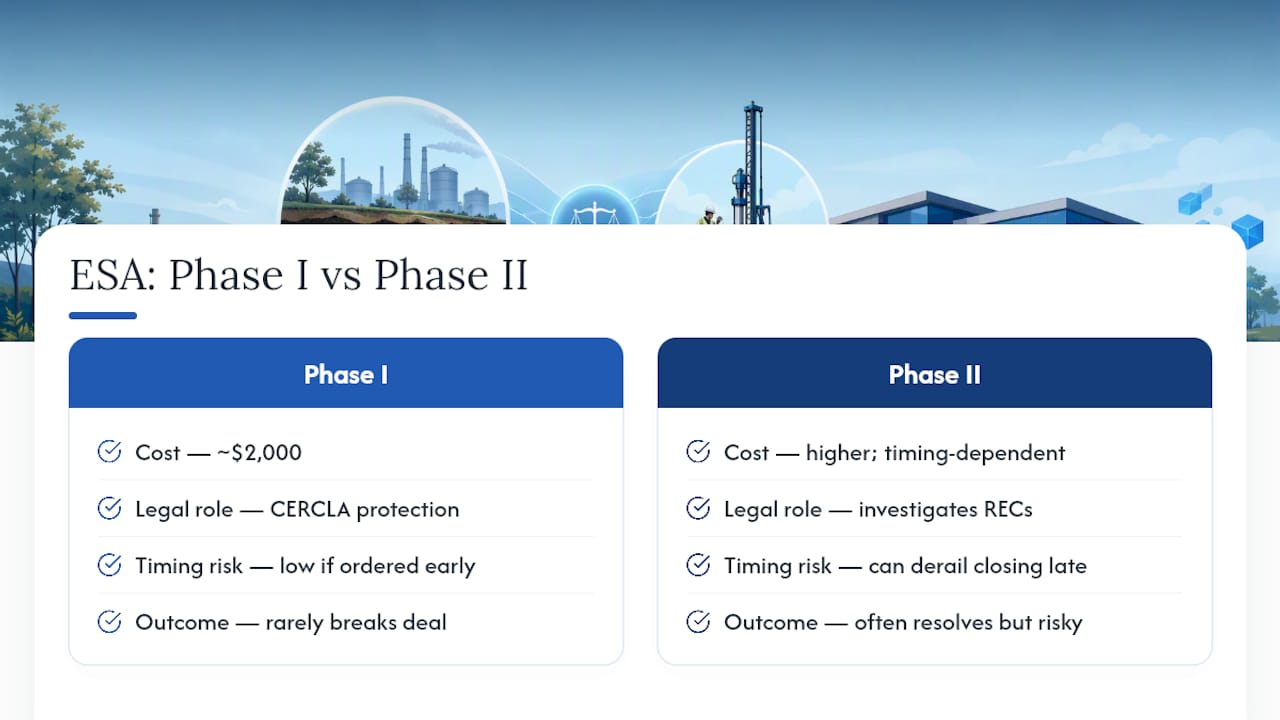
The most overlooked piece of this entire process is timing, not cost. A $2,000 Phase I fee rarely breaks a deal. A Phase II that surfaces three weeks before a scheduled closing, after loan documents are already in motion, absolutely can. Order environmental due diligence the moment a property goes under contract, not after your lender asks for it.
We’d also push back on treating a REC as automatically bad news. Most Phase II investigations resolve without derailing a transaction. The properties that actually run into trouble are the ones where nobody looked closely enough, early enough, to know what they were dealing with before the closing clock started running.
— PHENYX
If you’re evaluating a commercial property purchase and want to understand how environmental due diligence fits into your SBA 504 financing timeline, Fbdc’s loan process walks through exactly when to order assessments relative to underwriting milestones. Florida business owners in South Florida can also review SBA 504 loan options for Boca Raton to see how financing structure and due diligence timing work together on a real transaction.
This article is general information, not a substitute for advice from a qualified lawyer. Consult a qualified legal professional about your own circumstances before acting on anything here.

