.svg)
.svg)
.svg)

Yield maintenance is a rate-sensitive make-whole prepayment penalty. It can cost almost nothing or several times your annual debt service, depending entirely on where Treasury yields sit relative to your loan rate. It runs highest when Treasury yields fall and a long remaining term is left on the loan, and it shrinks toward zero when rates rise or the balloon is close. The calculation example and negotiation checklist below show exactly how to estimate your own exposure.
TL;DR:
- Yield maintenance costs fluctuate significantly based on current Treasury yields, with sharp increases when yields fall and remaining loan terms are long.
- The penalty is primarily driven by the rate spread between the original loan rate and the comparable Treasury yield, not the loan size.
- Defeasance and yield maintenance serve similar purposes but differ in complexity, cost, and timeline, with defeasance being more expensive and slower to execute.
- Other prepayment penalties like fixed percentage fees, step-down schedules, or lockout periods offer more predictable costs but may lack flexibility.
- Borrowers should request formal prepayment estimates and negotiate caps or schedules upfront, especially when refinancing or renegotiating loans.
A prepayment penalty is a broad umbrella term covering any fee a lender charges for paying off a loan early. Yield maintenance is one specific, formula-driven version of that penalty, built to protect the lender’s reinvestment yield rather than to punish the borrower with a flat fee.
Lenders use yield maintenance because a loan is an investment they’ve priced against expected interest income over the full term. When a borrower pays off early, the lender has to reinvest that principal somewhere else, and if rates have dropped since origination, the new investment earns less than the original loan would have. Yield maintenance closes that gap. The lender collects the present value of the interest income it’s losing, calculated against a comparable Treasury yield.
This structure shows up most often in:
Because the penalty is tied directly to Treasury movement, your liability can swing wildly over the life of the loan without you doing anything at all. A loan that would cost almost nothing to prepay in one rate environment can become extraordinarily expensive a year later if Treasury yields fall.
The standard yield maintenance formula calculates the present value of your remaining scheduled payments, discounted at a Treasury yield with a maturity closest to your loan’s remaining term, then multiplies that by the spread between your loan rate and that Treasury yield. The note itself controls which Treasury benchmark applies and how the math gets applied, so two loans with identical balances can produce very different penalties.
Here’s a simplified worked example:
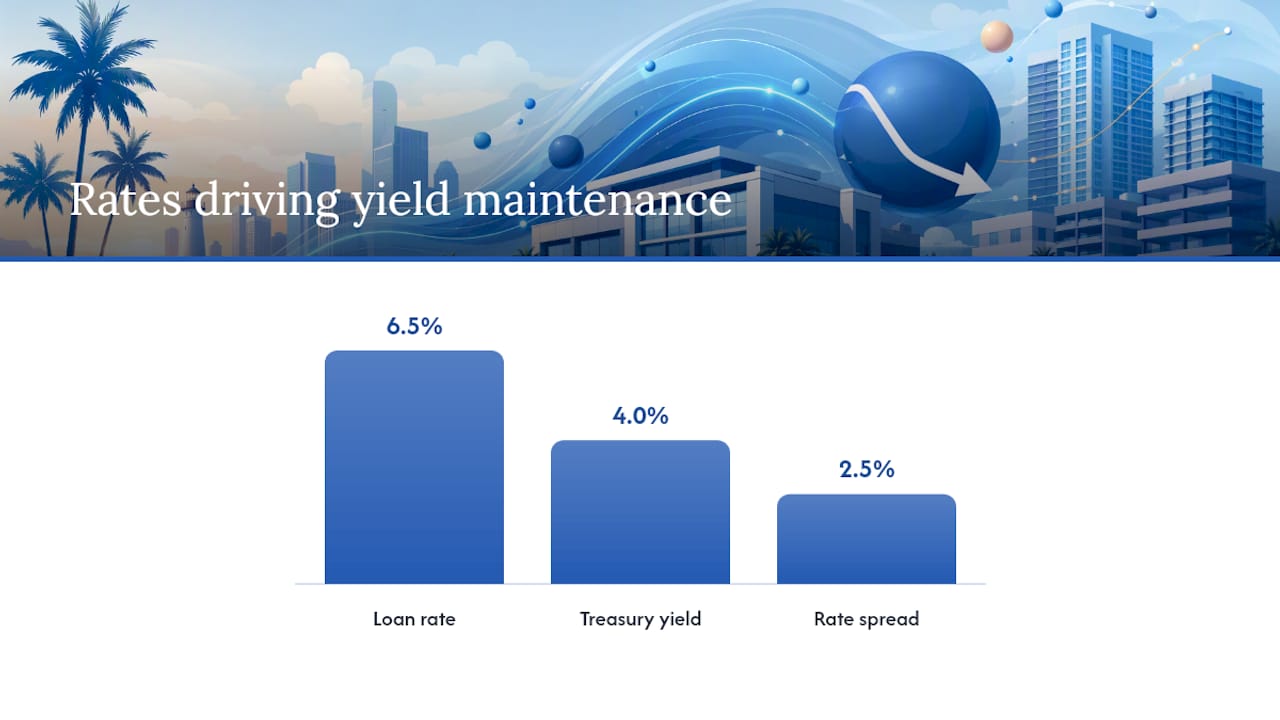
The rate spread is 2.5 percentage points. Applied against the present value of the remaining payment stream over five years, that spread produces a penalty in the range of $200,000 to $250,000, depending on the exact discounting method the note specifies.
Rate spread matters more than loan size. A 2.5-point gap between your loan rate and the current Treasury yield is what drives the bulk of the penalty. Close that gap and the payoff cost can fall dramatically even on the same loan balance.
Three things routinely make a servicer’s actual number diverge from any generic calculator: a floor written into the note that sets a minimum penalty regardless of rates, the specific Treasury benchmark selected when maturities don’t line up neatly, and the day-count convention used to discount the remaining cash flows. Always request the servicer’s own worksheet before relying on an estimate.
Defeasance and yield maintenance solve the same problem for the lender, but they work in completely different ways operationally. Yield maintenance is a cash settlement: you write a check, the loan is retired, and the transaction is done. Defeasance substitutes your collateral with a portfolio of government securities structured to replicate the loan’s exact cash flow, leaving the original loan intact for the bondholders who own it.
That structural difference drives everything else:
If your loan documents give you a choice, defeasance can occasionally undercut yield maintenance in cost depending on where Treasury yields sit, but the added complexity and third-party fees make it a heavier lift for most small-balance borrowers.
Not every commercial loan uses a rate-sensitive formula. Four other structures show up regularly in loan documents, each with a different trade-off between predictability and market exposure.
Fixed and step-down structures give you predictability that yield maintenance can’t match, which matters if you expect to sell or refinance on a known schedule. SBA 504 loans typically use their own declining prepayment schedule on the debenture portion rather than a Treasury-linked formula, which is one reason SBA 504 exposure tends to look very different from a CMBS loan’s.
Don’t estimate your penalty from a generic calculator and treat it as final. Request a formal prepayment estimate from your servicer in writing, and if defeasance applies, get a quote from a qualified defeasance consultant before you model anything else. Both numbers change with market movement, so timestamp whatever figures you receive.
Once you have real numbers, run the comparison that actually matters: modeled monthly savings from a refinance at today’s rate, multiplied out over your expected holding period, against the one-time prepayment cost. A tool like FBDC’s loan calculator can help frame that math side by side. Build in extra time, too. Defeasance transactions in particular can take several weeks to close, and rushing one against a hard refinance deadline usually costs you leverage.
If you’re negotiating loan terms at origination, or renegotiating an existing note, push on these specific points:
Pro Tip: Ask your servicer for prepayment estimates on two or three different possible closing dates, not just one. Yield maintenance moves with the market daily, and a signed payoff statement locked to a specific date protects you from a number that shifts between your estimate and your actual closing.
SBA 504 loans don’t carry Treasury-linked yield maintenance on the debenture portion. Instead, they use a declining prepayment premium that drops over roughly the first half of the loan term, which makes exposure far easier to forecast than on a CMBS loan tied to daily rate movement. That predictability is one reason FBDC borrowers rarely face the kind of sudden six-figure surprise that a falling-rate environment can create on a conventional yield maintenance note.
Servicing rules also differ. SBA 504 debentures are pooled and sold, but the prepayment schedule is fixed at closing, not recalculated against market yields. If you’re weighing a refinance against your current prepayment cost, FBDC’s borrower resources can walk through the specific schedule attached to your loan.
— PHENYX
FBDC gives Florida small business owners a lower-cost route into commercial real estate ownership and refinancing than most conventional lenders, with down payments as low as 10% and long-term fixed rates that make it easier to model your true cost of capital against any prepayment exposure you’re carrying.

If a current loan’s prepayment penalty is holding you back from refinancing into better terms, FBDC can help you model the tradeoff realistically. That means running your existing penalty estimate against the savings a new SBA 504 structure would generate over the remaining term, so you’re deciding with real numbers instead of guesswork. For borrowers researching interest rate timing more broadly, this breakdown of how rate moves affect deal value is a useful companion read. Some lenders have extensive experience helping small businesses across Florida secure financing that traditional lenders often turn away.
Ready to see where you stand? Start FBDC’s six-step SBA 504 process and request a refinance review to find out whether now is the right time to move.
Run your own figures against primary sources before you finalize any decision:
This article is general information, not a substitute for advice from a qualified financial advisor. Consult a qualified financial professional about your own circumstances before acting on anything here.
There’s no blanket state-by-state ban list for commercial loans; prepayment penalty rules vary far more by loan type and lender than by state, so the terms in your promissory note govern, not general state law.
This isn’t a recognized industry rule for commercial or SBA financing; if you’ve seen it referenced elsewhere, it doesn’t apply to yield maintenance or SBA 504 prepayment structures, and you should rely on your loan documents instead.
Not necessarily. A prepayment penalty is often the tradeoff for a lower fixed rate, and structures like SBA 504’s declining schedule are predictable enough that avoiding them entirely isn’t always the smarter move.
Yes, prepayment penalties are legal and contractual as long as they’re disclosed in the loan documents; the CFPB confirms borrowers should read those terms closely before signing.

