.svg)
.svg)
.svg)

Recourse loans let lenders pursue borrower assets beyond the pledged collateral if the borrower defaults. Nonrecourse loans generally limit the lender’s recovery to the collateral itself, subject to the loan documents and state law. That last part matters more than most borrowers realize, because guarantees, carve-outs, and where you live can turn a “nonrecourse” loan into something that behaves like a recourse one. Tax treatment differs between the two as well, which we cover below.
TL;DR:
- Nonrecourse loans typically limit recovery to the collateral, but carve-outs, guarantees, or specific laws can make them behave like recourse loans in practice.
- State foreclosure procedures and laws significantly influence whether lenders can pursue deficiencies beyond the collateral, especially distinguishing residential from commercial protections.
- Tax treatment differs: canceled recourse debt may trigger taxable income, while nonrecourse debt affects the full amount realized, potentially causing tax liabilities on appreciated assets.
- SBA 504 loans are not automatically nonrecourse; personal guarantees and specific loan documents determine whether borrowers have liability beyond collateral.
- Lenders reserve nonrecourse financing mainly for income-generating commercial real estate or specialized projects, requiring stronger collateral and borrower qualifications.
A recourse loan gives the lender the right to collect the full debt from the borrower, not just from whatever was pledged as collateral. If a foreclosure sale does not cover the balance, the lender can pursue a deficiency judgment, garnish wages, or levy bank accounts and other assets. A nonrecourse loan caps the lender’s recovery at the collateral’s value: once the lender takes the property or equipment, the debt is generally satisfied even if the sale proceeds fall short.
Few loans are purely one or the other. Many nonrecourse commercial loans include carve-outs, sometimes called “bad boy” provisions, that convert the debt to recourse if the borrower commits fraud, waste, environmental violations, or unauthorized transfers. Personal guarantees attached to an otherwise nonrecourse loan create a separate recourse obligation for the guarantor.
A quick contrast:
A typical home mortgage is a recourse loan in most states, though state anti-deficiency rules can blunt that exposure for residential borrowers.
A commercial real estate loan structured as nonrecourse limits the lender to the property unless carve-outs or a personal guarantee say otherwise.
The word “nonrecourse” on a term sheet is a starting point, not a guarantee. State statutes and the foreclosure method actually used determine whether a lender can chase you for a shortfall. Some states restrict deficiency judgments after certain foreclosure procedures, particularly for residential purchase-money mortgages, while leaving commercial debt largely unprotected.
Two foreclosure paths lead to different outcomes:
Borrowers frequently assume that because their state limits deficiencies on home loans, the same protection applies to a business loan. It usually does not. Residential anti-deficiency statutes were built for homeowners, and commercial transactions, including most recourse and nonrecourse debt, depend on the specific promissory note, guarantee, and state law rather than a blanket label.
The IRS treats recourse and nonrecourse debt differently when a loan ends in foreclosure, repossession, or forgiveness, and the difference can change what you owe the following April. According to IRS guidance on recourse and nonrecourse debt, canceled recourse debt can generate cancellation-of-debt income (CODI) in addition to any gain or loss on the disposal of the property. Nonrecourse debt is typically handled under amount-realized rules instead, meaning the full canceled debt amount is treated as sale proceeds, which can produce a taxable gain even when no CODI applies.
IRS Publication 5550 walks through worked examples showing how recourse debt can trigger both CODI and a separate gain or loss calculation, while nonrecourse debt is folded entirely into the amount realized. That structural difference is why a borrower can lose a property and still owe tax on “income” they never saw in cash, particularly with nonrecourse debt on an appreciated asset.
Say a small-business owner has an asset securing a $300,000 loan that is foreclosed on when the asset is worth $250,000. Under recourse treatment, the borrower could realize CODI on the forgiven $50,000 shortfall plus a separate gain or loss based on the asset’s basis. Under nonrecourse treatment, the entire $300,000 is treated as the amount realized on the disposition, which can create gain without any CODI at all.
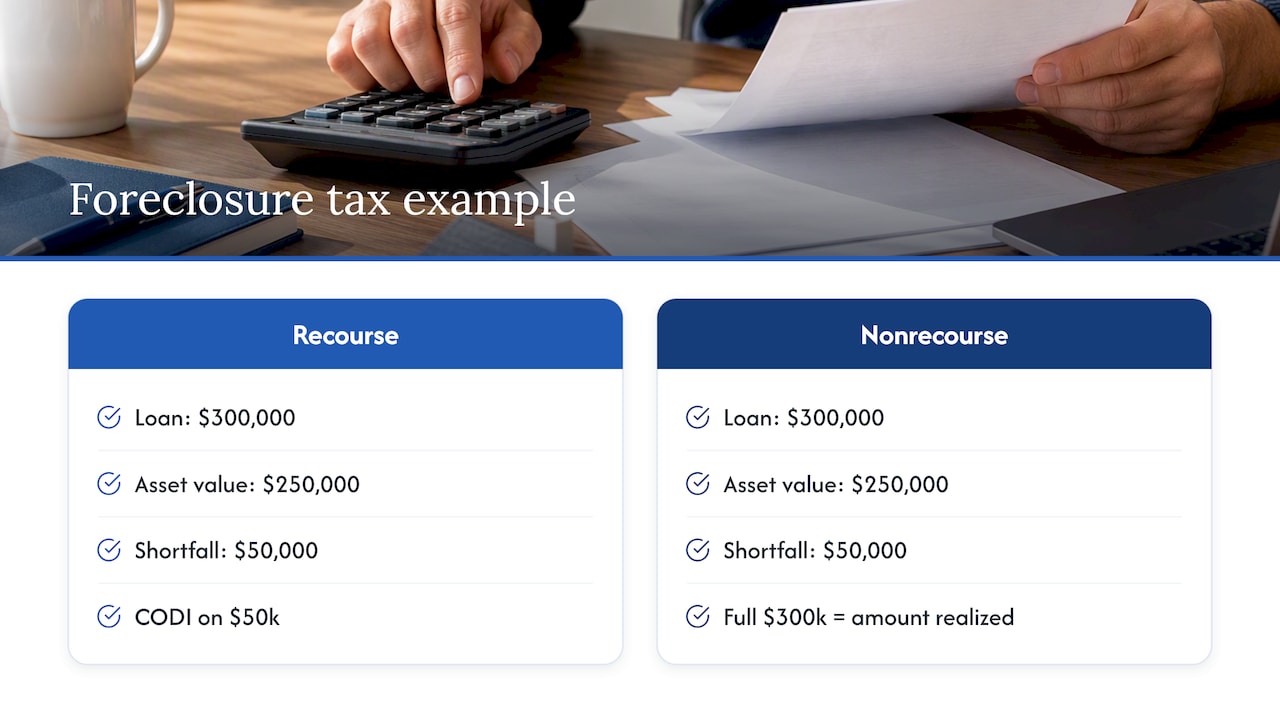
The IRS also lists exclusions for canceled debt, including bankruptcy and insolvency, that can reduce or eliminate the taxable amount. Given how quickly these calculations get complicated, talk to a tax professional before a distressed sale or workout closes.
SBA 504 loans are delivered through Certified Development Companies (CDCs) working alongside a bank or nonbank lender, and the SBA’s own program pages make clear that the executed authorization and guarantee documents, not the program label, determine what a borrower is on the hook for. A 504 structure being government-backed does not make it nonrecourse: personal guarantees are standard practice, and they create direct recourse against the guarantor regardless of how the underlying real estate loan is classified.
Before signing, borrowers should check a few things:
That focus means the lender’s team walks borrowers through the guarantee and collateral language line by line rather than leaving it buried in closing paperwork.
Pro Tip: Ask your CDC for the exact guarantee language in writing before you sign anything, not just a summary of the loan terms.
Nonrecourse structures are not handed out broadly. Lenders reserve them for situations where the collateral itself carries enough independent value and stability to justify limiting their own remedies.
Recourse lending remains the default for most small-business term loans, equipment financing, and working capital lines, where the lender wants a broader claim than the collateral alone provides.
Before you sign a promissory note, read the security instrument closely for recourse language and any carve-out provisions buried in the definitions section. Confirm exactly who is signing a personal guarantee and whether it is capped at a dollar amount or open-ended.
Pro Tip: Get the lender’s deficiency and tax-reporting practices in writing before closing, not as a verbal assurance during negotiation.
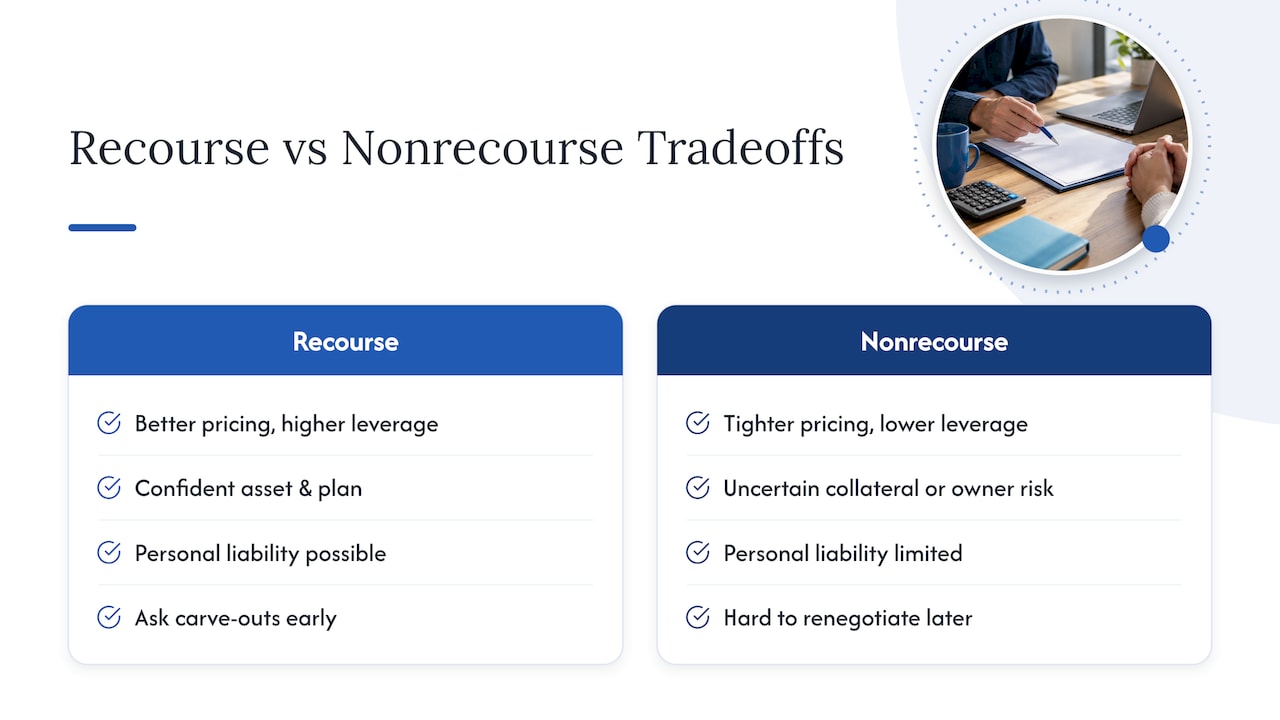
Accepting recourse terms in exchange for better pricing or higher leverage can make sense for a borrower confident in the asset and the business plan. Insisting on nonrecourse status, or at least narrow carve-outs, makes more sense when the collateral’s value is uncertain or the deal size threatens the owner’s personal balance sheet.
The strongest negotiating position comes from asking for carve-out language early, before a term sheet is finalized, rather than trying to renegotiate guarantee terms after underwriting is complete.
— PHENYX
Understanding recourse exposure before you close is only half the job. Pairing it with the right financing structure is the other half, and that is where FBDC’s focus on SBA 504 lending comes in.
If you are weighing a commercial real estate purchase or an equipment upgrade and want a lender who will walk through guarantee and collateral terms with you directly, explore FBDC’s SBA 504 Loan Program and check your eligibility today.
This article is general information, not a substitute for advice from a qualified financial advisor. Consult a qualified financial professional about your own circumstances before acting on anything here.
No state guarantees a purely nonrecourse mortgage across the board. Several states limit deficiency judgments for certain residential purchase-money loans or specific foreclosure procedures, but the rules vary by state and loan type, so borrowers should confirm the exact statute that applies to their situation rather than assume protection.
SBA 504 loans are not automatically nonrecourse just because they carry a government guarantee. The SBA 504 program is delivered through CDCs, and the signed authorization and personal guarantee documents, not the program label, determine whether a borrower faces personal liability.
Nonrecourse financing is most common in commercial real estate and project finance, where lenders accept collateral-only recovery in exchange for stronger underwriting standards. Qualifying borrowers usually offer experienced sponsorship, lower leverage, and income-producing assets that hold value independent of the borrower’s broader finances.
A commercial real estate loan secured only by the property itself, with no personal guarantee and no carve-outs beyond standard fraud or environmental provisions, is a clear example of nonrecourse debt. Some reverse mortgages are also structured as nonrecourse, limiting repayment to the home’s value regardless of the remaining loan balance.

