.svg)
.svg)
.svg)

For most Florida small businesses buying owner-occupied real estate or major equipment, the SBA 504 loan is the strongest financing option available, offering a down payment as low as 10%, a long-term fixed rate, and support from a local Certified Development Company. If you can meet the eligibility rules, the smart next move is a quick prequalification conversation with a Florida CDC like Fbdc before you sign a contract on a property or a piece of equipment.
TL;DR:
- SBA 504 loans in Florida require at least 51% owner-occupancy for existing buildings or 60% for new construction, with some startups facing higher requirements.
- The typical project structure involves a 50% bank mortgage, a 40% fixed-rate debenture from a CDC/SBA partnership, and as little as 10% borrower equity.
- Qualified small businesses must meet SBA size standards, demonstrate sound management, and have a strong credit history, with special scrutiny for startups and certain property types.
- The application process generally takes 60 to 90 days, with preparation of financial documents and project summaries able to speed up closing.
- SBA 504 rates are fixed for the life of the debenture, linked to Treasury rates, and working with an experienced CDC eases coordination and accelerates approval.
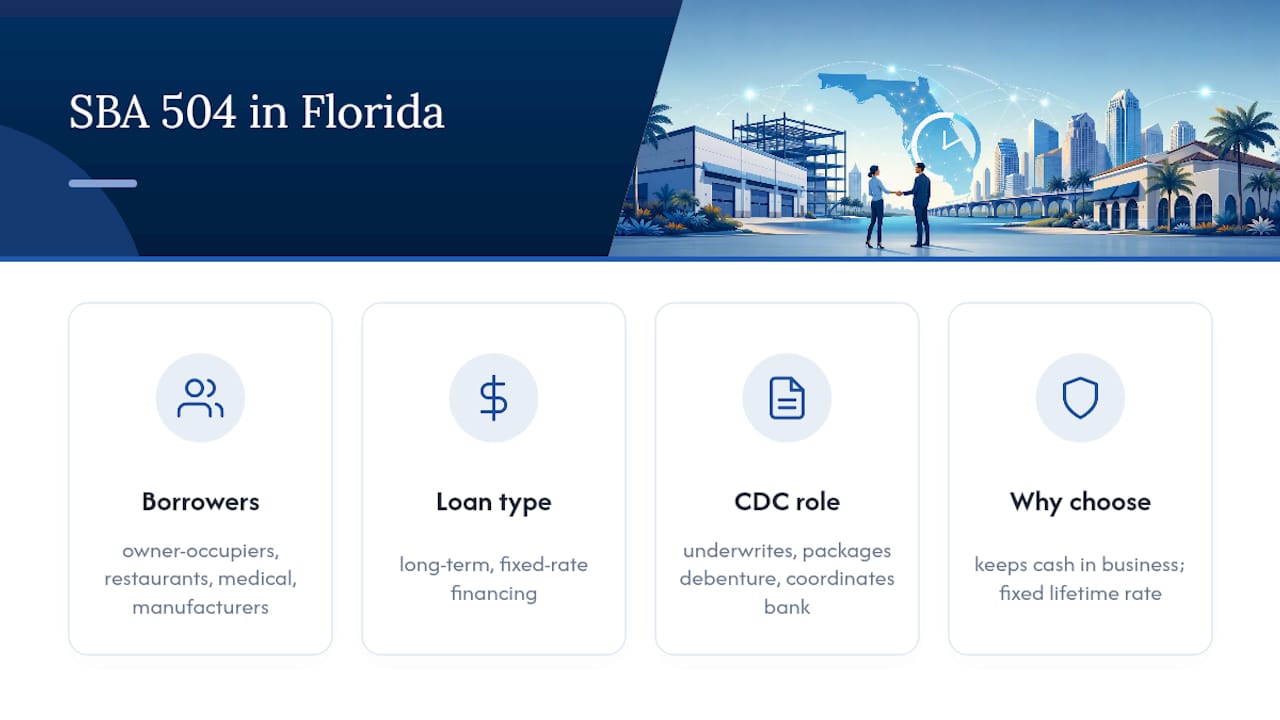
The SBA 504 program provides long-term, fixed-rate financing for major fixed assets, exactly the kind of purchase that stretches a small business’s cash reserves thin. The Small Business Administration doesn’t fund these loans directly. Instead, it partners with Certified Development Companies, nonprofit organizations authorized by the SBA to originate the 504 portion of each loan and coordinate closely with a bank lender on the rest.
In Florida, that CDC relationship matters more than most borrowers expect. A CDC underwrites your project, packages the SBA debenture, and works alongside your bank from application through closing. Experienced CDCs are why so many Florida owner-occupiers, restaurant groups buying their building, medical practices expanding into a new office, manufacturers adding a production facility, choose 504 financing over a conventional commercial mortgage. The structure keeps more cash in the business while locking in a rate that won’t move for the life of the loan.
Before you approach a lender, run through the basic eligibility filters the SBA applies to every 504 applicant:
Startups and special-purpose properties, think gas stations, hotels, or self-storage facilities, face additional scrutiny and sometimes higher equity requirements. The federal rules behind these thresholds are spelled out in eCFR Title 13 § 120.882, which is worth a look if you want the exact regulatory language.
The 504 program is built for fixed assets with long useful lives, not day-to-day cash flow. Eligible uses include:
Florida businesses use 504 loans constantly for projects like a restaurant buying its building, a medical office consolidating into owned space, a warehouse expansion for a logistics company, or an owner-operated hotel or professional practice purchasing its own headquarters. What the program won’t touch: working capital, inventory financing, or any property held as a passive investment rather than occupied by your business. If you’re wondering whether a specific piece of equipment qualifies, equipment-specific guidance can save you a wasted application.
Every 504 deal splits into three pieces, and understanding that split is the key to understanding your actual cost of capital.
By the numbers: Industry guidance on typical 504 structures points to a common 50/40/10 split between bank financing, the CDC/SBA debenture, and borrower equity, though the exact mix shifts with project type and borrower risk profile.
The SBA debenture amortizes over a fixed term, and blending it with the bank’s rate usually produces a lower overall cost of capital than a conventional commercial real estate loan for owner-occupiers, according to the SBA’s own program description. There’s a cap on how large the SBA debenture itself can be, but because the bank’s first mortgage isn’t subject to that cap, total project size can run well beyond it when the bank portion is scaled up. Fees are rolled into the debenture and repaid over the loan term, so there’s little out-of-pocket cost beyond your equity contribution and standard closing costs.
The application sequence is predictable once you know the stops along the way:
In Florida, a complete application with an experienced CDC typically closes in 60 to 90 days, though appraisal delays, environmental reviews, or incomplete paperwork can stretch that timeline. Local resources like the Florida SBDC network can help you prepare financials before you ever contact a CDC.
Pro Tip: Gather three years of business tax returns, a current personal financial statement, and a one-page project summary before your first CDC conversation. Walking in prepared can shave weeks off your timeline.
The 504 program isn’t free of friction, and it isn’t right for every project. Here’s the honest scorecard:
Some Certified Development Companies have more experience in SBA 504 lending than others, which can make the coordination between your bank and the SBA debenture a more routine process. Services include:
To get started, have your recent tax returns, a project summary, and a rough budget ready before reaching out.
The 504 program rewards businesses that plan ahead and punishes those that don’t gather documents early. If you’re weighing this financing for a Florida property or equipment purchase, talk to a CDC before you sign anything.
— PHENYX
For Florida business owners seeking SBA 504 financing, working with an experienced Certified Development Company focused on this program can be beneficial. That focus shows up in the details: down payments as low as 10%, long-term fixed rates, and staff who coordinate the bank and SBA sides of your deal so you aren’t stuck relaying paperwork between two lenders yourself.
If you’re ready to see what a 504 loan could look like for your project, the SBA 504 Loan Program page walks through approximate fees and program details, and the 504 loan calculator lets you estimate payments before you talk to anyone. For businesses that need financing bridged quickly while the SBA debenture closes, the 504 Velocity Bridge Loan Program is worth a look too. Reach out to Fbdc for a prequalification review and find out where your project stands.
For-profit small businesses that meet SBA size standards, stay under net worth and net income limits, and will occupy at least 51% of the property being financed generally qualify. Startups and special-purpose properties face extra scrutiny and often need higher equity contributions.
SBA 504 rates are fixed for the life of the CDC/SBA debenture portion of the loan, set at the time of funding based on current Treasury rates. Current rate details are available directly from Fbdc or your CDC, since they change with market conditions.
It’s more paperwork-intensive than a standard bank loan because two lenders, your bank and a CDC, coordinate on one project, but it isn’t harder to qualify for if your business meets the size and net worth thresholds. Working with an experienced Florida CDC that closes deals in the typical 60 to 90 day window makes the process considerably smoother.
The main drawbacks are the owner-occupancy requirement, which excludes passive real estate investors, and the added documentation from working with two lenders instead of one. Closing timelines also tend to run longer than a conventional commercial loan, though the lower down payment and fixed rate often offset that tradeoff for qualified borrowers.

