.svg)
.svg)
.svg)
SBA 504 is often the strongest option for owner-operated, stabilized hotels that want long-term, fixed-rate financing on the real estate itself. It works less well for passive investors or heavy soft-cost renovations.
TL;DR:
- SBA 504 loans typically require about 15% borrower equity for stabilized hotels, which is higher than the standard 10% for other small businesses.
- The fixed-rate CDC debenture portion of a 504 loan lasts for 25 years, offering rate stability amid market volatility, while the bank debt usually has a shorter amortization.
- Soft costs such as franchise fees, short-life FF&E, and PIP expenses are not covered by 504, often requiring a separate SBA 7(a) loan.
- Hotel projects with heavy PIP work or franchise conversions should plan for layered financing, combining 504 real estate funding with 7(a) soft cost coverage.
- The typical timeline for SBA 504 hotel deals ranges from 60 to 180 days, depending on franchise approvals, environmental reviews, and PIP scope, which can be expedited with experienced lenders.
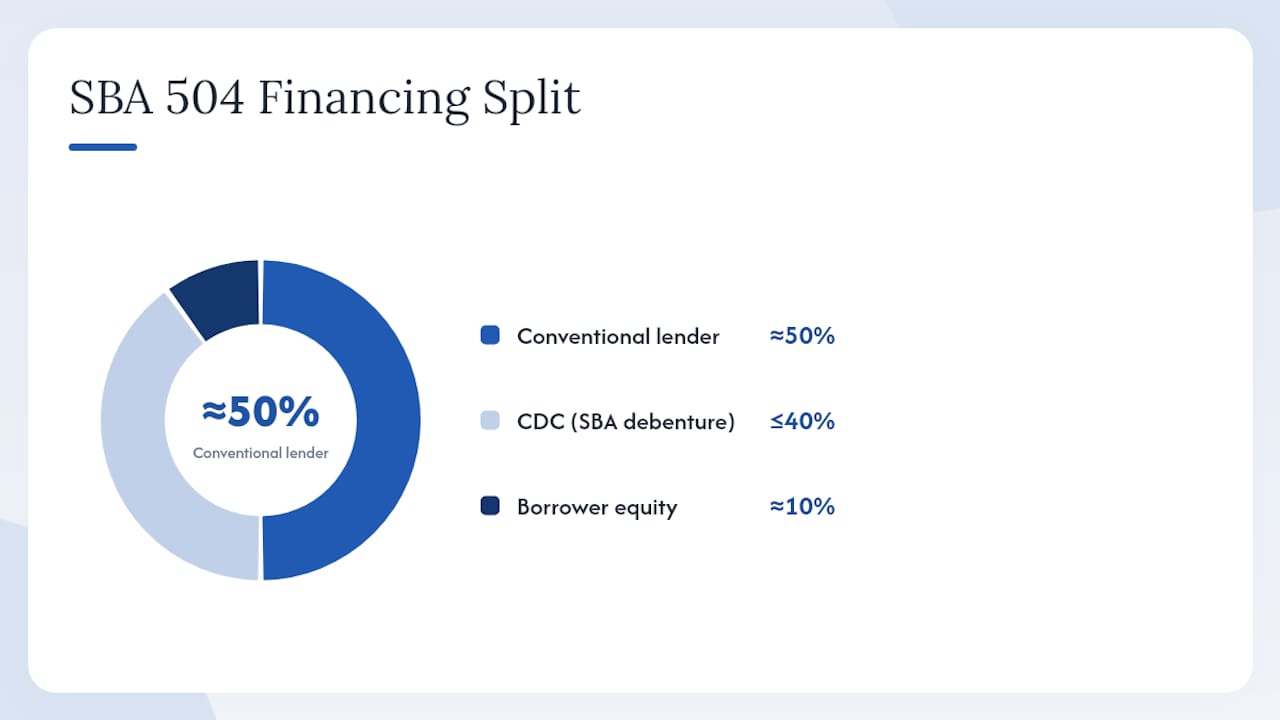
An SBA 504 hotel loan splits financing across three parties instead of one bank carrying the whole deal. A conventional lender funds roughly half the project, a Certified Development Company (CDC) funds up to 40% through an SBA-backed debenture, and the borrower puts in the rest as equity. The SBA 504 program exists specifically to fund major fixed assets like buildings and long-life equipment, delivered through CDCs working alongside a senior lender.
For a hotel, this structure matters because hotels almost always qualify as owner-occupied real estate. The operator runs the business inside the asset being financed, which is the core requirement for 504 eligibility. That same fact, though, is what makes hotels a special-purpose property in the SBA’s eyes. Fixtures, room layouts, and branding limit how easily the building could serve another use, so lenders price that risk into the equity ask.
Compared with conventional hotel lending, 504 offers two clear advantages:
Run through this before you spend time on a full application:
None of these are disqualifiers on their own. They’re simply where underwriters slow down and ask more questions, so having the paperwork ready before you’re asked saves weeks.
The two programs cover different halves of a hotel deal, and mixing them up wastes time with your lender. SBA 504 versus 7(a) comes down to what each was built to finance.
If your deal is mostly building and equipment, 504 alone may cover it. If a franchise flag change or a heavy PIP is part of the plan, budget for a 7(a) piece from the start rather than discovering the gap mid-underwriting.
The textbook 504 split is 50% conventional bank debt, 40% CDC debenture, and 10% borrower equity. Hotels usually land closer to 50/35/15, because special-purpose property status pushes the equity requirement up, commonly to around 15% for a stabilized property. A first-time operator or new construction project can push that higher still.
Hotels typically need around 15% borrower equity under SBA 504, roughly 5 points above the standard 10% minimum other small businesses often get, according to industry guidance on hotel financing structures.
The CDC debenture piece carries a fixed rate for its full 25-year term, amortized to match, which is the main reason owners choose 504 over conventional financing in a volatile rate environment. The bank portion typically runs a shorter amortization and a market-based rate.
Budget for these costs beyond the loan amount itself:
A 504 loan calculator can give you a rough equity target before you talk to a lender.
504 dollars are for anything structural or long-life. PIP dollars are a mixed bag, and sorting them correctly upfront avoids a mid-deal scramble for a second source of financing.
Pro Tip: Ask your franchisor for an itemized PIP scope before you apply, then split it into a “504 list” and a “7(a) list” yourself. Handing your lender a pre-sorted PIP saves at least one full underwriting cycle.
The workflow runs in a predictable sequence:
Routine 504 projects close in about 30 to 90 days. Hotel deals commonly run 60 to 180 days, because franchise approvals and PIP scoping add steps a standard office or warehouse deal doesn’t have. An experienced CDC that runs franchise review and environmental work in parallel with bank underwriting, rather than in sequence, can meaningfully cut that timeline.
Hotel underwriting leans on metrics that differ from typical commercial real estate. RevPAR, revenue per available room, is calculated as average daily rate multiplied by occupancy, and it’s the starting point for how much debt service the property can realistically support.
Hotels are frequently underwritten with the expectation of roughly 15% equity, driven by their special-purpose property classification and the fixture-heavy layouts that limit alternate uses.
Appraisal and environmental reviews tend to flag underground storage tanks, prior dry-cleaning or laundry operations, and deferred maintenance. Ordering the Phase I ESA early avoids a late surprise that stalls closing.
FBDC has worked in SBA 504 lending for over 35 years, and hotel deals bring their own moving parts: franchise coordination, RevPAR-driven package prep, PIP scoping, and, when timing gets tight, bridge financing to keep a deal moving while the debenture is being sold.
Down payments as low as 10% are available for qualifying non-special-purpose deals, and FBDC’s team walks hotel borrowers through what documentation underwriters will actually ask for, before the file goes to the CDC. If you’re preparing to apply, gather your financials, three years of tax returns, a management résumé, and your franchise agreement, then request prequalification to see where your deal stands.
We’d recommend 504 for owner-operators who want fixed-rate, long-term financing on a hotel’s real estate, and a layered 7(a) structure when the deal includes a heavy PIP or franchise conversion. We’d point buyers toward other financing when the buyer is a passive investor, when soft costs dominate the budget, or when the operator has no track record and can’t absorb a higher equity ask.
— PHENYX
FBDC’s SBA 504 program gives hotel owners a path to fixed-rate real estate financing with a down payment as low as 10% on qualifying deals, well below what most conventional hotel lenders require. That gap matters most when you’re weighing whether to tie up cash in a down payment or keep it for PIP work and operating reserves.
Before reaching out, pull together your last three years of tax returns, current financials, a management résumé, and your franchise agreement if one applies. FBDC’s team has guided hotel borrowers through this exact process for over three decades, and the 6-step application process starts with a straightforward prequalification conversation, not a stack of paperwork. If you’re ready to see where your deal stands, request prequalification and get a realistic read on your equity requirement and timeline.
It funds the purchase, construction, or renovation of a hotel building along with long-life fixed assets like HVAC systems and structural improvements. It doesn’t cover working capital, marketing, or short-life FF&E.
It’s more involved than a standard 504 deal because hotels require franchise approvals, PIP scoping, and RevPAR-based underwriting, but a well-documented, owner-operated hotel with a solid track record is a strong candidate.
The CDC debenture portion is generally capped, but combining a 504 loan with a 7(a) loan raises total financing capacity since each program’s limit is calculated separately. Exact limits depend on your project type and should be confirmed with your CDC.
Yes. Many hotel buyers close a 504 loan for the real estate and a 7(a) loan for PIP soft costs, franchise fees, and shorter-life equipment, since each program is designed for a different part of the deal.

