.svg)
.svg)
.svg)

Expect roughly six standard charges on an SBA 504 loan: the SBA guarantee fee, CDC processing fee, funding fee, underwriting fee, lender participation fee, and closing costs. The FY2026 SBA fee notice sets the exact percentages currently in force, so it’s worth checking before you sign anything.
TL;DR:
- Most fees, including guarantee, processing, funding, and underwriting, are wrapped into the loan and paid over the loan term, not upfront cash.
- Borrowers can qualify for fee waivers or reductions, especially manufacturing businesses under NAICS codes 31-33, but must verify eligibility each year.
- Annual servicing fees range from 0.625% to 2%, recalculated every five years as the loan balance decreases, often with SBA approval required for higher rates.
- Requesting a detailed fee worksheet early in the process helps borrowers avoid surprises at closing, as general percentage estimates often do not reflect specific project costs.
An SBA 504 loan uses two loans stacked together: a conventional bank loan secured by a first lien, and a debenture backed by a Certified Development Company (CDC) and the SBA in second position. Fees show up on the CDC/SBA side, and they’re not hidden add-ons. They’re spelled out in 13 CFR § 120.971, the federal regulation that caps what CDCs can charge borrowers.
Here’s the breakdown of one-time charges you’ll see on a typical closing statement:
A CDC practitioner fee sheet puts the combined one-time package around 2.65% of the debenture for most borrowers and 2.15% for manufacturers. That’s your starting reference point, not a guarantee, since the FY2026 notice governs the actual number on your loan.
The one-time fees get the attention, but 504 loans also carry annual charges that ride along for the life of the loan. The CDC servicing fee funds ongoing loan monitoring, and 13 CFR § 120.971 sets it between a floor of 0.625% and a cap of 2% per year, depending on the CDC and loan type. CDCs need SBA approval to charge above the standard rate, and they typically have to show why the higher servicing burden is justified.
On top of that sits the Central Servicing Agent (CSA) fee and the SBA’s ongoing guaranty fee, both assessed annually against the outstanding balance. These combine with the CDC servicing fee into a single blended rate that shows up inside your monthly payment, not as a separate bill.
| Fee Component | Typical Annual Rate |
|---|---|
| CDC servicing fee | 0.625% to 2% |
| CSA fee | Set annually by SBA notice |
| SBA ongoing guaranty fee | Set annually by SBA notice |
One quirk catches borrowers off guard: at each five-year anniversary, the servicing fee recalculates against your remaining unpaid principal. As the balance shrinks, the dollar amount of the fee usually shrinks too, but the underlying percentage structure can shift the math on your payment.
Pro Tip: Ask your CDC to show you the servicing fee schedule at loan origination and again at your first five-year anniversary. It’s the one 504 fee that changes shape mid-loan, and most borrowers never think to ask.
This is where borrowers plan their closing budget wrong most often. Most one-time fees don’t require cash out of your pocket. They get rolled into the debenture and repaid over the loan’s term alongside principal and interest.
Knowing this split matters for cash planning. A 503 debenture-heavy fee structure keeps your closing table cash need lower than a conventional commercial mortgage, where fees are usually paid out of pocket in full.
Not every borrower pays the full fee schedule. Manufacturing businesses classified under NAICS codes 31 through 33 often qualify for reduced or waived guaranty and ongoing fees, a distinction the FY2026 SBA notice spells out directly.
Run the math on a $1,000,000 debenture and the one-time fees typically land in this range:
Add your lender’s first-lien participation fee, typically about half a percent of that separate loan amount, plus appraisal, title, and legal costs that vary by deal.
Before you can get a real number, gather four things: your target debenture amount, your lender’s expected first-lien amount, your business’s NAICS code, and a rough estimate of third-party closing costs from your appraiser or title company. Once you have those, a 504 loan calculator turns them into a working estimate in minutes, and your CDC should still confirm the numbers with a formal fee worksheet before you rely on them for a purchase contract.
Most 504 fee confusion comes from borrowers seeing a percentage on a webpage and assuming it applies to their exact loan. It rarely does. Manufacturing status, refinance structure, and the specific SBA fiscal year notice in effect all shift the real number, sometimes by tens of thousands of dollars on a seven-figure debenture.
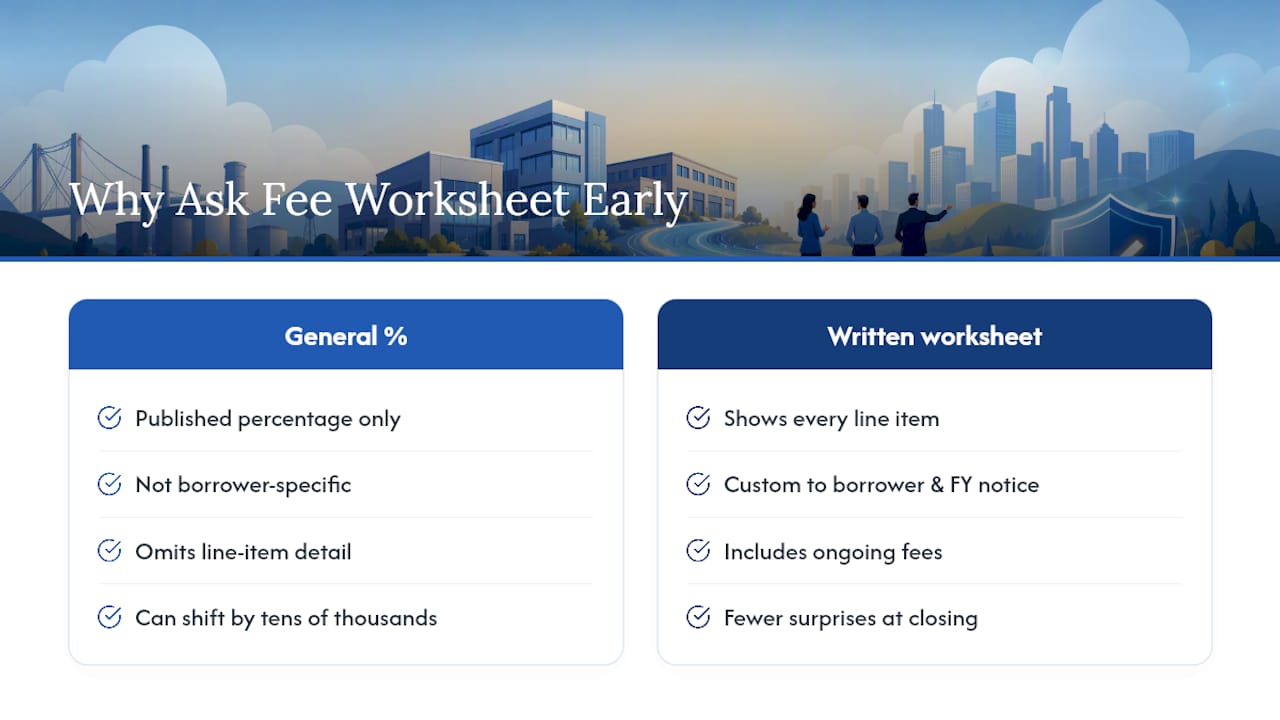
Many experienced SBA 504 lenders find that borrowers who ask for a written fee worksheet during pre-approval close with far fewer surprises than those who work off general percentages. That worksheet shows every line item, upfront and ongoing, before you commit.
Request a custom fee estimate before you sign a purchase contract, not after.
— PHENYX
Generic percentages tell you the shape of your costs. They don’t tell you your actual number, and that gap is exactly where borrowers get surprised at closing. A fee worksheet prepared during pre-approval lays out every SBA and CDC charge specific to your project, so you’re negotiating your purchase contract with real figures instead of estimates pulled from a fee sheet.

Two moves make sense right now. Run your numbers through the 504 loan calculator to get a starting estimate, then request a formal fee worksheet through Fbdc’s 504 loan process to see what your project actually costs once financing and closing fees are accounted for. Start with the SBA 504 loan program page to see current terms and down payment requirements before you talk to a lender.
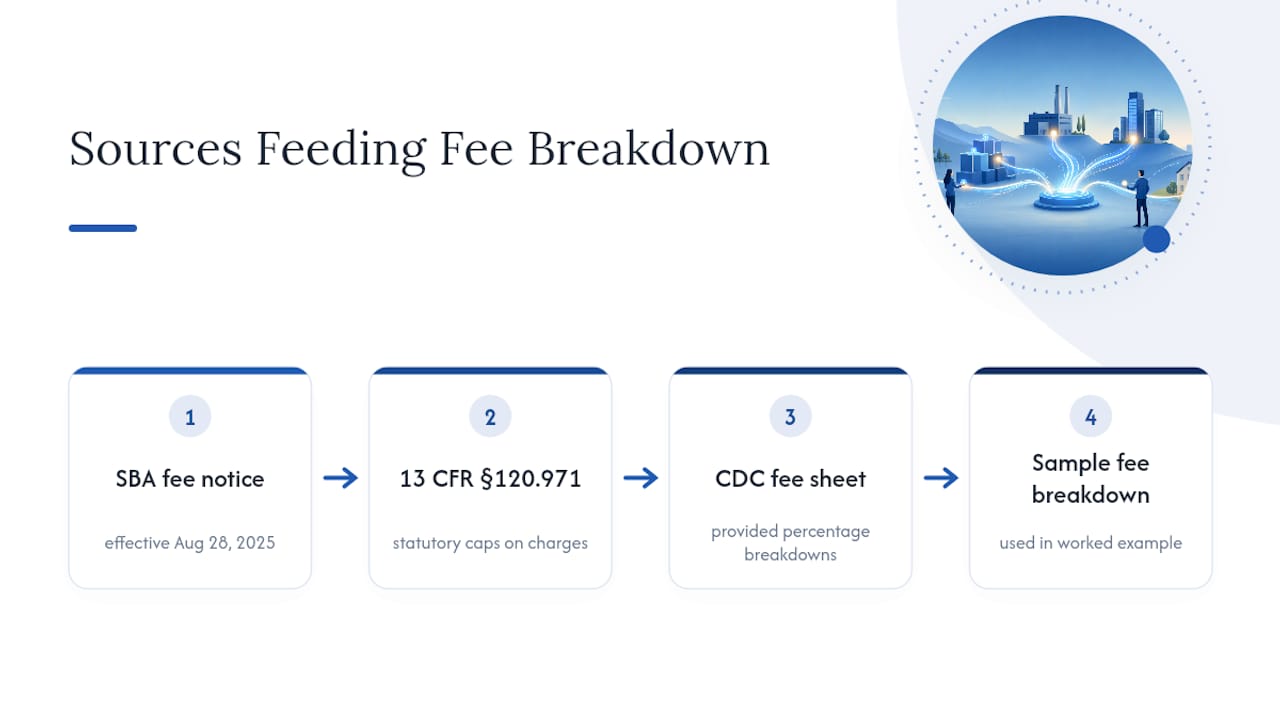
The FY2026 SBA fee notice, effective August 28, 2025, sets the current fee schedule. 13 CFR § 120.971 establishes the statutory caps on CDC processing and servicing charges. A CDC practitioner fee sheet supplied the sample percentage breakdowns used in the worked example above.
This article is general information, not a substitute for advice from a qualified financial advisor. Consult a qualified financial professional about your own circumstances before acting on anything here.

