.svg)
.svg)
.svg)

SBA 504 loans still cap out at $5 million per project for most small businesses, or $5.5 million for qualifying green and energy-efficiency projects. What changed in 2026 is the ceiling above that: eligible borrowers can now combine a 504 loan with a 7(a) loan for up to $10 million in total SBA-backed financing, effective July 4, 2026. Certified Development Companies (CDCs) still originate every 504 loan.
TL;DR:
- The new SBA rule allows borrowers to access up to $10 million in total SBA-backed financing by combining a 7(a) loan with a 504 loan, effective July 4, 2026.
- The SBA’s cap on the 504 debenture portion remains at $5 million for most small businesses and $5.5 million for energy-efficient projects, with project costs including land, construction, machinery, and soft costs.
- Qualification for the full $5 million (or $5.5 million green threshold) depends on business size, ownership, occupancy, and compliance with SBA size and affiliation rules.
- The separation of 7(a) and 504 programs means existing SBA debts no longer impact each other’s limits, enabling more flexible and larger financing strategies for capital-intensive businesses.
- The fixed-rate CDC debenture amortizes over 10 to 25 years, but actual borrowing capacity depends on lender standards such as loan-to-value ratios and debt-service coverage, not just program caps.
The standard 504 loan caps the CDC/SBA debenture portion at $5 million for most small businesses. Manufacturers and businesses completing energy-efficient or renewable-energy projects can qualify for a higher debenture, up to $5.5 million, when the project meets specific green criteria, such as reducing energy consumption by a set percentage or generating renewable energy on-site.
“Per project” means the total cost of land, building, construction, and equipment, not just the SBA-backed piece. A typical 504 stack looks like this: 50% from a bank or credit union as the senior lender, up to 40% from the CDC debenture, and 10% from the borrower as a down payment. On a $6 million facility purchase, the CDC portion alone might land at $2.4 million, well under the cap, while the total project cost drives your down payment and senior loan size.
What counts toward the project total:
The combined 7(a) and 504 exposure limit doubled from $5 million to $10 million, effective July 4, 2026. The SBA’s announcement decoupled the two programs so a qualified borrower can now access up to $5 million through a 7(a) loan and up to $5 million through a 504 loan at the same time, rather than having the two balances count against a single shared cap.
This matters most for capital-intensive businesses: manufacturers running several distinct 504 projects, hotel owners financing both a property and heavy equipment, and growing companies that need working capital from 7(a) alongside a real estate purchase through 504. Before this rule, a business that had already used $3 million of 7(a) exposure had less room left for a 504 project sharing the same combined ceiling. Now the two programs run on separate tracks up to their own $5 million caps.
If you’re planning a combined financing strategy, this is the moment to start mapping out which costs belong on the 504 side and which belong on 7(a), since the order you apply in can affect underwriting timelines.
Reaching the maximum limit on SBA 504 loans depends on more than the project cost. The SBA’s size standards and affiliation rules, laid out in 13 CFR Part 120, determine whether your business even qualifies as “small,” and affiliated companies under common ownership or control get aggregated together when the SBA calculates how much exposure a borrower group already carries.
Eligibility checkpoints that shape access to the full cap include:
If your company has multiple affiliates, each pursuing separate real estate or equipment projects, those loans typically aggregate toward the same borrower-group limit rather than each getting its own independent $5 million allowance.
Before July 2026, a borrower’s 7(a) and 504 balances often functioned as though drawing from the same well. A business carrying a $4 million 7(a) balance had comparatively little room left if it also needed 504 financing, since regulators and lenders evaluated combined SBA exposure conservatively. The 2026 rule change separates the two, giving each program its own $5 million lane up to the new $10 million combined ceiling.
Three scenarios show how this plays out:
Talk to your CDC before applying to either program. Sequencing matters: applying for 504 first often gives your senior lender clearer visibility into total debt service before a 7(a) request goes in behind it.
CDCs package the SBA/CDC portion of the debenture, coordinate with the senior lender on timing, and manage the paperwork that keeps a project inside program rules. That packaging role is where experienced CDCs earn their keep: phasing a large expansion into separate qualifying projects, routing an energy-efficient build toward the higher green project cap, or restructuring soft costs so a project fits cleanly under the standard limit.
FBDC has spent more than 35 years structuring 504 financing for Florida small businesses, with down payments as low as 10% and fixed rates that hold steady for the life of the debenture.
Pro Tip: If your project sits close to the $5 million standard cap, ask your CDC early whether an energy-efficiency upgrade could qualify the project for the $5.5 million green loan threshold instead of forcing a redesign later.
The CDC/SBA debenture portion of a 504 loan typically amortizes over 10, 20, or 25 years at a fixed rate set when the debenture is sold, which keeps your largest fixed cost predictable for the life of the loan. The senior lender portion, usually covering half the project, carries its own term and rate, often variable or fixed for a shorter period than the CDC piece.
A $5 million 504 cap on paper doesn’t always translate into $5 million a bank will actually fund. Loan-to-value limits and debt-service coverage requirements from the senior lender often shape borrowing capacity more than the SBA’s stated maximum does, which is why realistic project sizing matters as much as knowing the cap itself.
Getting from application to funding on a 504 loan generally follows a predictable path, though timelines shift with project complexity and how quickly documents come in.
Expect a CDC processing fee, an SBA guaranty fee, and costs for appraisals or environmental reports where required. Ask your CDC for its exact fee schedule before signing a letter of intent, since fee structures vary by project size and type.
The 504 refinancing program lets business owners refinance existing commercial real estate debt, and the same per-project caps apply here as they do to a purchase or new construction. A $5 million standard cap or $5.5 million green cap governs the CDC debenture whether the project is new financing or a refinance of an existing loan.
Refinancing eligibility depends on a few specific conditions the SBA built into the program. The existing debt generally needs to be at least two years old, and the business must have made payments on time for the preceding period. Cash-out refinancing for business expenses is allowed up to a portion of the property’s current appraised value, which means the loan-to-value math on a refinance can look different from a straight purchase.
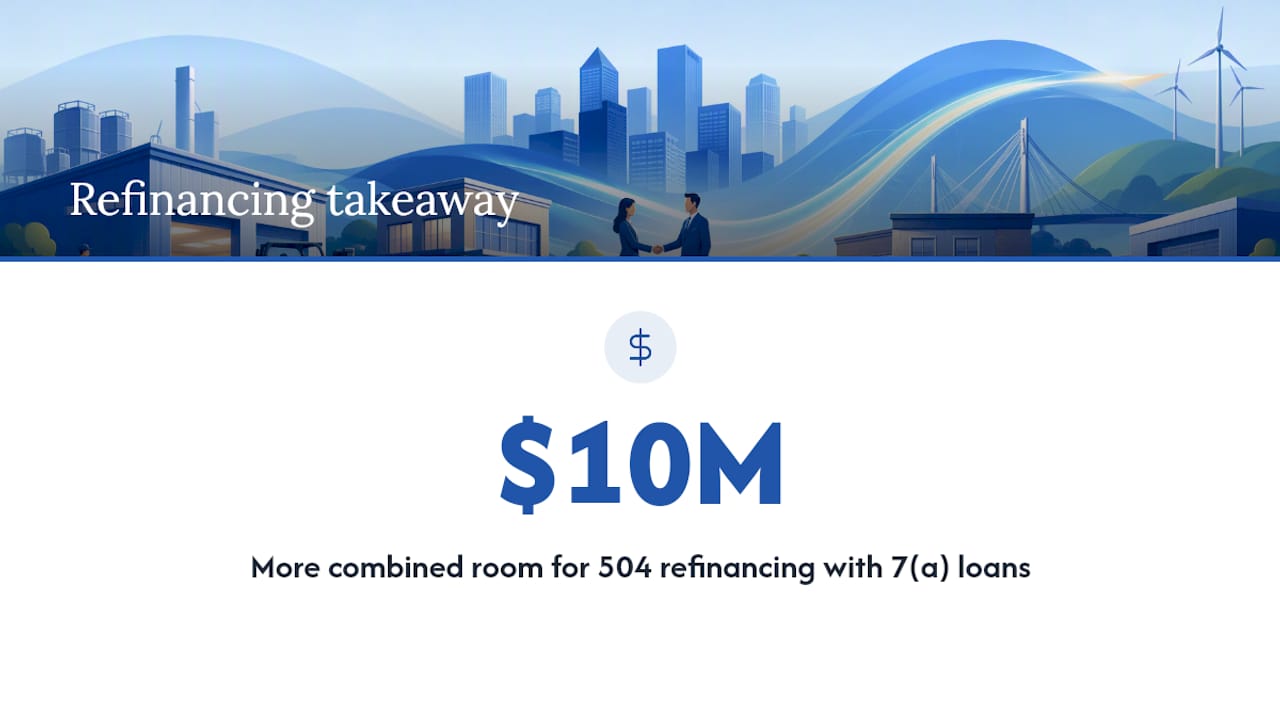
Where the new $10 million combined limit matters for refinancing is scale. A business refinancing an existing 504 debenture while also carrying or adding a 7(a) loan for equipment or working capital now has more combined room to work with than it did before July 2026. A manufacturer refinancing a $4.5 million facility loan under the standard cap, for instance, no longer has to worry that an existing 7(a) balance will crowd out that refinance the way it might have under the old combined ceiling.
One practical wrinkle: refinance projects sometimes qualify for a slightly different treatment of eligible debt versus new money, so the effective amount available for cash-out can be smaller than the headline project cap suggests. Work through the numbers with your CDC before assuming the full $5 million or $5.5 million cap translates directly into refinance proceeds.
A 504 loan is really three separate pieces stacked together, and understanding each one matters for knowing how the limits apply to your specific deal.
The senior lender portion, usually a bank or credit union, typically covers about 50% of total project cost and holds the first lien position on the collateral. This portion isn’t capped by SBA rules directly, since it’s not SBA-guaranteed, though the lender’s own underwriting standards set practical limits on size.
The CDC debenture is the SBA-backed second-lien piece, and this is where the $5 million standard cap (or $5.5 million green cap) actually applies. The debenture gets pooled with other CDC debentures nationally and sold to investors, which is how the program locks in a fixed rate for the life of the loan. This portion typically covers up to 40% of project cost, though it can run higher on some smaller or startup-related projects.
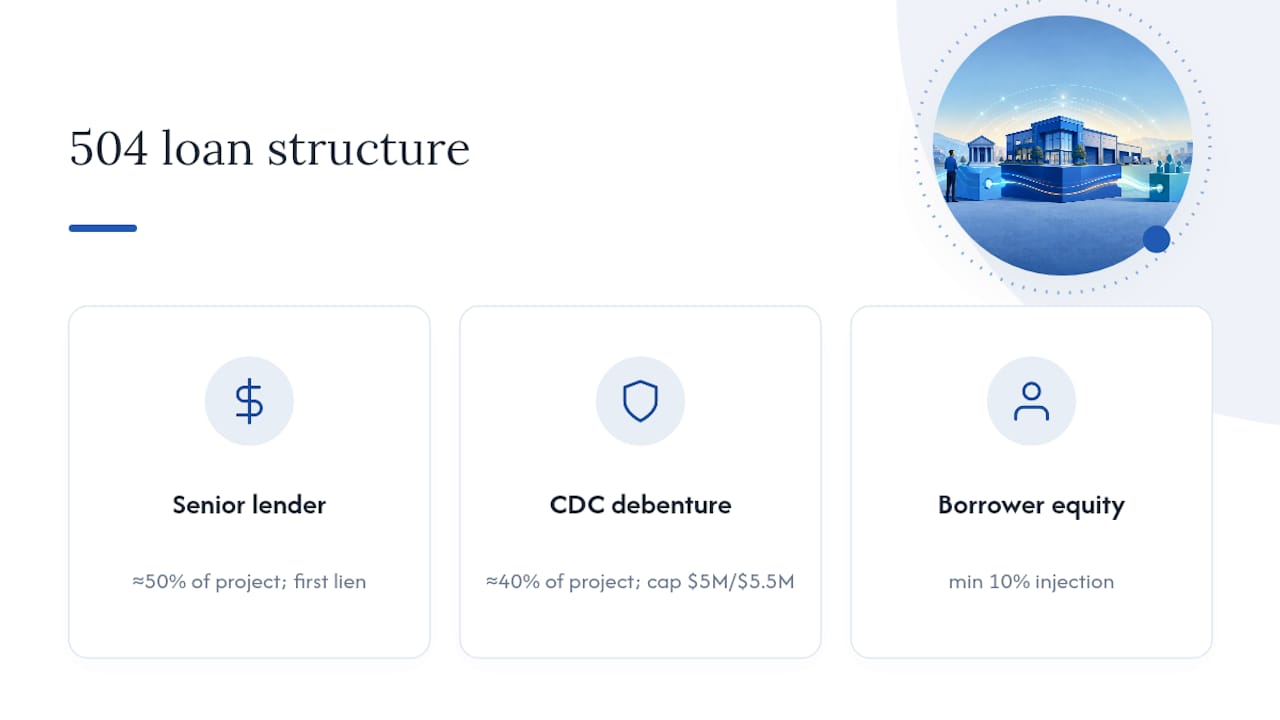
The borrower’s equity injection, usually a minimum of 10%, forms the third piece, and it’s this component that gives 504 loans their reputation for low down payments compared to conventional commercial real estate financing.
Knowing which piece the limit applies to matters when you’re structuring a large project. The $5 million or $5.5 million cap governs only the debenture, not the total project cost, so a $12 million facility can still work under 504 financing as long as the debenture piece itself stays under the cap and the senior lender covers the rest.
The 2026 rule change is a real opportunity for businesses outgrowing conventional financing, especially manufacturers and capital-intensive operators who’ve bumped against the old combined ceiling. That said, a bigger theoretical limit doesn’t change what your business can actually service. Match project scale to realistic cash flow and let your lender’s underwriting, not the SBA’s maximum, set the true boundary of what you borrow.
— PHENYX
More borrowing room only helps if a lender who knows the program is structuring the deal alongside you.
Whether you’re buying commercial real estate, purchasing equipment with a 10-year-plus useful life, or refinancing an existing property, an experienced CDC team can walk through your specific project against the current caps and figure out where the numbers land. Start by reviewing Fbdc’s 6-step 504 process or check your project against current SBA 504 program details for Florida borrowers, then reach out for an eligibility review before you lock in project plans.
This article is general information, not a substitute for advice from a qualified financial advisor. Consult a qualified financial professional about your own circumstances before acting on anything here.
Starting July 4, 2026, eligible borrowers can combine up to $5 million in 7(a) financing with up to $5 million in 504 financing for a total of $10 million in SBA-backed exposure, up from the previous $5 million combined ceiling.
The CDC/SBA debenture portion of a 504 loan amortizes over 10, 20, or 25 years at a fixed rate, depending on whether the financing covers equipment or real estate.
Yes. The SBA doubled the cumulative 7(a) and 504 exposure limit from $5 million to $10 million, effective July 4, 2026, decoupling the two programs so each carries its own $5 million cap.
The CDC debenture portion carries a fixed rate set when the debenture is sold, while the senior lender portion’s rate depends on that lender’s own underwriting terms; ask your CDC for current pricing on a specific project.
There’s no fixed number of 504 loans a business can hold, but affiliated companies and related projects generally aggregate toward the same borrower-group exposure limits under federal regulation.

