.svg)
.svg)
.svg)

Yes, you can prepay an SBA 504 loan, but you’ll almost always owe a prepayment premium if you’re still inside the penalty window. That premium declines every year and typically disappears after roughly ten years, with the exact cost set by the Certified Development Company (CDC) and Central Servicing Agent (CSA) based on your debenture rate and remaining term. Before you wire a single dollar, check three things: how many years remain on your penalty schedule, your official written payoff figure from the CDC, and the next semi-annual debenture date.
TL;DR:
- Paying off a 504 loan early incurs a declining prepayment premium that typically disappears after about ten years, depending on your specific note and terms.
- To avoid extra costs, schedule your payoff within the correct window, coordinate wire transfers precisely, and confirm the official payoff amount from your CDC in writing.
- The prepayment penalty is based on the CDC’s debenture portion, not the bank’s mortgage, and includes fees like CSA service charges, SBA guarantee fees, and accrued interest.
- Waiting until after a semi-annual debenture date or pursuing an SBA-approved refinance can significantly reduce early payoff costs.
- Confirm all details with your CDC before wiring funds, and request a detailed payoff estimate and timeline to prevent unexpected interest and fees.
Under eCFR § 120.940, a borrower who wants to prepay a 504 loan must pay the full principal balance, all unpaid interest, any outstanding fees, and any prepayment premium written into the note. The CDC then prepays the matching debenture, and investors in that debenture pool get repaid on a pro rata basis.
The penalty isn’t limited to a simple early payoff. Several borrower actions can trigger it:
Rare exceptions exist, sometimes tied to death or disability, but these are handled case by case. Your note and your CDC’s own servicing policies govern the specifics, so never assume a general rule applies to your loan without confirming it in writing.
The premium is tied to the CDC/debenture portion of your loan, not the bank’s first mortgage piece. It reflects the present value of the interest the debenture pool investors would have collected had you kept paying on schedule, per the SBA’s guidance on 504 loan terms.
Industry explainers commonly describe a declining percentage schedule that starts high in year one and phases toward zero by roughly year 10, though your note’s actual debenture rate and terms determine the real numbers. The premium generally follows a declining schedule, starting high in the first years and phasing toward zero by about year ten, though exact figures depend on your note’s actual debenture rate and terms.
Pro Tip: Ask your CDC for the exact declining schedule printed in your loan documents. Generic percentage tables online are illustrative, not your contract.
Your total payoff also includes several add-ons beyond the premium: CSA servicing fees, the SBA guarantee fee, the CDC’s monthly fee, accrued daily interest, and any outstanding late fees. Skip one of these and your wire will land short.
Getting an accurate number starts with your CDC. You can request an estimate up to six months ahead through CDC Online, and the CDC must eventually issue an official written payoff figure, not just a rough estimate. The SBA also directs borrowers toward the SBA Loan Portal for debenture-purchased loans and account status.
Timing matters more than most borrowers expect. Prepayment scheduling opens on the sixth business day of the month and closes on the third Thursday, and your CDC must submit the request to the CSA at least eight calendar days before that Thursday deadline.
Pro Tip: Coordinate your payoff for the month before a semi-annual debenture date. Missing that window by even a few days can force you into another half-year of interest, SBA fees, and CSA charges you didn’t need to pay.
Debentures settle on a semi-annual schedule, and prepaying the month before that date is the single biggest lever you control. Wait until just after a debenture date instead, and you’re locked into six more months of carrying costs for no benefit.
Beyond timing, you have three real paths forward:
Run the math before deciding: compare the penalty dollars against the interest you’d save, factor in closing or transaction costs, and get your written payoff figure locked in before wiring anything. If a sale is driving the payoff, make sure escrow and closing dates line up with the CDC/CSA scheduling window. Closing three days after the cutoff can turn a clean sale into an unexpected six-month fee hit.
Many CDCs have extensive experience working inside SBA 504 lending, and prepayment questions come up constantly, whether a client is selling a building, refinancing into better terms, or just weighing the math on an early payoff.
When a borrower calls about prepaying, the process typically looks like this:
The advice stays consistent: get your CDC’s written payoff before you plan around a number, ask directly about the semi-annual dates that affect your total cost, and confirm exactly where each fee gets assessed before you commit.
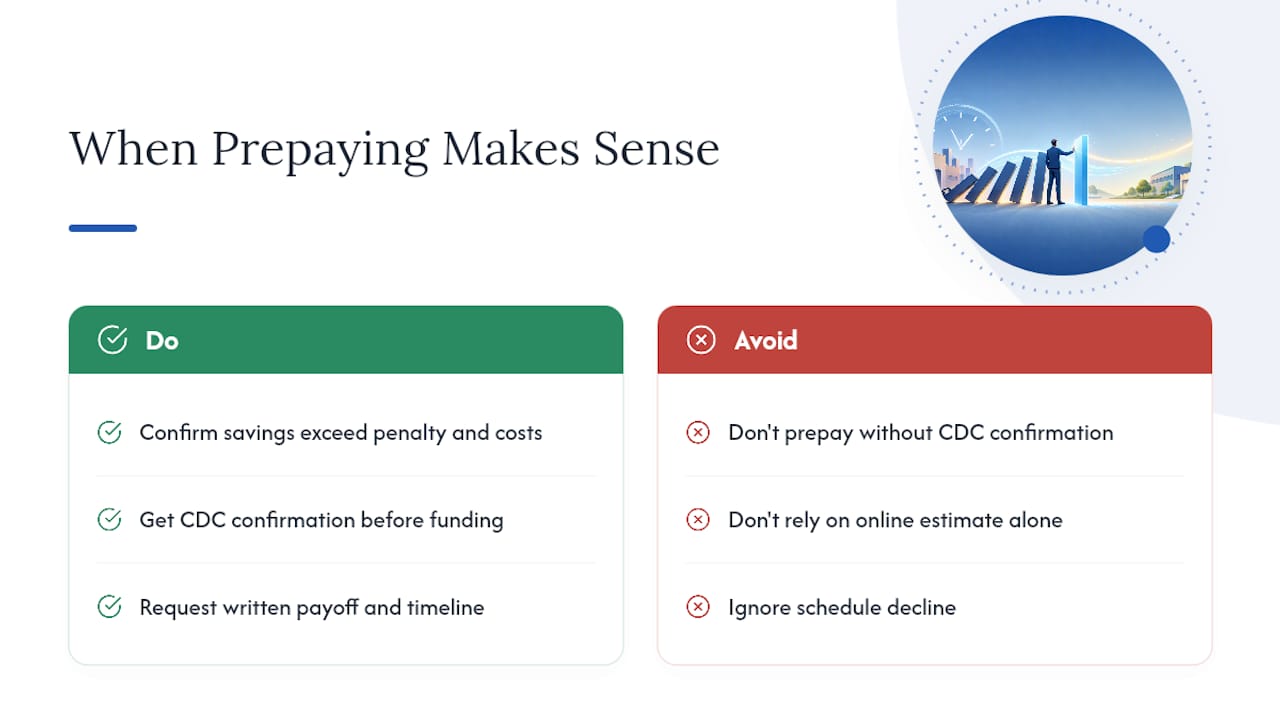
Prepaying makes sense when the interest you’ll save clearly outweighs the penalty and transaction costs combined, or when a sale or refinance is happening regardless of the penalty. Outside those cases, waiting for the schedule to decline usually wins.
Scheduling nuance trips up more borrowers than the penalty math itself. Get a second confirmation from your CDC before moving funds, not just an online estimate. Request a written payoff statement and an annotated timeline for your specific loan. That single document settles more disputes than any general rule ever will.
— PHENYX
Certain SBA 504 lenders can provide Florida small business owners with a faster path than guessing at payoff math or waiting on generic online calculators. They can prepare an itemized payoff figure that accounts for your debenture premium, CSA and SBA fees, and accrued interest, then map the timing against your next semi-annual debenture date so you’re not paying for six extra months you didn’t need.
If you’re weighing an early payoff against an SBA-approved refinance, our team walks through both options using your actual numbers, not a generic percentage table. Fbdc’s low down payments, long-term fixed rates, and hands-on guidance through our 6-step process have helped small businesses across Florida move through exactly this decision. Reach out for a payoff review, or start by exploring SBA 504 loan terms to see how refinancing might fit your timeline better than an outright payoff.

