.svg)
.svg)
.svg)
Yes: when your self-storage project meets SBA rules, an SBA 504 loan can finance acquisition, construction, renovation, or eligible refinancing with a low down payment and a long fixed term. The main trade-off is the CDC debenture’s 10-year prepayment penalty, which makes the program better suited to owners planning to hold and operate their facility rather than flip it. The Small Business Administration and CDCs like FBDC work together to deliver this financing.
TL;DR:
- SBA 504 loans are best suited for owners planning to hold their storage facilities long-term due to the 10-year prepayment penalty on the CDC debenture.
- Typical equity contribution ranges from 10% to 15%, with the maximum CDC-backed loan amount set at $5.5 million depending on project size.
- Eligibility requires active management and realistic occupancy projections; passive ownership structures without an operating company are often rejected.
- The financing structure includes a senior bank loan for about half the project, with fixed-rate CDC debentures covering roughly 35% to 40%, plus a small equity stake.
- The process requires early appraisal and environmental reports, and approval can take several months, especially for construction or conversion projects.
Self-storage owners use 504 financing across a wide range of project types, not just straightforward purchases. The program covers buying an existing facility, building new from the ground up, converting a non-storage property into storage use, renovating or modernizing an older facility, and refinancing qualified existing debt. Compared to conventional commercial loans, 504 financing often wins on equity requirements and rate stability: borrowers put down less cash up front and lock in a fixed rate on the CDC portion for the life of the loan.
A stabilized purchase typically moves faster through underwriting because occupancy and income are already established. Ground-up construction takes longer, since the CDC and lender need to evaluate lease-up projections before committing.
Eligibility starts with SBA’s standard rules: the business must be for-profit, meet SBA size standards, and intend to occupy at least 51% of the property for new construction or 60% for existing buildings. Many self-storage owners hold real estate through an Eligible Passive Company (EPC) while an Operating Company runs the business, a structure that eCFR regulations permit as long as the Operating Company guarantees the loan and the lease meets SBA’s subordination rules.
CDCs generally expect a documentation package that includes:
Red flag: passive, rental-only ownership without an active Operating Company guarantor is one of the most common reasons CDCs decline a self-storage application, along with thin occupancy projections and missing appraisals.
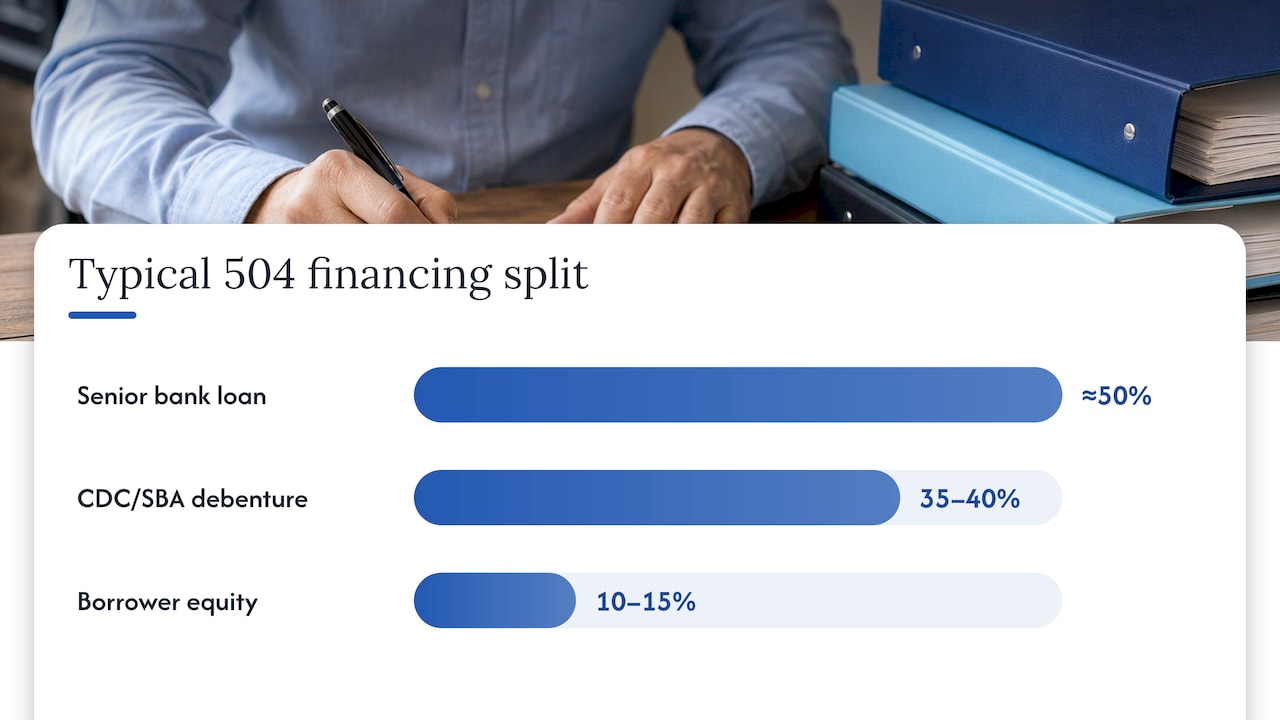
A standard 504 deal is a three-part financing stack. A bank or credit union typically funds around 50% of the project as a senior loan, the CDC/SBA debenture covers roughly 35% to 40%, and the borrower contributes the remaining equity. Industry guidance for self-storage operators puts typical borrower equity at about 10%, rising to 15% for newer businesses or those in specialized property types.
The maximum CDC-backed portion is $5.5 million, with repayment terms available at 10, 20, or 25 years depending on the asset financed. Fees on the CDC side typically include a debenture financing fee rolled into the loan itself, CDC closing costs, and an ongoing annual service fee, all disclosed before closing.
The debenture’s fixed rate protects against market swings over the life of the loan, but it carries a prepayment penalty that declines over the first 10 years. Selling or refinancing early in that window can mean paying a meaningful premium, so the structure rewards owners who plan to hold.
Most self-storage owners start by contacting a local CDC or an SBA resource partner for an initial feasibility conversation before approaching a bank.
Appraisals and environmental reports are the most common sources of delay, especially for construction or conversion projects where the property’s prior use requires extra review. A straightforward purchase can close in a few months; ground-up construction often takes longer because of permitting and lease-up underwriting.
Pro Tip: Order your appraisal and any required environmental report as soon as you have a signed purchase contract or construction budget, since these reports routinely set the pace for the entire approval timeline.
The 504 program’s biggest advantages for storage owners are a lower initial equity requirement, a fixed long-term rate on the CDC portion, and the ability to finance site improvements and many soft costs alongside the real estate itself, while understanding insurance requirements for commercial real estate helps mitigate lender risk. The tradeoffs are real too: 504 proceeds cannot cover working capital, approval takes longer than a conventional commercial loan, and the CDC debenture carries that 10-year prepayment penalty.
Recent program updates have simplified refinancing rules, making it easier for self-storage owners to consolidate qualified debt into 504 financing. Refinance eligibility still depends heavily on current debt service coverage and occupancy, so owners should model their exit scenario before applying. If you expect to sell within five to seven years, weigh the prepayment penalty carefully against the rate savings.
A CDC that has closed self-storage deals before brings three practical advantages: it knows how to structure financing stacks around lease-up risk, it has relationships with senior lenders comfortable with storage as a property type, and it manages documentation in a way that avoids the back-and-forth that slows other applications down.
FBDC brings more than 35 years of experience in SBA 504 lending, with down payments as low as 10% and long-term fixed rates on the CDC portion. Its stated focus is a faster, more streamlined process with direct guidance from experienced staff throughout the loan.
Before committing to a CDC, ask about its experience with storage properties specifically, its typical timeline from application to closing, how its fees are structured, and whether it offers bridge financing to cover timing gaps during construction or lease-up.
The biggest misread on this program is treating it as a generic commercial real estate loan with a better rate. It is really a hold-and-operate instrument, and the 10-year prepayment penalty on the CDC debenture is the clearest signal of that design. Owners who plan to sell or refinance within a few years often chase the low down payment without pricing in what an early exit actually costs them.
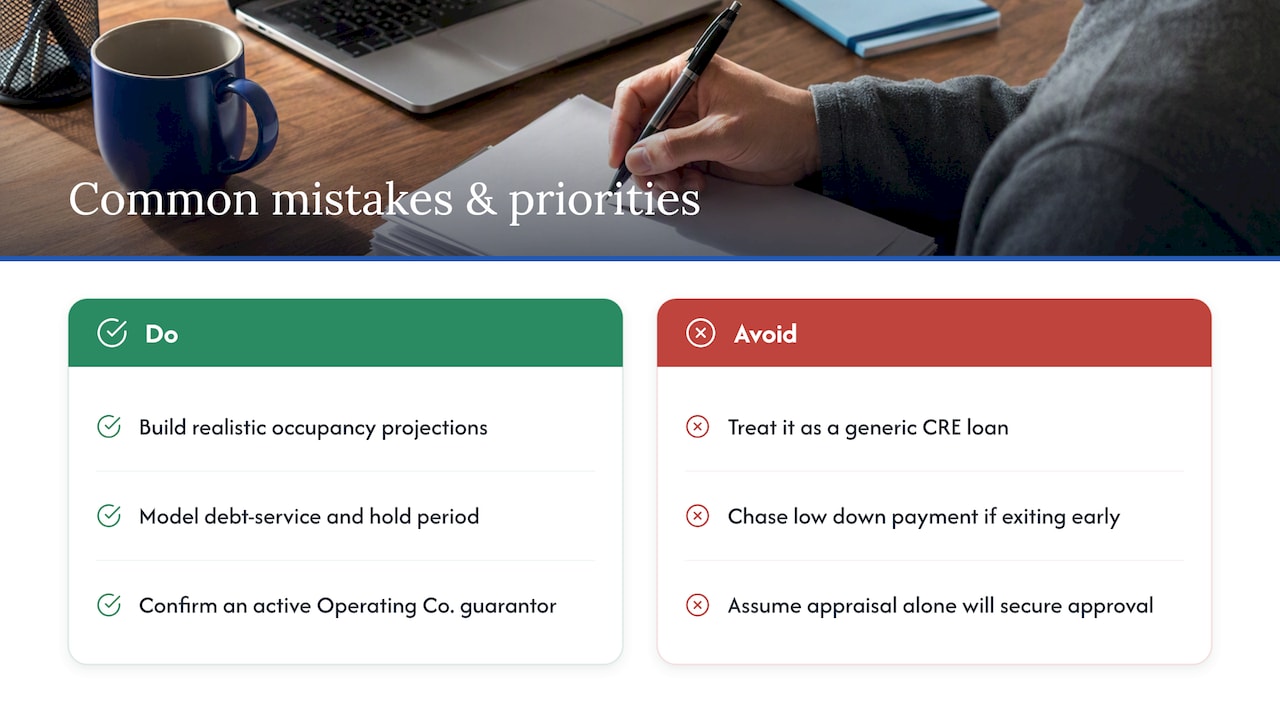
The second miscalculation is underestimating the documentation burden around occupancy and management experience, especially for EPC structures where a passive owner needs an active Operating Company guarantor. Borrowers who assume a strong appraisal alone will carry the application are often surprised when thin lease-up projections stall underwriting.
If you are serious about this financing, prioritize two things before you ever contact a CDC: build a realistic occupancy and debt-service projection, and decide honestly whether your hold period matches the program’s structure. Everything else in the process moves faster once those two answers are settled.
— PHENYX
FBDC specializes in SBA 504 lending for small business owners who want to acquire, build, renovate, or refinance self-storage real estate with less cash up front than a conventional loan requires. 
Before reaching out, gather your tax returns, a property appraisal or construction budget, and occupancy projections. Visit the SBA 504 Loan Program page to see program details and approximate fees, or start a conversation about your project today.
This article is general information, not a substitute for advice from a qualified financial advisor. Consult a qualified financial professional about your own circumstances before acting on anything here.
Yes, SBA 504 loans can finance the purchase, construction, or renovation of self-storage facilities when the borrower meets SBA eligibility rules. The SBA’s own program page confirms these loans are designed for major fixed assets like commercial real estate.
Industry guidance for self-storage operators puts typical borrower equity at around 10%, with newer businesses sometimes required to put down 15%. The exact figure depends on the CDC’s underwriting of the specific project.
Yes, the CDC debenture portion carries a prepayment penalty that applies for the first 10 years of the loan and declines over that period. This makes the program better suited to owners planning a longer hold rather than a quick resale.
No, 504 financing does not cover working capital, so owners need a separate plan for operating cash during initial lease-up. Many borrowers pair 504 financing with a bridge loan to manage this gap.
The maximum CDC-backed portion of a 504 loan is $5.5 million, with repayment terms available at 10, 20, or 25 years. The total project size can be larger once the senior lender’s portion and borrower equity are added in.

