.svg)
.svg)
.svg)

Startups can qualify for an SBA 504 loan, but the path is narrower than it is for established businesses. The loan must run through a Certified Development Company, and funds can only cover major fixed assets, not day-to-day working capital. Contact a CDC early to confirm your project fits before you invest in appraisals or projections.
TL;DR:
- Startups must use a Certified Development Company and focus on fixed assets; they cannot use funds for working capital, inventory, or refinancing.
- The borrower contribution for startups is typically at least 15 percent of project costs, with higher requirements if the property is special-purpose or if both conditions apply.
- Applications rely heavily on management experience, detailed financial projections, and documented financials, since startups lack operating history.
- The loan structure involves a third-party lender providing about 50 percent, a CDC debenture covering up to 40 percent, and the startup contributing 10 to 20 percent, depending on circumstances.
- Pre-application consultation with a CDC and thorough documentation prevent delays, while non-asset uses and unstructured borrowed contributions are common reasons for rejection.
Before you build a full application package, run your business through the basic eligibility filters the SBA applies to every 504 project. Most rejections at this stage come from mismatched business type, size, or use of funds rather than weak financials, so this is worth ten minutes before you call anyone.
The 504 loan program is open to for-profit businesses that operate in the United States and fall within SBA size standards, generally a tangible net worth under $20 million and average net income under $6.5 million after taxes for the preceding two years. A startup that meets these thresholds is treated the same as an established business on the size test; the difference shows up later, in how much cash you need to bring to the closing table.
The SBA defines a startup, for 504 purposes, as a business that has operated for two years or less. That label triggers the higher contribution requirement described in the next section, and it also means CDCs will scrutinize your management background and projections more closely since there is little or no operating history to lean on.
Some business types and project uses are excluded outright, regardless of how strong the founder’s credit looks:
If your project clears these filters, the next real question is how much cash you need to bring, and that depends on whether your business counts as a startup or your property counts as special-purpose.
The equity injection is where startup 504 deals diverge most sharply from standard ones. Federal regulations set the baseline and the exceptions in plain terms, and CDCs apply them without much flexibility because they are not internal lending policy, they are the law.
Borrower contribution under 13 CFR §120.910 is typically around one-tenth of total project costs for a standard applicant, higher for startups or special-purpose properties, and higher still when both conditions apply at once, per the eCFR text. A special-purpose property is one with a limited alternative use, such as a hotel, gas station, or manufacturing plant built around specialized equipment.
Contributions can come from cash, land already owned free and clear, or other owned assets that the CDC and lender accept as equity. When part of the contribution is borrowed rather than coming from the founder’s own funds, SBA rules require that loan to be subordinated to the 504 financing and repaid no faster than the 504 debenture itself. A borrowed down payment that repays on an aggressive schedule, or one that sits in a senior lien position, will typically disqualify the project until it is restructured.
Documentation matters as much as the amount. CDCs want to see:
Founders short on seasoned cash are not automatically out of options. Down payment assistance programs exist specifically to bridge this gap, a point worth returning to later in the application process rather than treating the equity requirement as a wall.
A 504 project is never a single loan. It is a three-party structure, and understanding who provides what helps explain why the CDC relationship matters from day one.
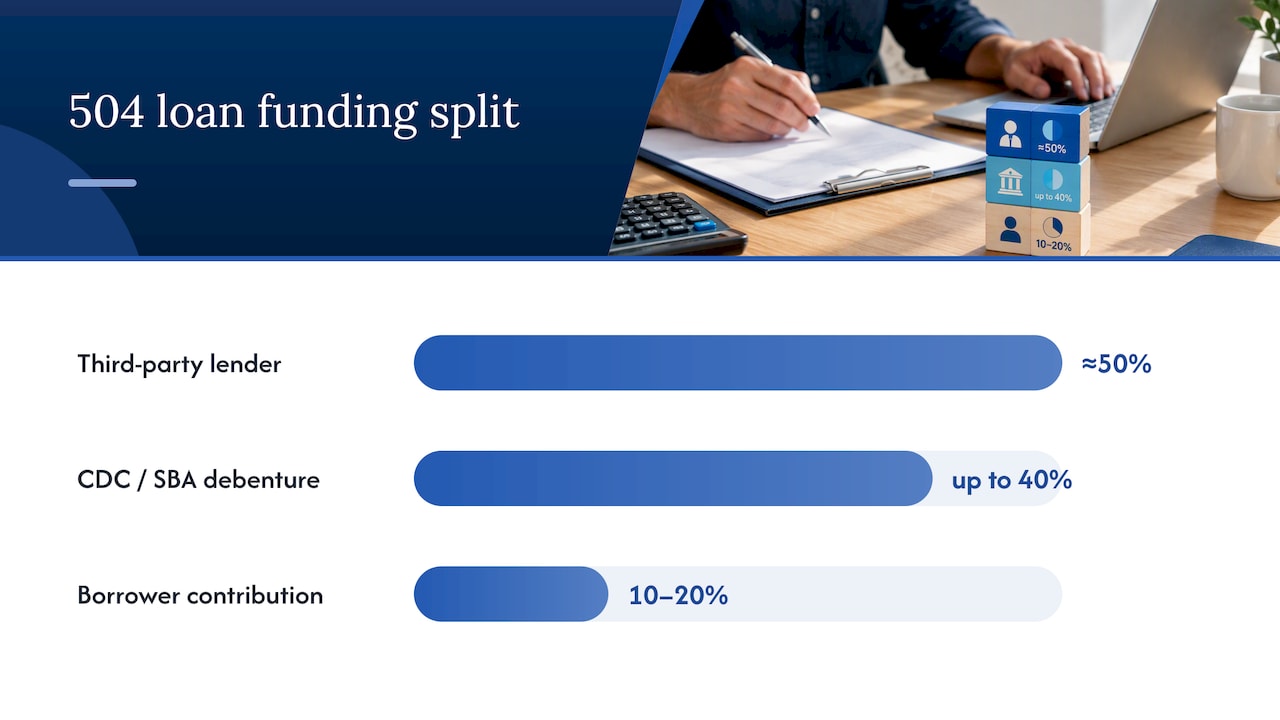
A typical project splits financing roughly as follows: a third-party lender, usually a bank, provides about 50% of project costs in first-lien position; a CDC debenture backed by the SBA covers up to 40%, per SBA guidance; and the borrower contributes the remaining 10% to 20%, depending on startup and special-purpose status. The debenture portion carries a long-term, fixed interest rate, which is one of the program’s core appeals for a business trying to lock in predictable payments on a building or major equipment purchase.
CDCs are not optional intermediaries, they are the only door into this program. 504 loans are available exclusively through Certified Development Companies, nonprofit organizations certified by the SBA to package applications, coordinate with the senior lender, and submit the finished file through the SBA’s E-Tran system for authorization. A CDC’s responsibilities include:
For a startup, the smartest first move is a conversation with a CDC before drafting a business plan or ordering an appraisal. A CDC that works 504 deals regularly can tell you within a short call whether your project, your industry, and your contribution level are likely to clear underwriting, which saves weeks of work on a package that was never going to qualify.
Without two or three years of tax returns to point to, a startup’s application leans heavily on the strength of its people and its numbers on paper. CDCs and senior lenders weigh these in a fairly consistent order.
Pro Tip: Build your cash flow projection around a conservative revenue ramp and a clearly marked breakeven month, CDCs read overly optimistic month-one revenue as a red flag rather than a selling point.
The paperwork for a 504 loan is standardized, and knowing the shape of it before you start saves a lot of back-and-forth with your CDC. The core application runs through SBA Form 1244, which organizes the file into numbered exhibits.
For a brand-new business, the pro forma balance sheet and monthly cash flow exhibits carry more weight than they would for an established applicant, since they are effectively standing in for history the company has not had time to generate. Keep files organized by exhibit number from the start. CDCs upload the finished package into E-Tran, and a well-labeled file set is one less thing standing between your application and a clean first submission.
A 504 application moves through a predictable sequence, though startups often need extra time at the front end to firm up projections and management documentation.
Packaging time varies with how complete the applicant’s financials are at the outset, which is the main reason startups should expect a longer runway than an established business with three years of clean tax returns. On the cost side, budget for a CDC processing fee, third-party lender fees, appraisal and environmental report costs, and closing costs tied to the debenture, all of which your CDC can itemize once your project scope is set.
Most rejected or delayed startup applications trace back to a small set of avoidable errors.
Pro Tip: If your projections and your tax returns tell slightly different stories, reconcile them with a one-page explanation before your CDC asks, it reads as organized rather than evasive.
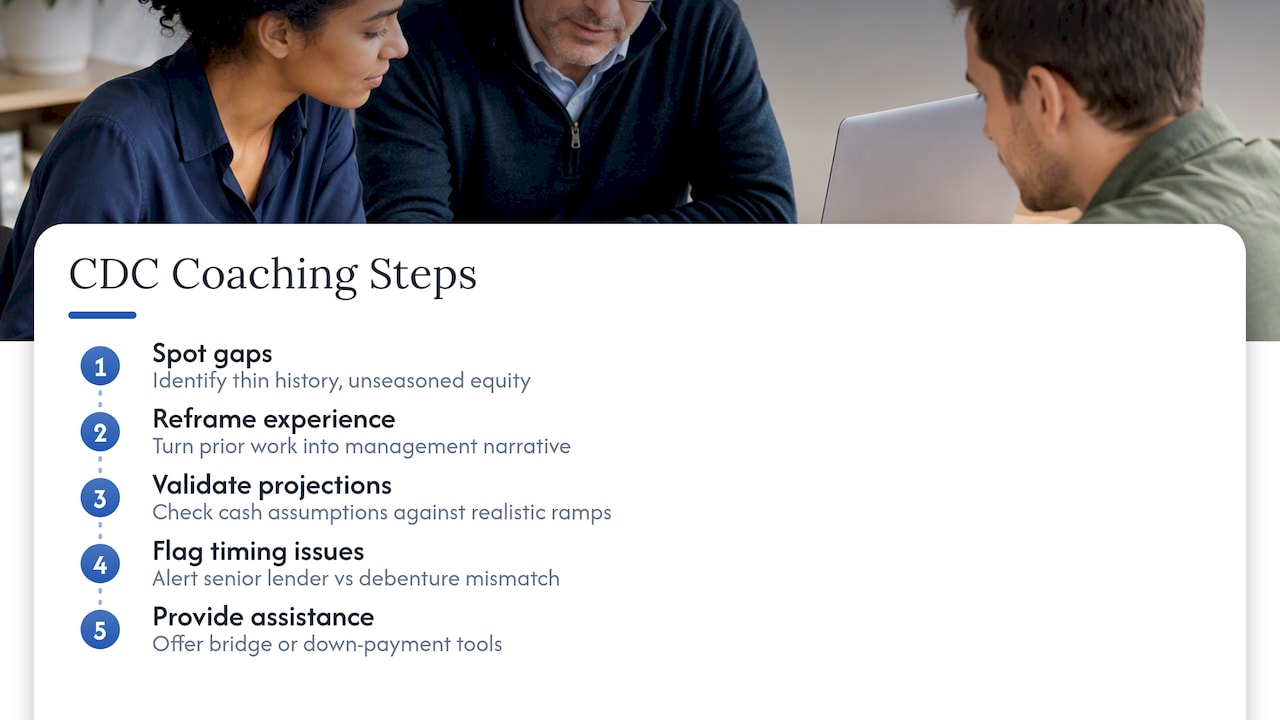
A CDC that has packaged hundreds of 504 projects over decades tends to spot a startup’s weak points before the applicant does. Some CDCs have specialized in SBA 504 lending for decades, helping founders navigate gaps such as thin management history, unseasoned equity, and projections that do not yet reconcile with tax returns.
In practice, that coaching looks like helping a founder reframe prior work experience into a credible management narrative, checking cash flow assumptions against realistic ramp periods before they go into the CDC memorandum, and flagging a timing mismatch between senior lender funding and debenture closing early enough to address it. When a borrower’s contribution is short on seasoning or needs a temporary bridge, a CDC with bridge and down payment assistance tools on hand can often keep a deal moving instead of sending the founder back to raise more cash from scratch.
— PHENYX
Startups weighing a 504 loan often need more than the core financing, they need help closing specific gaps between what they have saved and what the project requires. FBDC’s SBA 504 Loan Program is the primary path for acquiring real estate or heavy equipment with a fixed rate and a contribution as low as 10% for qualifying projects. For founders whose contribution falls short on seasoning, the Down Payment Assistance Program helps bridge that gap, and the FBDC 504 Velocity Bridge Loan Program covers timing gaps between senior lender funding and debenture closing.
Relevant FBDC options for startup borrowers include:
If your project involves real estate or equipment with at least a 10-year useful life, it is advisable to reach out to a CDC to confirm fit before you commit time to a full application package.
For founders also firming up business formation paperwork before applying, Legal Stepz walks through the basic steps of getting a new business properly documented.
This article is general information, not a substitute for advice from a qualified financial advisor. Consult a qualified financial professional about your own circumstances before acting on anything here.
A 504 loan is more document-intensive than a typical bank loan because it requires a complete exhibit package, a CDC review, and SBA authorization, but it is a standard, well-established program rather than an exotic one. Startups face a steeper path specifically because of the higher contribution requirement and the need to prove management strength without years of operating history.
Startups can qualify for both 504 and 7(a) loans, though lenders scrutinize management experience and projections more closely given limited financial history. The 504 program adds a specific hurdle: a 15% minimum contribution for startups, rising to 20% if the property is also special-purpose, under SBA regulations.
504 fees typically include a CDC processing fee along with third-party lender and closing costs tied to the debenture sale, and the exact breakdown varies by project and lender. FBDC lists approximate fees for its SBA 504 Loan Program on its program page.
The standard borrower contribution is 10% of total project costs, rising to 15% for startups or special-purpose properties, and 20% when a project is both a startup and special-purpose, as set out in 13 CFR §120.910. Founders short on seasoned cash can look at down payment assistance options to help close that gap.

