.svg)
.svg)
.svg)

A triple net (NNN) lease pushes property taxes, insurance, and common area maintenance onto the tenant, on top of base rent. A gross lease folds all of that into one predictable payment the landlord manages. For most small businesses, gross wins on budget certainty. NNN only makes sense if you can negotiate caps, secure audit rights, and actually control the underlying costs.
TL;DR:
- Landlords often estimate expenses conservatively; tenants should request past reconciliation statements to assess true year-end liabilities.
- CAM, property taxes, and insurance pass-throughs in NNN leases can lead to unpredictable costs exceeding initial forecasts, especially without caps.
- Comparing lease offers requires building detailed all-in cost projections over multiple years, including expense escalations, not just based on base rent.
- Longer NNN lease terms typically come with limited flexibility, making shorter gross or modified leases more suitable for businesses needing adaptability.
- Ownership through SBA 504 loans can offer more cost stability and asset-building advantages than leasing, especially for long-term, cash-flow positive small businesses.
The dividing line between these lease types comes down to one question: who writes the check for taxes, insurance, and building upkeep? There are three main structures you’ll run into as a small business tenant, and the differences show up expense by expense.
A full-service gross lease has the landlord covering property taxes, insurance, common area maintenance (CAM), utilities, janitorial service, and structural repairs. You pay one number every month. Simple, but that simplicity is priced in.
A modified gross lease splits the load. Tenants often take on utilities and janitorial for their own space, while the landlord still covers taxes, insurance, and major structural items. Many modified gross deals use a “base year” (more on that below) to cap how much the tenant absorbs.
A triple net (NNN) lease flips the model. You pay base rent plus your pro-rata share of taxes, insurance, and CAM. In many NNN deals, tenants also cover their own janitorial and interior repairs, while structural repairs and capital expenditures should stay with the landlord, though that split depends entirely on the lease.
Here’s the item-by-item reality:
None of these labels are legally binding definitions. The lease document controls exactly who pays for what, including every carve-out and exclusion buried in the CAM section. Two leases both labeled “NNN” can produce wildly different tenant costs depending on how broadly the landlord defines maintenance.
Every NNN and modified gross lease runs on the same basic mechanic: your landlord estimates annual expenses, bills you monthly, then reconciles against actual costs once the year closes.
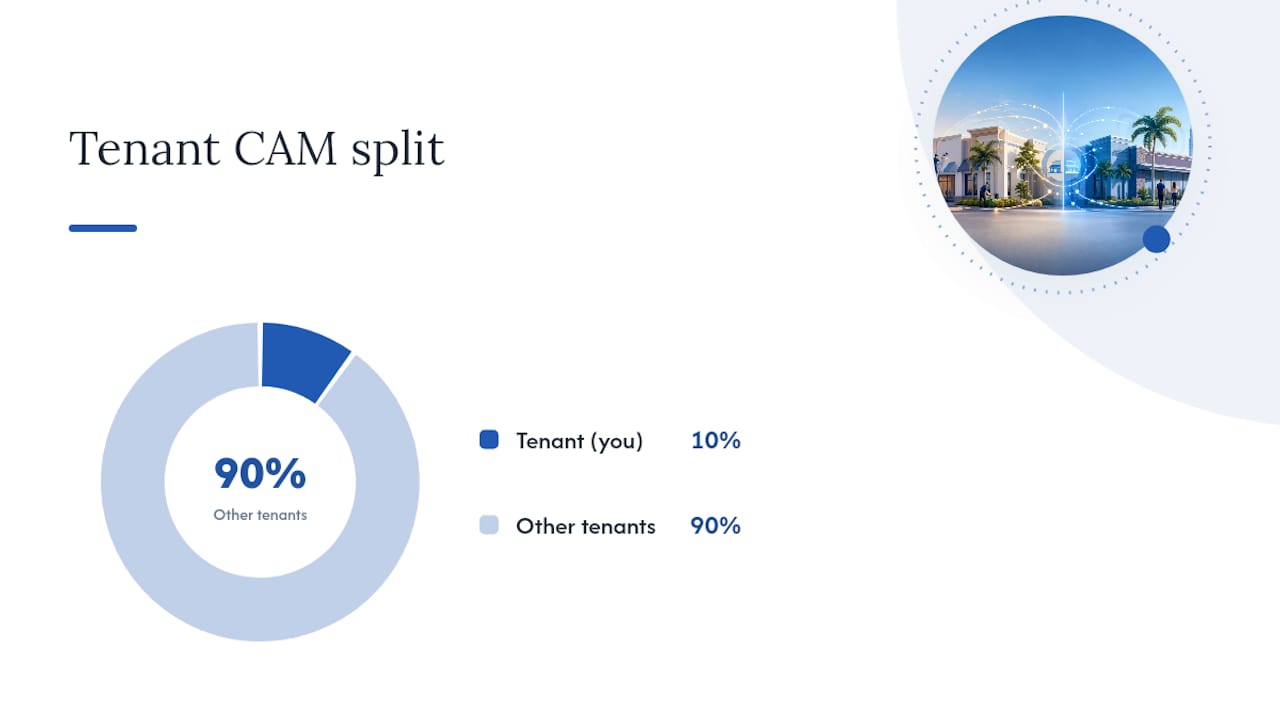
Say your 5,000 square foot space carries a 10% pro-rata share of the building. If the landlord budgets $60,000 in CAM, taxes, and insurance for the property, your monthly estimate lands around $500. That’s the number on your invoice. It is not the number you’ll owe.
Here’s the sequence that catches tenants off guard every year:
If actual costs run higher than projected, you get a bill, sometimes a large one, months after the fact. That gap is exactly where insider CAM practice tends to create surprise year-end charges, especially when the CAM definition is broad enough to sweep in property management fees or major repairs.
Modified gross leases limit this exposure through a base year. The landlord agrees to cover expenses up to the base year level, and you only pay increases above that baseline. It’s a meaningful buffer, but only if you get base-year documentation in writing before signing.
Watch for gross-up clauses too. If a multi-tenant building runs at partial occupancy, landlords often “gross up” CAM as if the building were fully leased, which inflates the per-tenant share beyond what a fully occupied building would generate. This is standard practice, but it needs a cap.
Pro Tip: Ask for the last two reconciliation statements, not just the current estimate. A landlord’s track record of over- or under-projecting tells you more about your real exposure than the marketing sheet ever will.
A triple net (NNN) lease quote often shows a lower base rent per square foot than a comparable gross lease quote, but that does not guarantee lower total cost. That NNN number is base rent only, and total occupancy cost requires adding taxes, insurance, and CAM before you can compare anything fairly.
Here’s a worked example for a 5,000 square foot space, comparing a full-service gross lease against a modified gross lease and an NNN lease, all quoted for the same market:
That $12 NNN quote, which looked like the deal of the year, actually lands slightly above the gross alternative once pass-throughs are added. And that’s Year 1.
Run the same numbers forward with expense growth. Property tax reassessments, insurance renewals, and CAM increases rarely stay flat. Model a modest 4% annual growth in pass-through costs on the NNN lease over five years, while the gross lease rent escalates at a fixed 3% contractual bump:
A gross lease premium of 25% to 40% over comparable NNN base rent exists specifically because landlords price in the operating cost risk they’re absorbing. You’re paying for certainty. Whether that premium is worth it depends on how aggressively local operating costs are climbing, and how well your NNN lease caps controllable expenses.
The core statistic to remember: a small gap in annual expense growth, even one or two percentage points, compounds fast enough over a 3 to 5 year term to erase the entire headline savings of a lower NNN base rent.
CAM caps and negotiated exclusions change this math substantially. A lease with a 5% annual cap on controllable CAM increases, and capital expenditures explicitly carved out, behaves nothing like an uncapped lease with a broad maintenance definition. Same label, very different five-year bill.
The right lease depends less on the label and more on your business’s cash flow profile and appetite for risk.
Gross leases favor tenants who need predictability. Startups, seasonal businesses, and anyone managing tight monthly cash flow benefit from one number they can plan around. There’s no reconciliation surprise, no CAM audit to chase, and no exposure to a landlord’s insurance renewal spike. That predictability comes at a rent premium, but for many small businesses the premium is worth the peace of mind.
NNN leases favor tenants who can manage or influence costs, and who have the negotiating leverage to secure real protections. A creditworthy, long-term tenant with a strong balance sheet can often negotiate a lower headline rent and accept the variable cost exposure, especially in a stable market where taxes and insurance aren’t spiking.
Common traps that turn an NNN lease into a bad deal:
Pro Tip: Before signing anything labeled NNN, ask specifically whether capital expenditures are excluded from CAM. If the answer is vague, that’s your first red flag.
Modified gross exists precisely because most tenants want something between full predictability and full exposure. It’s a negotiated middle ground, and the base year documentation is the single most important attachment to review before you sign.
Comparing a gross quote against an NNN quote by base rent alone is the single most common mistake small business tenants make. Here’s the process that actually works.
Negotiation priorities, in order of impact:
| Red flag | Why it matters |
|---|---|
| No CAM cap on controllable expenses | Costs can rise without limit each year |
| No audit rights | You can’t verify what you’re being billed |
| Vague or absent maintenance definition | Opens the door to capital expense pass-throughs |
| No base-year documentation (modified gross) | You can’t calculate real future exposure |
| Unlimited gross-up with no occupancy floor disclosed | CAM inflates artificially in a partly vacant building |
Walk away, or push back hard, if a landlord won’t provide reconciliation history or refuses audit rights outright. That refusal alone tells you how the next five years are likely to go.
Tax treatment differs for landlords and tenants under gross and NNN structures, and it’s worth understanding before you assume one is automatically better for your bottom line.
For landlords, a gross lease means they carry the operating expense burden directly, but they also get to deduct those costs (taxes, insurance, maintenance) as ordinary business expenses against rental income. Under an NNN lease, the landlord passes those costs through, which simplifies their tax position but also reduces the deductions flowing through their side of the ledger since the tenant is footing the bill directly.
For tenants, rent paid under a gross lease is typically a straightforward deductible business expense on the income statement. Under NNN, the base rent is deductible, and so are the pass-through payments for taxes, insurance, and CAM, since these function as additional rent for tax purposes. The total deduction ends up similar either way; the difference is more about cash flow timing than net tax benefit.
Where it gets more interesting is ownership. If you’re evaluating whether to keep leasing at all, buying property changes the tax picture entirely, opening up depreciation deductions and interest expense write-offs that neither lease structure offers a tenant. That’s a separate calculation from lease-type comparison, but it’s one worth running in parallel if your occupancy costs keep climbing year after year.
The lease structure you sign determines who calls the repair company when the HVAC dies at 2 a.m., and that operational reality matters as much as the dollar figures.
Under a full-service gross lease, the landlord’s property management team handles everything: routine maintenance, capital repairs, vendor relationships, and building systems. You call the front desk or property manager, not a contractor. That convenience is baked into the rent premium.

Under a triple net lease, tenants often take on more direct responsibility, particularly for their own suite’s interior repairs and sometimes for HVAC units serving their space exclusively. Structural elements, roofs, and shared systems generally stay with the landlord, but “generally” is the operative word. Some NNN leases push more onto the tenant than others, especially in single-tenant net lease deals where the tenant effectively manages the building as if they owned it.
This distinction changes your staffing and vendor relationships. A retail tenant used to a full-service gross building suddenly signing an NNN deal for a freestanding location needs to line up its own HVAC contractor, landscaping service, and janitorial staff, none of which the old lease required. Budget for that operational shift, not just the cost shift, because the time and management burden is real even when the dollar amounts are modest.
Lease structure preference tends to track property type and tenant business model more than geography or company size alone.
Retail and restaurant tenants, especially in freestanding buildings, single-tenant pads, and national chain locations, gravitate toward NNN leases. Retailers with predictable, stable operations and enough scale to negotiate CAM caps often accept the variable cost exposure in exchange for lower headline rent across a large real estate portfolio.
Office tenants, particularly smaller professional services firms (law offices, accounting practices, medical offices in multi-tenant buildings) lean toward gross or modified gross leases. These businesses often share a building with other tenants, want predictable monthly costs for budgeting, and don’t have the internal bandwidth to manage CAM audits or reconciliation disputes.
Industrial and warehouse tenants frequently see NNN structures too, particularly for larger single-tenant distribution or manufacturing facilities where the landlord prefers to pass through property taxes and insurance entirely rather than absorb the risk on large, high-value properties.
Startups and early-stage small businesses, regardless of industry, skew toward gross or modified gross options when available. Cash flow predictability matters more in the early years than optimizing for a marginally lower base rent that comes with unpredictable year-end bills.
Lease structure and lease term tend to travel together, and that pairing has real implications for how much flexibility you retain.
NNN leases, particularly single-tenant net leases for retail or industrial space, often come with longer terms, sometimes 10 to 20 years, because landlords use these leases to secure long-term, bondable income for financing or resale purposes. If you’re a small business signing a 15-year NNN lease, you’re locking in exposure to whatever property tax and insurance markets do for a decade and a half, with limited ability to renegotiate mid-term.
Gross and modified gross leases, more common in multi-tenant office and smaller retail spaces, tend to run shorter, often 3 to 5 years with renewal options. That shorter term gives you more frequent opportunities to renegotiate, relocate, or right-size your space as your business grows or contracts.
For a small business still finding its footing, shorter gross lease terms offer real optionality. For a stable business with a fixed location need, like a restaurant with proven foot traffic or a manufacturer with expensive fixed equipment, a longer NNN term in exchange for lower base rent can make sense. Match the lease term to how confident you are about where your business will be in five years, not just to whichever quote looks cheapest today.
The single biggest financial surprise in commercial leasing isn’t the base rent. It’s the reconciliation statement that arrives months after the lease year closes.
Here’s how it happens: your landlord estimates annual CAM, taxes, and insurance at lease signing, then bills you monthly based on that estimate. If actual costs come in higher, which they do more often than tenants expect, you receive a reconciliation bill for the shortfall, sometimes thousands of dollars, due in a lump sum with 30 days’ notice.
The size of that surprise depends almost entirely on how the lease defines “CAM.” A narrow definition covers landscaping, common area lighting, parking lot maintenance, and basic upkeep. A broad definition can sweep in property management fees, administrative overhead, and in poorly negotiated leases, even capital repairs that should never hit a tenant’s CAM bill in the first place.
Request the CAM reconciliation history for the past two years before you sign anything. If the landlord has consistently under-estimated and hit tenants with large year-end bills, that pattern will likely continue. If reconciliations have run close to estimates, you have more confidence in the numbers you’re being quoted.
Negotiate a cap on your annual reconciliation exposure for controllable expenses, and insist on audit rights so you can challenge a bill that looks inflated. Without those two protections, you’re accepting an open-ended financial commitment disguised as a fixed monthly rent number.
Every lease, gross or NNN, is still a bet on someone else’s building. If your business has found a stable location and plans to stay for the long haul, ownership starts to look different than either lease structure.
An SBA 504 loan lets qualifying small businesses purchase commercial real estate with a down payment as low as 10%, paired with a long-term fixed rate that removes the variable cost exposure NNN tenants live with every year. No CAM reconciliation, no gross-up clause, no landlord setting your insurance renewal.
Ownership makes the most financial sense when your business has a stable, long-term location need, values the depreciation and interest deductions that come with owning versus renting, and wants to stop absorbing rent escalations indefinitely. Fbdc has spent more than 35 years structuring SBA 504 financing for Florida small businesses making exactly this move, including Tampa business owners who traded lease uncertainty for a fixed monthly mortgage payment.
Most lease comparison guides stop at “which lease costs less this year.” That’s the wrong finish line for a small business planning to occupy a space for five, ten, or fifteen years. The real question is whether you should be negotiating a lease at all.
Here’s the uncomfortable math nobody puts in the brochure: a well-negotiated NNN lease with a CAM cap and audit rights can genuinely beat a gross lease over a five-year term. But a well-structured SBA 504 loan can beat both, because it converts every dollar of rent, whether fixed or variable, into equity building in an asset you control. You stop negotiating CAM caps because there’s no CAM. You stop worrying about gross-up clauses because there’s no landlord grossing anything up.
The catch, and it is a real one, is that ownership requires operational stability. If your business might relocate, downsize, or pivot in the next few years, a flexible short-term gross lease still beats the commitment of a mortgage. But for the stable, cash-flow-positive small business that’s been renewing the same lease for a decade, treating a 10% down payment SBA 504 loan as just another financing option, rather than a leap only “real estate people” take, is the single biggest blind spot in how small businesses think about occupancy costs.
— PHENYX
If the all-in cost math in this article made your current lease terms look shakier than they did an hour ago, you’re not wrong to start asking whether renewing is even the right move. Fbdc specializes in exactly this alternative: SBA 504 financing that lets qualifying Florida small businesses buy their space instead of absorbing another round of rent escalations and CAM surprises, with down payments as low as 10% and long-term fixed rates that remove the variable cost exposure a triple net lease carries.

Fbdc’s six-step SBA 504 process walks you through eligibility, documentation, and funding without the guesswork most first-time buyers expect. Before you commit to another lease term, run your numbers through the 504 loan calculator to see whether a purchase pencils out against your current occupancy costs. If you’re weighing a larger industrial space, this breakdown on buying a warehouse with 10% down shows exactly how the structure works in practice. Reach out to Fbdc for a brief eligibility check and find out whether ownership fits your business better than your next lease renewal will.

