.svg)
.svg)
.svg)

You qualify for an SBA loan if your business operates for profit, meets the SBA’s size standards, runs primarily in the United States, has creditworthy owners who can repay the debt, and can’t get comparable financing on reasonable terms elsewhere. This applies to citizens or U.S. nationals maintaining their principal residence in the U.S. or its territories, a rule that trips up more applicants than any other single requirement.
TL;DR:
- Applicants must verify that their business meets SBA size standards by including affiliated companies and ownership details before applying.
- Personal guarantees, creditworthiness, and U.S. residency are scrutinized for all owners holding 20% or more of the business, especially after recent citizenship rule updates.
- Valid documentation, including tax returns and financial statements, must be reconciled to match between P&L, tax filings, and debt schedules to avoid delays.
- Loan approval timelines range from a few weeks for Express loans to three months for 504 loans, with down payments typically starting at 10% for established businesses.
- Working with an SBA-approved lender and clarifying their approval process as a Preferred Lender Program can significantly reduce application processing time.
The Small Business Administration doesn’t lend money directly in most cases. It guarantees a portion of a loan a bank or credit union makes, which is why eligibility runs on two tracks: the federal rules and whatever the lender adds on top. The federal baseline comes straight from 13 CFR Part 120, and it’s shorter than most owners expect.
To clear the first hurdle, your business needs to check these boxes:
That last point, known as the “credit elsewhere” test, is often misunderstood. It doesn’t mean you were rejected by a bank. It means the 7(a) program exists to fill a gap conventional lenders won’t cover on their own, whether that’s due to loan term, collateral shortfall, or down payment size. Size standards deserve extra scrutiny too, because affiliation rules pull in related companies you might not think to count. If you and a business partner also co-own a second company, or your business is majority owned by a parent entity, the SBA may combine both operations when measuring size. A detailed look at how affiliation affects size limits is worth reading before you assume you’re in range. Program rules differ slightly by product: 7(a) loans have a maximum loan amount set by SBA program limits, 504 loans focus on fixed assets like real estate and equipment, and microloans serve smaller borrowing needs suited to small startup financing.
Every owner holding 20% or more of the business gets scrutinized individually, not just the company as a whole. Lenders pull personal credit reports, require personal guarantees, and verify identity and residency status for each of those owners.
The most consequential recent change came through a procedural notice effective March 1, 2026, which tightened citizenship and residency requirements for both 7(a) and 504 loans. citizens or U.S. nationals who maintain their principal residence in the U.S. or its territories. If your ownership structure includes a foreign national above that threshold, confirm current guidance with your lender before you invest time in an application.
Certain business types are ineligible outright under 13 CFR §120.110, including:
Franchises are eligible, but the SBA reviews the franchise agreement to confirm the franchisee retains genuine operating control.
SBA regulations set the floor. Your lender sets the actual bar, and that bar is almost always higher. Two applicants who both meet federal eligibility can get very different answers from the same bank, because underwriting adds layers the CFR doesn’t touch.
Lenders typically weigh:
Pro Tip: Pull your own credit report and check CAIVRS status before you apply, not after a lender flags a problem. Resolving a federal debt issue can take weeks, and finding out mid application costs you the timeline you were counting on.
A complete packet on the first submission is the single biggest lever you control over your own timeline. Lenders don’t reject strong applicants for weak paperwork, but they do stall them for months.
Build your file in this order:
The most common holdup isn’t a missing tax return. It’s mismatched numbers between the P&L and the tax filing, or a debt schedule that leaves off a small equipment lease the lender finds later during verification. Reconciling those figures before submission, rather than after a lender flags the gap, is what actually separates a Miami small business that closes in weeks from one stuck in back-and-forth for months.
Pro Tip: Ask your lender upfront whether they’re PLP designated for the program you want. It’s a five-minute question that can shave real time off your approval.
Approval speed depends heavily on loan type. SBA Express loans can move in a few weeks; standard 7(a) loans often run 30 to 60 days; 504 loans, because they involve a CDC and a separate lender for the first-lien portion, typically take 60 to 90 days from complete application to closing.
Budget for these costs beyond the loan principal, including an equity injection generally required for 504 loans, which may be around 10% or higher depending on the business and loan specifics
A 10% down payment on a 504 project is a real, program-supported figure, but it typically applies to established businesses with strong financials; startups and special-use properties often see higher equity requirements.
Meeting SBA rules on paper and getting a lender to say yes are two different challenges, and most readiness gaps show up in the space between them. Fbdc’s six-step process is built around closing that gap for real estate and equipment financing specifically.
In practice, that means:
That kind of hands-on structuring is where 35-plus years of CDC experience actually shows up, not in the marketing copy, but in the number of applications that don’t bounce back for a second round of questions.
Most guidance on this topic treats SBA eligibility like a pass/fail quiz: for-profit, right size, U.S. based, done. That framing isn’t wrong, but it’s incomplete in a way that actually hurts applicants. The regulatory bar in 13 CFR Part 120 is genuinely low. The lender’s underwriting bar is not, and conflating the two is why owners walk into applications confident and walk out confused about a rejection.
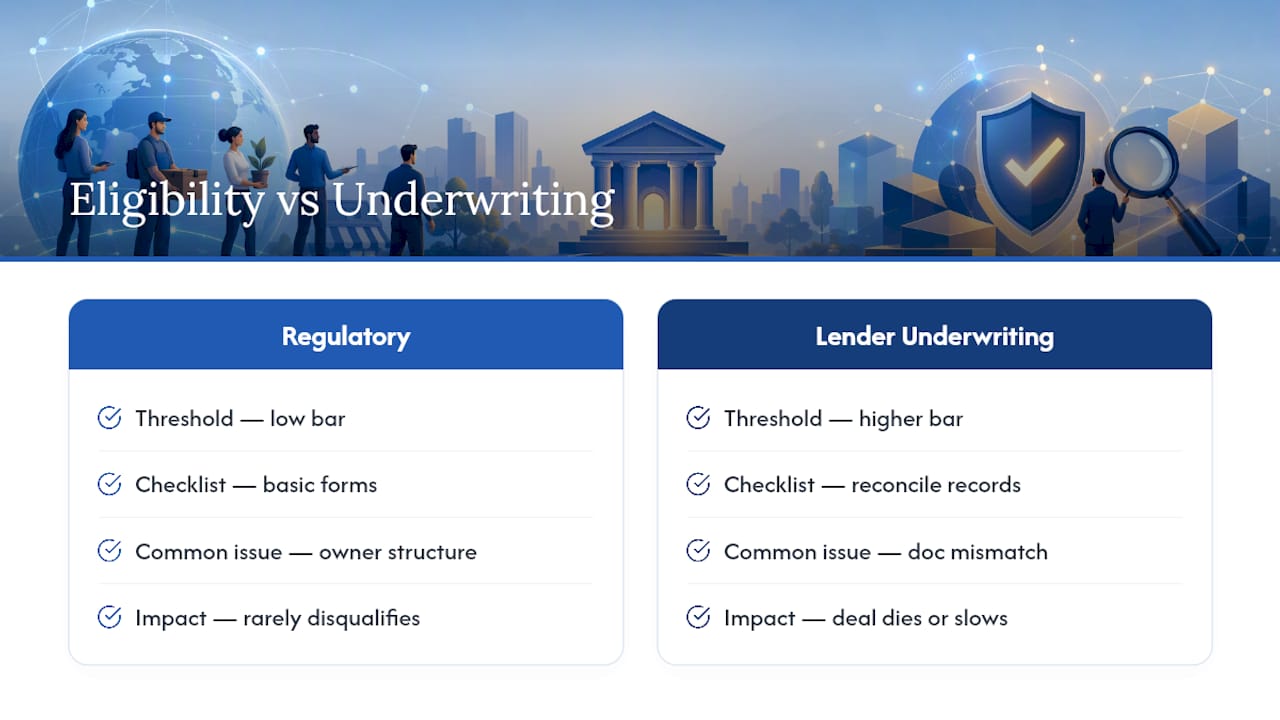
The March 1, 2026 citizenship and residency update is the clearest example of a rule that looks like a footnote and isn’t. An owner structure that was fine in 2025 can be disqualifying now, and that’s exactly the kind of detail generic checklists skip because it changed recently.
If you take one thing from this article, prioritize document reconciliation over document collection. Gathering the forms is the easy part. Making sure your P&L, tax returns, and debt schedule tell the same story is what actually determines whether a lender moves fast or slow.
— PHENYX
If you’re weighing SBA 504 financing for commercial real estate or equipment with at least a 10-year useful life, Fbdc structures the deal so you’re not carrying the full weight of a conventional down payment. Down payments as low as 10%, long-term fixed rates, and a lender relationship that’s been doing this for more than 35 years mean the paperwork gaps that stall most applications get caught early instead of late.
Fbdc’s six-step process walks you from initial eligibility review through closing, and the 504 loan program page breaks down current terms and typical use cases in more detail. If your borrowing need is smaller and doesn’t fit a real estate or equipment purchase, the direct lending program covers loans in the $50,000 to $400,000 range. Reach out to start a conversation about your project and get a straight answer on whether a 504 loan fits your timeline and equity position.
This article is general information, not a substitute for advice from a qualified financial advisor. Consult a qualified financial professional about your own circumstances before acting on anything here.

