


Impact fees are one-time charges a local government levies on new development to help pay for the roads, schools, utilities and emergency services that growth requires. For a business owner, they are a real project cost that usually comes due before the building opens. The way to finance them is to find the number early and put it in the project budget, so it is covered by the same financing as the land, the building and the equipment. If you are buying, building or renovating commercial property in Florida, our SBA 504 loan program is built for exactly that kind of real estate project, with down payments as low as 10% and long-term fixed rates.
Fbdc
Plan Real Estate Financing With Confidence
FBDC’s SBA 504 lending helps Florida businesses finance commercial real estate with down payments as low as 10% and long-term fixed rates.
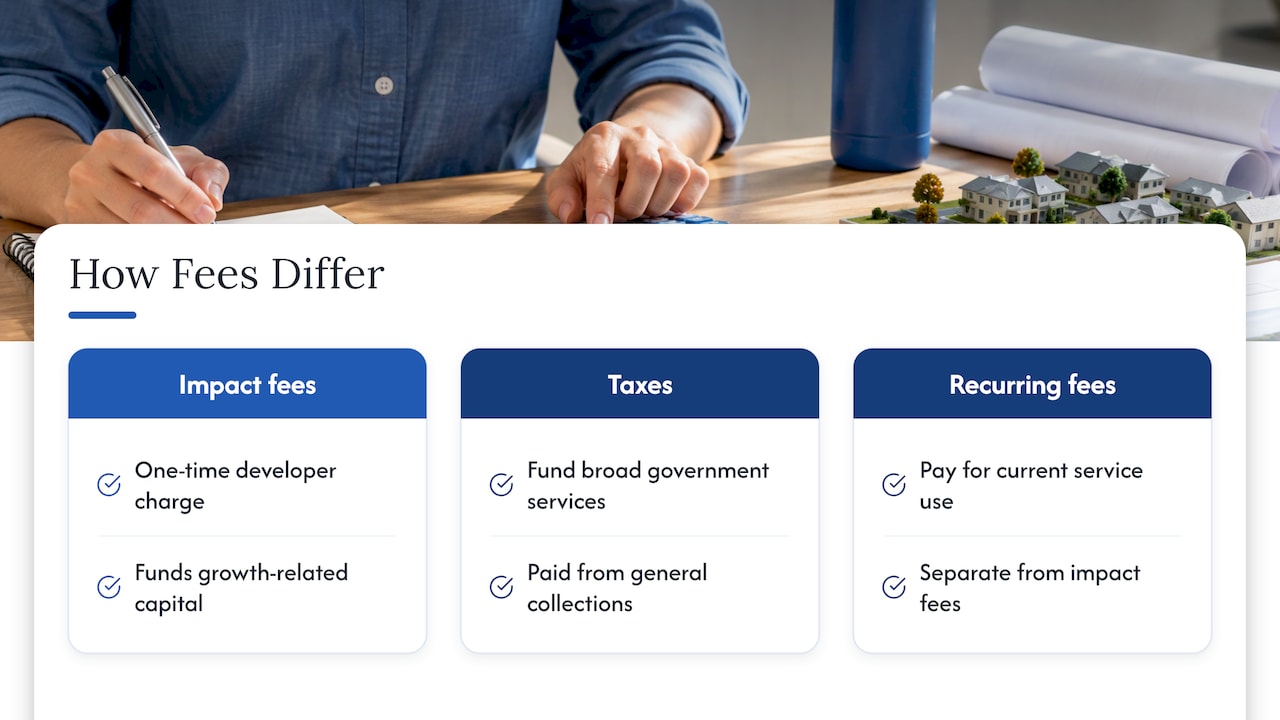
An impact fee is a charge a local government places on a new development to recover a share of the cost of public infrastructure that the development will use. The Federal Highway Administration describes them as one-time charges levied by local governments and paid by developers to help recover growth-related infrastructure and public-service costs. The American Planning Association describes them as advance payments for new or expanded public capital facilities needed to serve the development.
The logic is that growth should pay for the added infrastructure it creates, rather than shifting that cost onto existing taxpayers. The FHWA also states that impact fees are not taxes: taxes fund broad government services from general collections, while impact fees are paid by developers to recover costs attributable to new development.
They also differ from the recurring fees a city charges for using a service. The Texas Municipal League explains that recurring municipal fees pay for use of a current service, while impact fees are one-time charges for growth-related capital improvements. Permit fees, utility bills and inspection fees are separate line items from your impact fees.
Depending on the jurisdiction, impact fees can offset some or all of the cost of off-site public facilities that benefit the development. The FHWA lists parks, schools, roads, water and sewer, utilities, and police, fire and emergency services among them.
Florida counties often bundle several of these into one total. Orange County’s 2026 assessment guide says the total project charge may combine school, law-enforcement, fire, parks, transportation, water and sewer capital charges. A commercial project may not owe every component, but you should expect more than one line on the assessment.
There are limits on what the money can fund, which matters if you ever question a charge:
The details differ by jurisdiction, but the pattern is consistent: your project is placed in a land-use category, measured in a unit, and multiplied by a published rate.
The FHWA explains that a typical calculation uses land-use and population projections and a 10-year capital-improvement plan, removes costs attributable to existing development, and divides the recoverable cost by projected new service units. That is how a county arrives at its rate per unit. You do not have to redo that math. You just need the published rate and your project’s units.
Orange County gives a practical Florida picture. It assesses fees using the rate in effect when a legally sufficient application is submitted and calculates them by land-use category. It also uses different measures for different components:
ComponentTypical measure in Orange CountyLaw enforcementGross square feetFireLiving-area square feetTransportationGross floor areaSchoolsHeated and cooled living-area square feetParks and recreationDwelling units
Those measures come from the county’s 2026 guide. Other Florida counties and cities publish their own schedules, so use the one for the place where you are building.
The numbers below are hypothetical and only show the structure. Suppose a county charges a transportation fee of $5.00 per square foot of gross floor area and a fire fee of $1.00 per square foot for a light-industrial building. For a 10,000-square-foot building:
The City of Erie, Colorado, ordinance states the same basic formula: service units multiplied by the fee per service unit, less any authorized credit. The same ordinance bases change-of-use fees on the increase in service units, so converting an existing building may cost less than building new. Your county’s rate and categories will give a different total, and the county’s impact fee office is the place to get the figure for your parcel.
Impact fees tend to come early. Orange County generally collects them when the permit is ready to issue, and says credits and deferrals may apply. That timing is the core financing problem: the check is due before the building generates any revenue.
Two practical consequences follow:
Sometimes, but it varies by place. In San Francisco, project sponsors may appeal for a reduction, adjustment or waiver when there is no reasonable relationship between the development impact and the fee, and the appeal must generally be filed within 15 days of the decision. San Diego’s FAQ says applicants who disagree with an assessment may request a second opinion and use a municipal waiver or reduction procedure.
The lesson for a Florida owner is that appeal windows can be short. Read the assessment the day you receive it and check your local code for the deadline. A land-use attorney or your local impact fee office can advise on a specific dispute.
Exemptions are also not uniform. San Diego says affordable units generally still pay fees, though some may qualify for a regional exemption with a 55-year affordability covenant. Never assume a waiver. Budget for the full fee, and treat any reduction as a bonus.
The most dependable approach is to treat the fee as part of the total project budget rather than as a separate expense to cover from operating cash. A step-by-step routine:
A business that waits until the permit is ready to learn the amount may face a large payment on short notice. A business that has the figure in the budget from the first meeting does not.
FBDC specializes in SBA 504 lending for for-profit businesses that want to acquire, build, renovate or refinance commercial real estate, or buy heavy machinery and equipment with a useful life of at least 10 years. The program offers down payments as low as 10% and long-term fixed rates. We bring more than 35 years of experience to the process, and our approach is built around expert guidance from the first conversation.
If your project is a purchase or build, start with the SBA 504 loan program. If you already own the property, see the SBA 504 refinance program. We also offer a bridge loan program for 504 projects, a direct lending program for smaller loans, and VetLoan Advantage Plus for veterans.
Bring your project budget and your county’s fee estimate, and we will walk through how the financing fits. You can reach us through the FBDC site.
This guide is for for-profit businesses planning real estate or equipment projects in Florida. Impact fees are charged on development, so they matter if you are building, expanding or changing the use of a property. They do not apply to working capital or inventory needs, which are outside what our SBA 504 and direct lending programs cover.

It helps to know the fee is not a general revenue source. The FHWA says impact fees should be spent in a timely fashion on new infrastructure and cannot generate revenue beyond the apportioned cost of the improvements they fund. The American Planning Association adds that a fee must provide some benefit to the paying development and be proportionate to its fair share.
Many jurisdictions also require that fee revenue be kept in separate accounts. One city ordinance requires separate funds by capital-improvement category. In Washington, the State Auditor says unused contributions must ultimately be returned to developers. Florida rules are set by state law and local ordinance, so ask your local office how refunds and credits work where you build.
Our perspective
We see impact fees as a budgeting question more than a cost problem. The fee is predictable once the land use and square footage are known, and it is published by the local government. What hurts a project is learning the number late.
That is why we encourage owners to bring the full project cost to the first conversation. SBA 504 financing is designed for real estate and long-life equipment, with down payments as low as 10% and fixed rates over the long term, so owners can keep more of their cash for running the business. A project budget that has accounted for every cost, fees included, is one we can structure with confidence.
After more than 35 years of working with small businesses, our view is simple: the earlier the numbers are on the table, the smoother the loan process.
PHENYX
They pay a share of the public facilities that new development relies on, such as roads, water and sewer, parks, schools and fire and police services. The FHWA lists these categories. Exactly which ones apply depends on the county or city where you build.
No. Permit fees cover the cost of reviewing and inspecting your project. Taxes fund general government services. Impact fees are one-time charges on new development for growth-related capital improvements, as the Texas Municipal League explains.
Usually near the permit stage. In Orange County, fees are generally collected when the permit is ready to issue. Put the payment in your schedule before you apply, and check your own jurisdiction’s rules.
Contact the impact fee office of the county or city where the property sits, and give them the land use and square footage. Many Florida counties publish a rate schedule or assessment guide. Ask for the estimate in writing and for any credits that may apply.

