


A bank denial usually means your request did not fit that bank’s credit box, not that your business cannot be financed. If you need to buy property, build, or purchase long-lived equipment in Florida, the strongest next step is often an SBA 504 loan, which pairs a private lender with a Certified Development Company (CDC) and asks for as little as 10% down. Other routes exist for other needs, and this guide walks through each, starting with how to find out why you were turned down.
Fbdc
Explore SBA 504 Financing
FBDC specializes in SBA 504 lending for Florida businesses acquiring real estate, heavy machinery, or equipment with low down payments and long-term fixed rates.
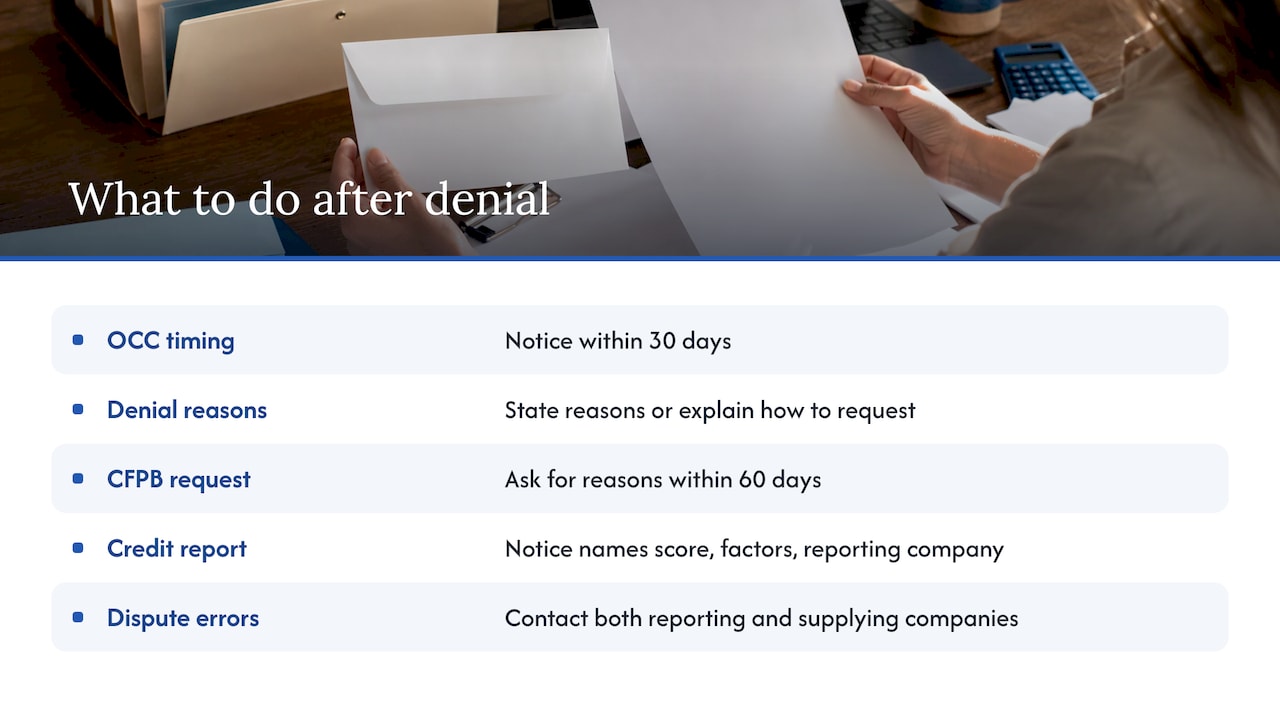
Before you apply anywhere else, get the reason in writing. Under the Equal Credit Opportunity Act, a lender should notify an applicant of its decision within 30 days of a completed application, and either state the reasons or explain how to request them, according to guidance from the OCC’s HelpWithMyBank site. That guidance is written around consumer applications, so ask your business lender what it can share in your case.
The Consumer Financial Protection Bureau explains that an adverse-action notice must give the principal reasons for denial, or tell you that you can request them within 60 days. When a credit report was used, the notice must also name the score, the key factors, the reporting company and your right to a free report, per the CFPB’s explanation of credit denials.
If the report contains something you believe is wrong, dispute it with both the reporting company and the company that supplied the information. The reporting company must investigate and correct errors it finds, as the CFPB describes.
The reason on the letter tells you which door to try next:
Reason you hearWhat it usually meansWhere to look nextNot enough down paymentThe bank wants a large equity shareSBA 504, where borrower equity can start at 10%Term too shortPayments on a 5 to 7 year schedule strain cash flowLonger-term fixed financing, such as 10, 20 or 25 year 504 termsCollateral shortfallAssets do not cover the requestSBA 7(a) or 504, which are structured differentlyThin credit or time in businessLimited track recordMicroloans, startup-friendly programs, documentation of your planPurpose does not fitLoan type does not match the useA product built for real estate, equipment or working capital
Banks lend against their own appetite. Some cap loan-to-value on commercial property, some will not finance owner-occupied construction, and some hold loans to short maturities. A decline can say more about the product than about you.
That matters because the fix is different. A weak credit file calls for repair and documentation. A structural mismatch, such as needing 25 years to repay a building, calls for a different program. Treat the two cases separately before you spend time on applications.
This is where we work every day, so we will be specific. The SBA describes the typical 504 structure as a private-sector senior loan covering up to 50% of project cost, a CDC/SBA-guaranteed junior loan covering up to 40%, and borrower equity of at least 10%, per the SBA’s lender comparison.
The SBA states that the 504 program provides long-term, fixed-rate financing of up to $5.5 million for major fixed assets. That includes long-term machinery and equipment with at least 10 years of useful remaining life. Available maturities are 10, 20 and 25 years, and CDCs originate the loans in collaboration with a senior lender.
What this means in practice:
The SBA’s 504 structure shows the trade-off clearly: the borrower contributes at least 10%, and the private lender and the CDC/SBA portion divide the rest. Your equity is the price of entry, and in return you get the long fixed-rate piece many banks will not offer on their own.
A 504 loan is for business that is operating, for-profit, small under SBA size requirements and able to repay. It is not designed for working capital or inventory. If your bank said no because of those uses, jump to the 7(a) section below.
Some owners ask whether a 504 beats a conventional commercial mortgage. We compare them directly in SBA 504 vs. a conventional commercial mortgage in Florida, and you can see how it stacks up against the other major SBA program in SBA 504 vs. 7(a).
For machinery, you have more choices than a bank denial suggests. Florida International University’s small business guidance lists equipment loans and leasing among the paths open to a business turned down by banks, along with accounts-receivable financing, purchase-order financing, project financing, factoring and community-based financing, as FIU’s business-growth article explains. It also cautions that these alternatives cost more, so you should weigh the cost and added risk.
If the machine will serve you for ten years or more, a 504 can finance it with fixed payments and 10% equity. For the decision between owning and leasing, see when equipment loans beat leases and our walkthrough of equipment financing in Florida with 10% down.
The SBA says 7(a) loans can help eligible businesses buy real estate, equipment and inventory, obtain working capital, and refinance business debt, as in its small business resource post. The 7(a) program page sets a maximum of $5 million, and requires an operating, for-profit U.S. small business that cannot obtain the credit it wants on reasonable terms elsewhere, is creditworthy and can show repayment ability. Most 7(a) term loans are repaid monthly from business cash flow.
That “cannot obtain credit elsewhere” test is one reason a bank denial can be useful: it is part of the documented story for an SBA-backed request.
The SBA’s microloan program caps loans at $50,000. It can support new equipment, supplies or working capital, and each microlender sets its own qualifications, according to the SBA’s financing overview. The SBA’s lender comparison adds that microloan terms run no more than six years, with negotiated interest rates.
Factoring, receivables financing, purchase-order financing and similar products can fund a gap quickly. They suit short-term cash needs, such as filling a large order. They are a poor match for buying a building, because their cost is built for short horizons. Compare total repayment, not just the headline rate, and ask for the full cost in dollars before you sign.
NeedProgram typeKey featureTypical fitBuy, build or refinance propertySBA 504Fixed rate, 10, 20 or 25 year terms, from 10% equityOwner-occupied Florida businessesLong-lived heavy equipmentSBA 504Assets with at least 10 years of useful lifeManufacturers, contractors, operatorsWorking capital, inventory, mixed useSBA 7(a)Up to $5 millionBusinesses needing flexible use of fundsSmall start-up needsSBA microloanUp to $50,000Early-stage businessesShort-term cash gapFactoring or receivables financingFast, higher costOrder or invoice timing
Most owners who come to us were told no for a reason that has little to do with the strength of the business. The bank wanted more equity than they could spare, a shorter term than the building deserves, or a loan type it does not offer.
The 504 structure was built for that situation. A private lender takes the first position, the CDC and SBA fund a long-term fixed-rate second piece, and the borrower can start with as little as 10% down. For a company buying its own space or a machine that will work for a decade, we believe that is the most practical way to protect cash while building equity.
We have spent more than 35 years in this program in Florida, and we aim to give you certainty and responsive service through an experienced team. Our approach is to tell you early whether a 504 fits, and to point you toward the right structure when it does.
PHENYX
If you were turned down for property or equipment financing, we can review your project and tell you whether SBA 504 is a fit. Start with the SBA 504 loan program, or read about 504 loans anywhere in Florida.
We also offer a 504 refinance program, the FBDC 504 Velocity Bridge Loan, a direct lending program for smaller loans, and VetLoan Advantage Plus for veterans. Fees and terms vary by program, so ask us for the current details.
Common causes are too little equity, weak collateral, credit report issues, short time in business, or a request that does not fit the bank’s product. Ask for the written reasons. Lenders are expected to provide them or explain how to request them, and that answer decides your next move.
Yes, for eligible projects. The SBA’s 504 structure calls for borrower equity of at least 10%, with a private lender covering up to 50% and the CDC/SBA portion up to 40%. Equity can be higher for some situations, such as startups, so confirm your number early.
Major fixed assets: commercial real estate, construction, renovation, refinancing of eligible debt, and long-term machinery with at least 10 years of useful life. It does not cover working capital or inventory. Those needs fit an SBA 7(a) loan better.
They can fill short gaps, but FIU’s guidance notes they cost more and add risk. For a long-term asset, a fixed-rate SBA 504 loan usually fits the life of the purchase better. Always compare total repayment in dollars.

