


If you own the building or equipment your Florida business runs on, an SBA 504 refinance is built for that situation. It pairs a bank loan with a long-term, fixed-rate loan from a Certified Development Company (CDC), a lender certified and regulated by the SBA that exists to finance business growth and jobs. A conventional commercial loan is priced and underwritten by the bank alone. At FBDC, we have specialized in SBA 504 lending for over 35 years, and this guide shows how the two routes differ on structure, rates, terms, cost and eligibility so you can judge which one fits your property.
Fbdc
Explore SBA 504 Refinance Options
FBDC specializes in SBA 504 lending, with long-term fixed rates and low down payments for small businesses financing property or equipment.
The structural difference explains almost everything else, so it comes first.
A conventional commercial loan is one loan from one lender. The bank sets the rate, the term, the amortization schedule and the loan-to-value limit by its own policy. Many conventional commercial mortgages carry rates that reset or balloon after a short period, so the payment or the payoff date can change before the loan is fully repaid.
An SBA 504 loan is two loans on one project. The Federal Register’s October 1, 2024 rule describes the usual structure: a private senior lender covers at least 50% of project cost, a junior CDC loan covers up to 40%, and the borrower contributes at least 10%. The CDC loan is the part that is funded through the SBA program, and it is the part with the fixed rate.
Here is the same idea in a simple table.
FeatureSBA 504 refinanceConventional commercial loanNumber of loansTwo: senior bank loan plus junior CDC loanOne bank loanBorrower equityAt least 10% on a typical projectSet by the bankRate on the long-term portionFixed for the life of the CDC loanSet by the bank; may be fixed, adjustable or resetMaturities 10, 20 or 25 years on the CDC loanSet by the bankWho sets the rulesSBA regulations plus the CDCThe bank’s own credit policyTypical propertyOwner-occupied real estate, long-life equipmentWide range, including investment property
The last row matters. A 504 loan is for assets your business uses, not for property you only hold as an investment. If you are weighing whether to sell the property outright instead, commercial property sales explained covers how that process differs from a home sale.
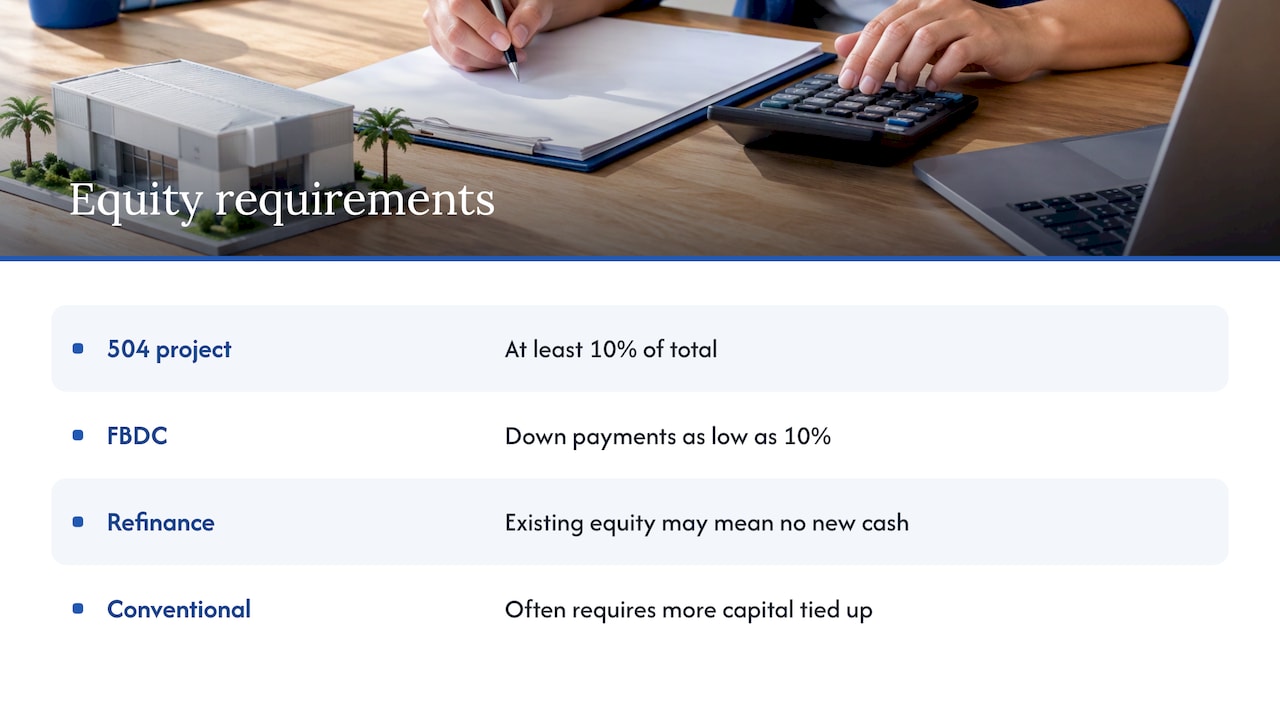
For most business owners, cash is the deciding factor. On a typical 504 project, the borrower’s equity is at least 10% of the total, per the Federal Register rule. That is the figure we work with every day: FBDC advertises down payments as low as 10%.
In a refinance, equity usually means the value you already hold in the property. If you have owned the building for several years and paid down the loan, the equity may already be in place and no new cash is needed to close. This is why many owners look at a refinance before they consider selling or moving.
A conventional lender sets its own equity requirement, and it often asks for more of your capital to stay tied up in the property. Money tied up in a building is money you cannot spend on hiring, inventory or a second location.
The SBA states that 504 rates are pegged to an increment above the current market rate for 10-year U.S. Treasury issues, and the program offers 10-, 20- and 25-year maturities. Once the CDC loan closes, its rate does not move. That gives you a payment you can put in a five-year budget.
Two points to keep in mind when you compare quotes:
Long amortization is the other advantage. A 20- or 25-year schedule on the CDC portion spreads the principal over a long period, which keeps the monthly payment lower than a short-term balloon loan on the same balance.
The SBA says program costs total approximately 3% of the debt and that the cost may be financed with the loan. Financing the fees means you do not need to bring that cash to closing. FBDC publishes an overview of approximate 504 fees so you can see what a project includes before you apply.
When you compare total cost, line up the same items on both quotes:
A conventional loan with a slightly lower first-year rate can cost more over the full term if the rate resets or a balloon payment forces a second refinance with new closing costs. A fixed 20- or 25-year CDC loan removes that second round.
The SBA lists three main uses: buying, building or renovating land and buildings; financing long-term machinery and equipment with at least 10 years of useful life; and refinancing qualifying debt under 13 CFR 120.882. Debt refinancing comes in two forms.
This form replaces an existing loan on your property or equipment without adding new construction or purchases. The current eCFR rule defines qualified debt as a commercial loan that:
Eligible fixed assets are long-term assets such as land, buildings, machinery and equipment acquired, built or improved for use in business operations, according to the same section.
This combines a refinance with a new improvement, an addition or an equipment purchase in a single project. Our guide to the 75% rule and six steps for a 504 refinance with expansion walks through how to document it.
The SBA’s 504 Debt Refinancing final rule, effective November 15, 2024, made two changes that matter most to Florida owners:
In practice, more of the loans that owners already carry can now be refinanced, and a refinance can bundle in additional business expenses. We explain what this means for Florida properties in our article on 90% LTV and the SBA 504 refinance.
The SBA says eligible borrowers must be operating, for-profit U.S. small businesses that meet SBA size standards and do not fall in an ineligible category. Management capability, a feasible business plan, good character and the ability to repay also count.
Two practical points follow:
For a fuller walk-through, read our four eligibility checks before you approach a CDC.
The SBA states the maximum 504 loan amount is $5.5 million. That figure is the CDC debenture, the SBA-backed portion of the project. The bank’s senior loan sits on top of it, so total project size can be considerably larger than the 504 portion alone.
Suppose a Tampa-area distribution company owns its warehouse and carries a bank loan from 2022 that was used to buy the building. The loan is more than six months old and all of it went to the building, so it meets the 75% fixed-asset test. The owner wants a fixed payment for the long term instead of a rate that resets.
In a 504 refinance, a bank would provide the senior loan for at least 50% of the project, and the CDC would fund the junior portion at a fixed rate. The existing equity in the building supplies the borrower contribution. Costs of roughly 3% of the debt can be financed, as the SBA describes. The owner leaves with two loans, one blended payment and a fixed rate on the CDC portion.
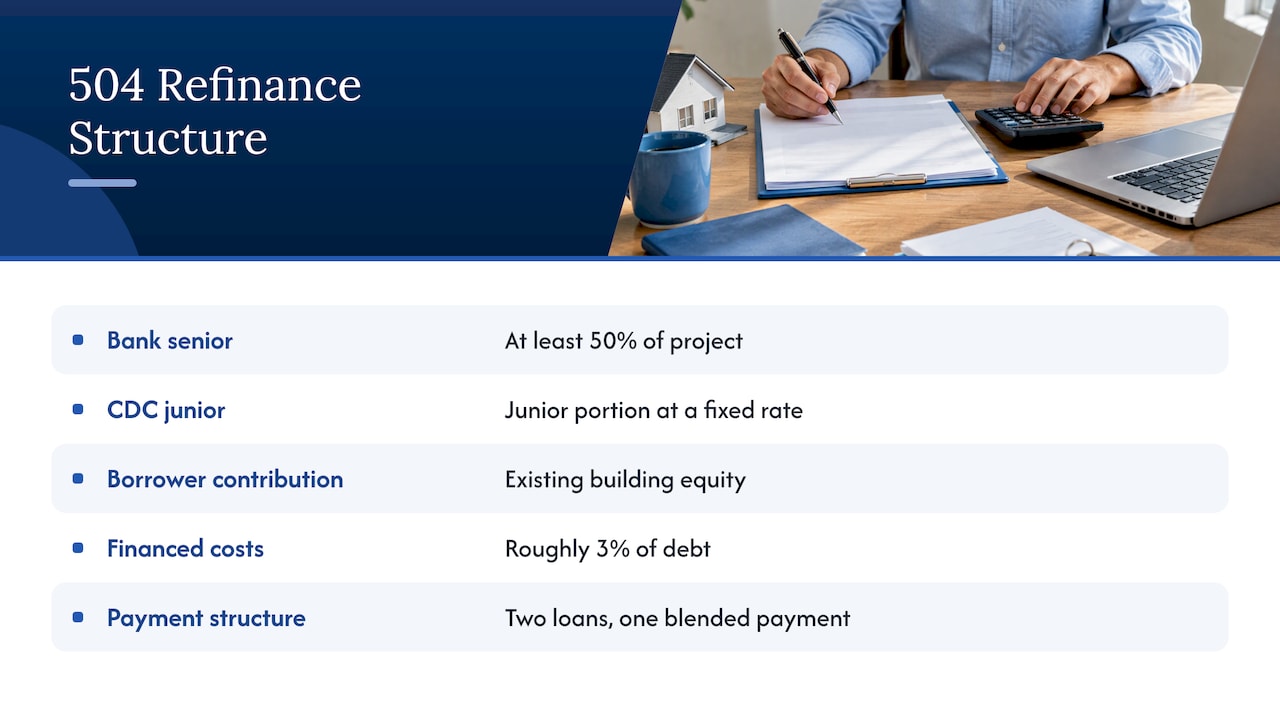
This is an illustration of how the structure works, not a quote. Your numbers depend on your appraisal, your debt and your lender.
Choose the structure that matches your goal:
For side-by-side detail, see our comparison of Florida SBA 504 refinance vs. conventional refinance and our page on SBA 504 vs. a conventional commercial mortgage. If you are also comparing the SBA’s 7(a) program, our 504 vs. 7(a) guide explains the difference.
We have worked on SBA 504 loans in Florida for more than 35 years, and the pattern is consistent. Owners come to us with a building, a loan that is working against them, and a question about cash.
The 504 structure answers that question directly. A low down payment, as low as 10%, keeps capital in the business. A long-term fixed rate on the CDC portion means the payment you plan around is the payment you make. Financeable costs mean closing does not drain your account.
The 2024 rule change widened what a refinance can do, and we think many Florida owners have not yet looked at it. If your loan is more than six months old and your property is owner-occupied, it is worth a review.
Our approach is to make the process swift and clear, with expert guidance from first conversation to funded loan. We want you to know your numbers before you commit to anything.
PHENYX
FBDC is a Florida CDC that finances owner-occupied commercial real estate and long-life equipment. Our SBA 504 Refinance Program is for for-profit small businesses looking to replace existing debt on their property or equipment. We also offer the FBDC 504 Velocity Bridge Loan Program for 504 projects, a Direct Lending Program for smaller loans, and VetLoan Advantage Plus for veterans.
If you want to see how it applies to your property, send us your current loan terms and property details and we will walk you through the structure. You can also see how we serve SBA 504 borrowers anywhere in Florida.
Yes, if the debt qualifies under 13 CFR 120.882. Under the eCFR definition, the loan must be at least six months old, secured by eligible fixed assets, made for the business’s benefit, and have used at least 75% of its proceeds for an eligible fixed asset. Our guide on refinancing an SBA loan in Florida covers the details.
On a typical project, borrower equity is at least 10%, according to the Federal Register’s description of the 504 structure. In a refinance, equity you already hold in the property can often count toward it. FBDC advertises down payments as low as 10%.
The SBA describes 504 as long-term, fixed-rate financing. The CDC portion has 10-, 20- or 25-year maturities, and its rate is based on an increment above the 10-year Treasury rate. Ask for the blended payment across the bank and CDC loans.
It is for fixed assets: land, buildings and equipment with at least 10 years of useful life, plus qualifying debt refinancing. It is not for working capital or inventory, and non-profits are not eligible borrowers.

