


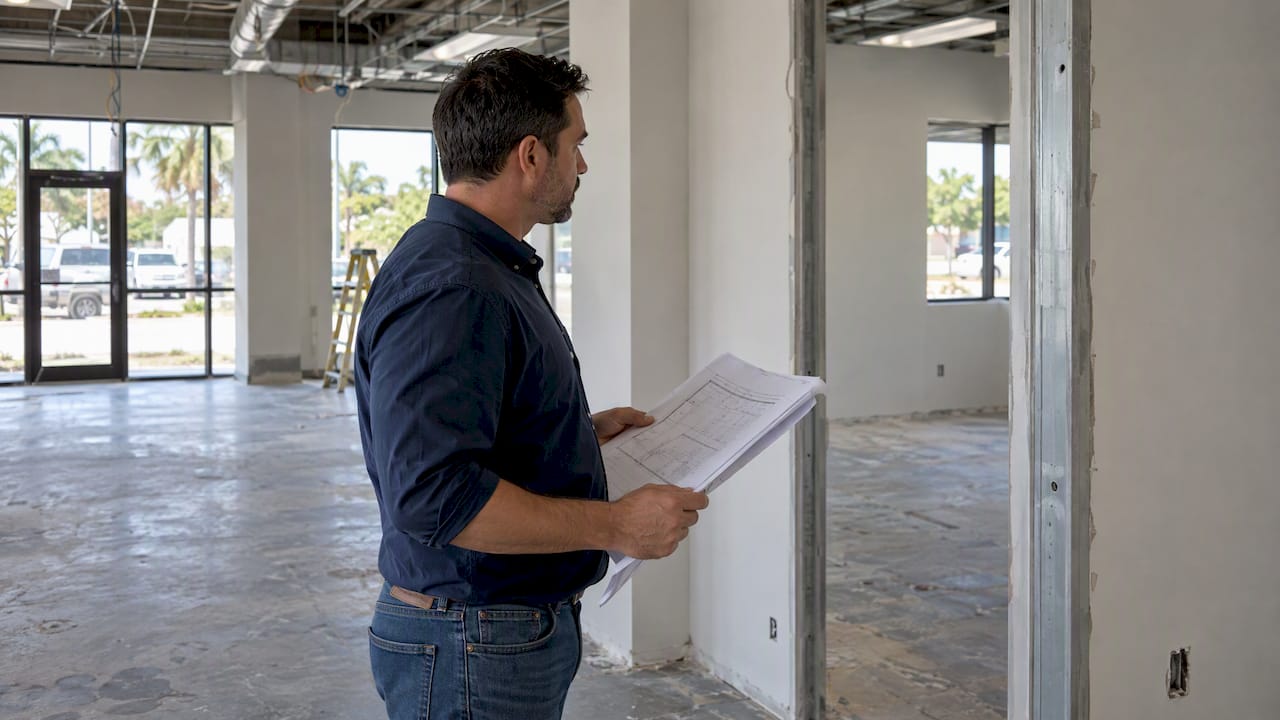
Yes, if you run a for-profit business in Florida and plan to occupy the property you finance, you likely can qualify. Four checks decide most cases: for-profit status, the SBA’s tangible net worth and average net income caps, owner-occupancy, and your ability to repay. Every 504 application runs through a Certified Development Company (CDC), and we help Florida borrowers work through the checklist below.
TL;DR:
- For existing buildings, businesses generally must occupy a majority of the space; new construction starts lower but requires a plan to increase occupancy.
- Projects combine senior financing, a CDC loan, and borrower equity; down payments often start near 10% and rise for new businesses or special purpose properties.
- Apply through a CDC, which reviews cash flow, management, collateral, and projections; gather tax returns, financial statements, purchase documents, and project bids beforehand.
- SBA ownership, citizenship, and residency rules changed March 1, 2026; revised procedures cover applications receiving an SBA loan number on or after October 1, 2026.
Before you look at the project, confirm that the business itself fits the program. The SBA’s 504 guidance sets the baseline, and a few items come up in nearly every conversation we have.
The SBA lists tangible net worth and average net income ceilings as baseline eligibility criteria for 504 loans. Check the current dollar thresholds on the SBA’s 504 page against your latest statements rather than relying on a number you heard secondhand.
Affiliation is the rule that surprises people most. If you own a stake in another company, or share ownership or management with one, the SBA may add that company’s size to yours. Mapping every related entity before you apply prevents a late-stage disqualification. If your situation sits on the edge, the SBA encourages contacting a CDC early, and we are glad to talk it through.
A 504 loan funds major fixed assets, not working capital or inventory. Eligible uses include:
The occupancy test is what screens out passive investment properties. In practice, a business buying an existing building generally needs to occupy a majority of the space, while new construction typically carries a lower starting occupancy threshold with a plan to grow into more. A Florida-focused 504 quick reference summarizes these thresholds and the eligible project expenses.
Special-purpose or limited-market properties, such as certain specialized facilities, usually require more borrower equity because they are harder to resell. Expect that to raise your down payment.
Pro Tip: Walk through our occupancy checklist before you sign a purchase agreement, so you know your planned square footage fits the rules.
A typical 504 project has three parts: a senior lender, a CDC-backed 504 loan, and your down payment. The senior lender covers the first lien portion, the CDC portion is funded through an SBA debenture, and you contribute equity. Down payments commonly start around 10%, and they rise for special-purpose properties or new businesses.
The eCFR states that 504 loan amounts are generally limited to $5,000,000 per borrower, with $5,500,000 exceptions for certain projects. Those caps apply to the CDC portion of the financing, not to the total project cost, which can be larger once the senior lender and your equity are added.
Having a clean package ready is the fastest way to shorten review. We typically ask for:
CDCs commonly collect a deposit that is applied to processing if your application is accepted, and processing fees vary by program. Our approximate fees are outlined on our program page. Timing depends on the project: a straight acquisition often closes faster than a construction project with bids and draws. Our overview of the closing process explains what moves a file along.
You apply through a CDC, not directly through the SBA. The eCFR states that applicants apply to a CDC for a 504 loan. The CDC coordinates the package with a senior lender and handles the SBA debenture. If you want the full picture of the CDC’s role, our guide to the Certified Development Company covers it.
During review, the CDC evaluates:
You will also certify that credit is not available on reasonable terms without SBA assistance. Your next steps are simple: complete the occupancy checklist, assemble clean financials, and ask us for pre-qualification help.
Pro Tip: Organize your documents into one folder by category before the first call, and your CDC can spot gaps in a single pass.
The 504 program also supports refinancing of qualifying business debt, and our SBA 504 Refinance Program page explains how it works. Certain public policy goals can lift the project cap: small manufacturers and energy efficiency projects may qualify for the $5,500,000 exceptions noted above.
SBA’s notice states that SOP 50 10 8.1 becomes effective October 1, 2026, and applies to applications issued an SBA loan number on or after that date. The SBA also published revised ownership, citizenship, and residency requirements effective March 1, 2026, so confirm your ownership structure against them.
Meeting the SBA baseline gets you in the door. The credit decision is a separate question, and it is made on your full financial picture rather than a single score.
Lenders and CDCs look at the pattern behind the numbers. Personal credit of the principals matters because owners guarantee the loan. Late payments, collections, tax liens, or past bankruptcies raise questions, and the strongest response is a short-written explanation with documentation showing the issue is resolved and not recurring.
Business history matters just as much. Consistent revenue, stable margins, and cash flow that covers existing debt plus the new payment tell a lender you can carry the loan. Gaps in tax filings, unexplained swings in income, or heavy reliance on one customer will draw scrutiny.
A few habits help before you apply:
A weaker area is not always a dead end. A larger down payment, stronger collateral, or a more conservative project scope can offset a soft spot. The key is to surface the issue yourself and bring a plan, rather than let the underwriter find it.
As an SBA 504 lender, we bring experience in handling eligibility questions before they become obstacles. We focus on small businesses that need affordable capital for real estate and equipment, and we know the Florida projects and property types that tend to fit.
Our process is built around early clarity. We review your size, net worth, and occupancy picture at the start, so you are not surprised halfway through. We offer down payments as low as 10% and long-term fixed rates, which help owners preserve cash for operations.
Several practical advantages support qualification:
If your project does not fit the standard 504 structure, we also run a Direct Lending Program and a VetLoan Advantage Plus option for veterans. Having several programs under one roof means we can often find the right fit instead of sending you elsewhere.
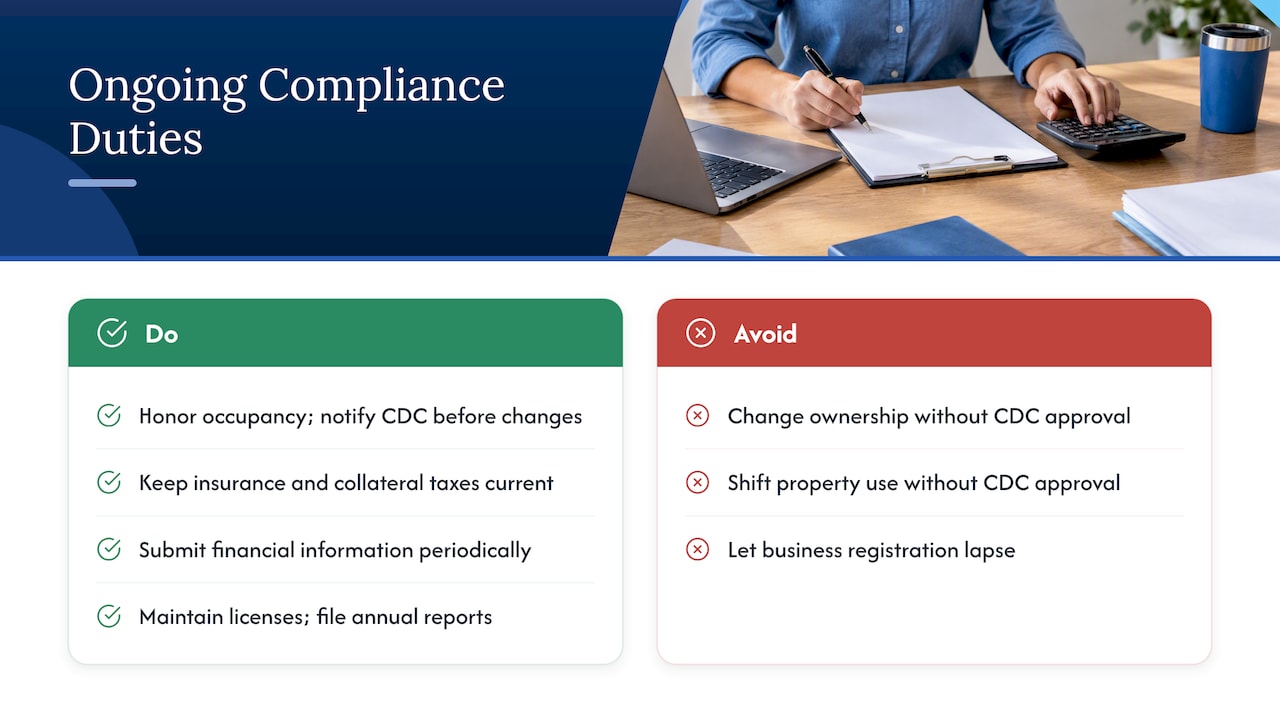
Closing is not the end of your obligations. A 504 loan carries ongoing responsibilities that protect both you and the program.
You are expected to keep the occupancy commitment you made at application, so the space you said you would use remains in business use. If your plans change, tell your CDC before acting, not after.
Insurance must stay in force on the financed property, in line with the coverage requirements set at closing. Property taxes and other obligations on the collateral should stay current, since a lapse can put the lien position at risk.
You will also be asked to supply periodic financial information, and CDCs may follow up on job and project outcomes tied to the loan. Keep your records organized, because clean books make these requests routine.
In Florida, remember the state-level basics of running your business. Keep your entity in good standing, maintain required state and local licenses, and file annual reports on time. The state’s business guide is a useful reference for those requirements. A lapsed registration can create default concerns that have nothing to do with your payments.
Finally, avoid unapproved changes in ownership or use of the property. Any transfer, sale of the business, or shift away from owner-occupancy should be discussed with your CDC first.
In our view, most applications are won or lost on preparation, not on the program rules. Clean up your financials first, because every other question flows from them. Confirm your occupancy plan on paper before you commit to a property. And build cash-flow projections that you could defend line by line, not ones that look good but fall apart under questions. Pre-package your documents and use the occupancy checklist so review moves quickly. Then talk to an experienced CDC early, while changes are still cheap.
— PHENYX
If your business is for-profit, Florida-based, and planning to occupy the property or put the equipment to work, we would like to hear about it. We are a direct SBA 504 lender with specialized Florida experience, and we back it with an occupancy checklist and refinance support.
Here is how to start:
Learn about the program and reach us on our SBA 504 Loan Program page.
This article is general information, not a substitute for advice from a qualified financial advisor. Consult a qualified financial professional about your own circumstances before acting on anything here.
A for-profit business located in the United States that meets SBA size standards and the tangible net worth and average net income caps can qualify. The project must also be a fixed asset purchase or build that you will occupy or use. SBA guidance lists these baseline requirements.
It is manageable when your financials are clean and your occupancy plan is clear. Most delays come from missing documents or unresolved questions about affiliation and repayment ability. Preparing a complete package and contacting a CDC early makes approval smoother.
Operating as a non-profit, failing the size or financial caps, or planning a passive investment property can disqualify an applicant. Insufficient repayment ability or unexplained credit problems can also stop a file. Check your situation against the SBA baseline before you apply.
Approval depends on your finances and the purpose of the loan, not on a single easy program. The 504 program fits real estate and long-life equipment projects, while other SBA products suit working capital. Talk with a CDC to match your goal to the right structure.

