


There are four main ways to finance commercial property in Florida: a conventional bank mortgage, an SBA 504 loan, an SBA 7(a) loan, or short-term bridge and private money. For a business that will occupy the building it buys, the SBA 504 loan usually asks for the least cash up front, typically 10% down, with a fixed rate on the long-term portion. Investors who will lease out most of the space need a different route, because 504 loans are built for owner-occupants.
This guide explains how each option works, what lenders test before they say yes, and how to choose.
This is the default route. A bank lends against the property and your business cash flow, usually with a shorter term than the amortization, so a balloon payment or refinance comes due after a few years. Rates are often fixed for an initial period and then reset.
The tradeoff is equity. Lenders typically finance a maximum of 65% to 85% of the value, so you contribute 15% to 35% in cash. On a $1.5 million building, 25% down is $375,000 that is no longer available for inventory, hiring or equipment.
Banks have also been cautious lately. The Federal Reserve’s October 2025 Senior Loan Officer survey reported that a modest net share of banks tightened standards on construction and land development loans, and the April 2025 survey found banks had tightened or held steady on every commercial real estate loan term it asked about. Plan for strict underwriting, not generous exceptions.
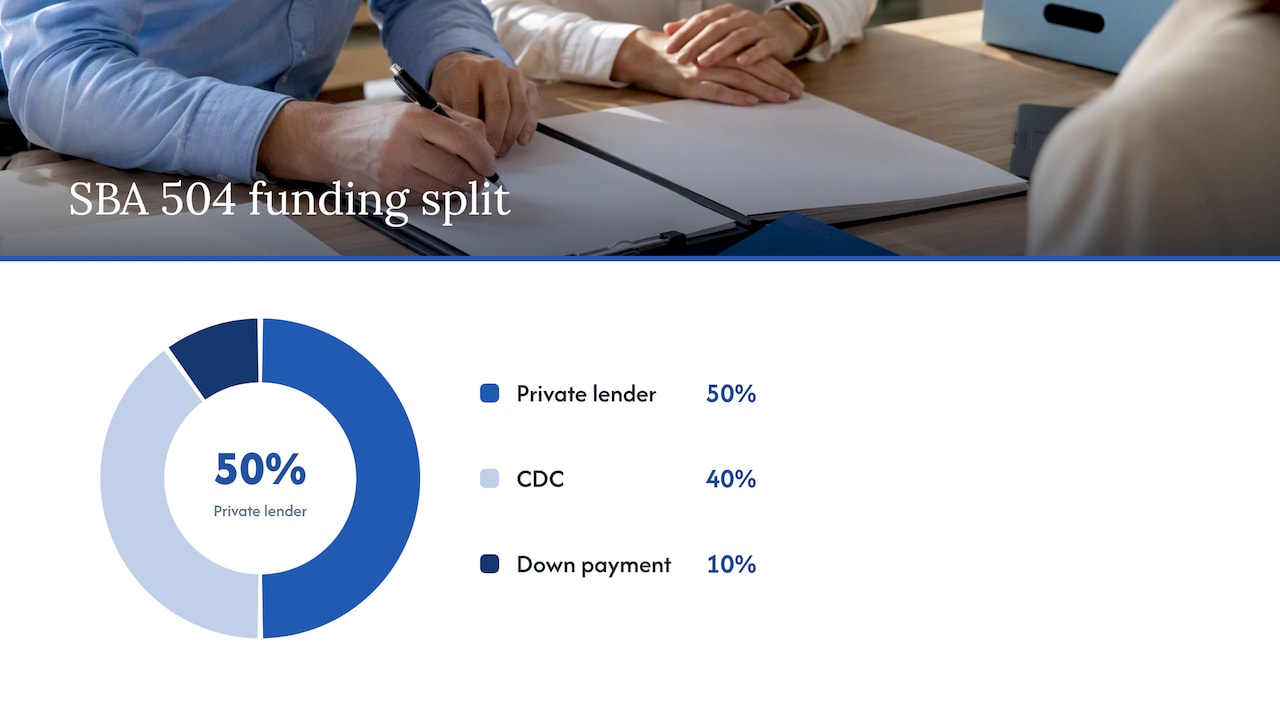
The SBA 504 program provides long-term, fixed-rate financing for major fixed assets such as real estate and heavy equipment, with the goal of business growth and job creation. CDCs authorized by the SBA originate the loans.
The structure is usually called 50-40-10:
We cover the mechanics in more detail below, because for owner-occupants this is often the strongest answer to the question this article asks.
The 7(a) program is more flexible in use. It can fund real estate, but also working capital, business acquisitions and refinancing combinations. Rates are commonly variable, and the program is a single loan rather than a two-part structure. It suits a business that needs the building and cash for operations in one package. If your main goal is the lowest down payment and a fixed rate on the property itself, a 504 loan is typically the better fit.
Sometimes timing matters more than cost. A seller will not wait, or the property needs work before permanent financing is possible. Bridge lenders and private lenders close quickly but charge higher rates and expect repayment in months, not decades. A bridge is a tool to reach permanent financing, so know your exit before you sign. For an owner-occupant, the exit can be a 504 loan. Our guide to Florida commercial bridge loans and the SBA 504 exit walks through that path.
| Feature | Conventional mortgage | SBA 504 | SBA 7(a) | Bridge or private |
|---|---|---|---|---|
| Typical down payment | 20% to 30% | As low as 10% | Varies by lender | Often 25% or more |
| Rate type | Fixed then reset, or variable | Fixed on the CDC portion | Often variable | Usually higher, short term |
| Best for | Owner-occupants and investors with strong equity | Owner-occupants buying, building or renovating | Real estate plus working capital | Fast closings, repositioning |
| Investor property | Yes | No | No | Yes |
Down payment ranges for conventional loans reflect common market guidance: published Florida lender guides cite 20% to 30%, while others cite maximum loan-to-value of 65% to 85%. Your actual terms depend on the lender, property and borrower.
Whichever route you take, underwriters ask the same questions. Prepare answers before you apply.
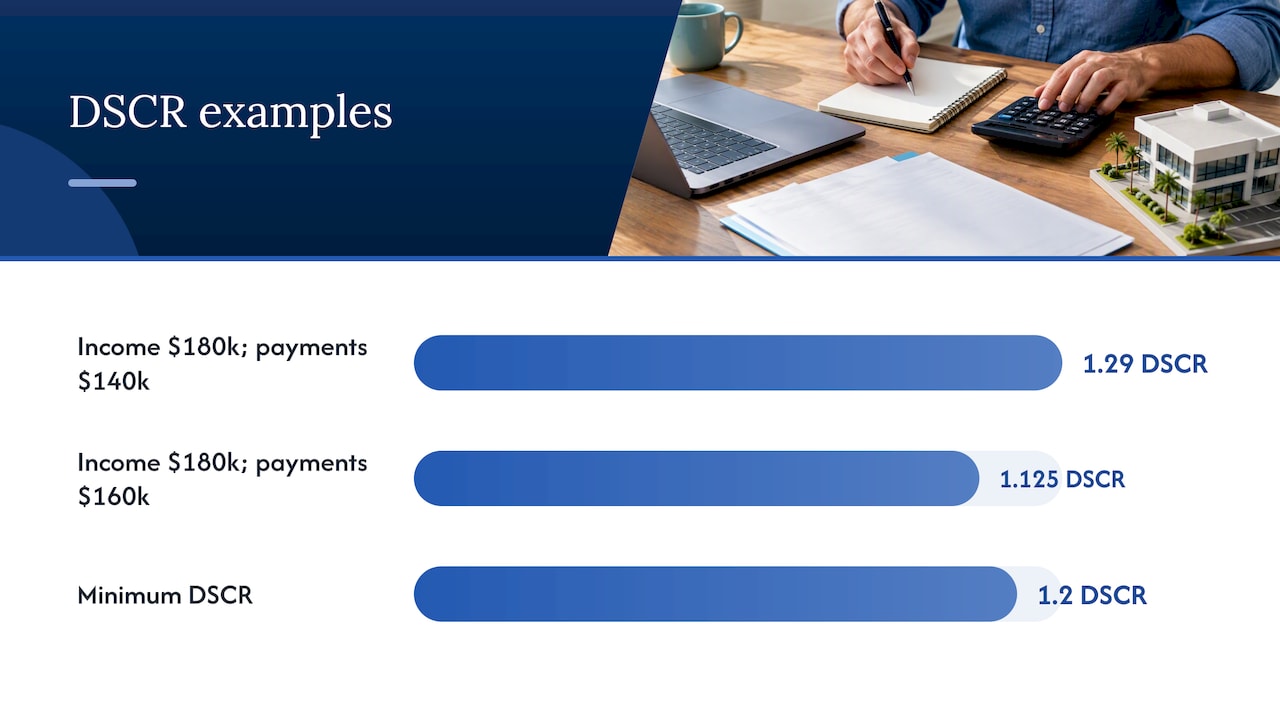
Lenders measure this with the debt service coverage ratio: net operating income divided by annual debt payments. Current commercial lending practice typically calls for a DSCR of 1.2 or higher, meaning income is at least 120% of the payment. Bank examiners also treat cash flow as the primary source of repayment on income property, so this ratio carries more weight than the appraised value.
A quick example: if your business can produce $180,000 of income available for debt service and the new payments total $140,000 a year, your DSCR is about 1.29. That clears 1.2. If payments were $160,000, the ratio drops to 1.125 and you would need a lower loan amount, more equity or higher income.
Owner-occupants often find that replacing rent with a mortgage payment improves the picture, since the rent you stop paying comes out of the expense line.
Expect a review of personal and business credit, tax returns, a personal financial statement and a global cash flow analysis that combines your business and personal obligations. Lenders look at the stability of income over time, not only collateral.
Office, retail, warehouse, industrial and medical properties are all common. Lenders and the SBA care whether you will occupy the space. For the 504 program, SBA eligibility documentation shows that the borrower must occupy a majority of the space for existing buildings, and limits on long-term leasing to others apply. Confirm the current occupancy percentages for your project with your CDC, since they differ for purchases and new construction.
Beyond the down payment, budget for the appraisal, environmental review, title and survey, legal fees, insurance, and financing fees. Ask each lender for a written estimate of these costs on the first call.
Imagine buying a $2 million warehouse for your distribution business, using the standard 50-40-10 split.
| Piece | Share | Amount |
|---|---|---|
| Bank first mortgage | 50% | $1,000,000 |
| CDC loan (SBA debenture) | 40% | $800,000 |
| Your down payment | 10% | $200,000 |
Compared with 25% down on a conventional loan, which would be $500,000, you keep $300,000 in the business. This is an illustration of the structure, not a quote. Closing costs, fees and any additional equity requirements are separate and depend on the project.
The SBA describes the CDC as a nonprofit corporation set up to contribute to the economic development of its community, certified and regulated by the SBA. The 40% portion carries a fixed rate for the life of the loan, which gives you a predictable payment on nearly half of the project. Terms of up to 25 years apply to real estate, and there is no balloon on the CDC portion.
It cannot be used for working capital or inventory.
The borrower must be a for-profit business that meets the SBA’s size standards. Our program page states a tangible net worth that does not exceed $20 million and net profit after taxes that does not exceed $6.5 million. Our post on four checks before approaching a CDC lays out the full picture.
Use these criteria in order:
For property-type specifics, see our Florida guides to warehouse loans, industrial property financing and owner-occupied loans.
We have worked in SBA 504 lending for over 35 years, and the pattern we see most is simple: owners compare interest rates and overlook the cash they commit on day one. A business that puts 25% or 30% into a building often has less left to hire, buy equipment or absorb a slow quarter. A 10% down payment with a fixed rate changes that math.
The second pattern is late preparation. Owners find a property, sign a contract with a short deadline, and only then start gathering financials. Talking to a CDC before you make an offer lets you learn what the project can support, what your equity will be and how long the process takes. Our approach is to give clear guidance early, so the loan process holds no surprises.
The third is mismatch. Not every project fits a 504 loan, and we say so. If you need working capital or you plan to be a landlord, a different product is the honest answer. But for a for-profit business that will occupy the property, we believe 504 financing deserves to be on your comparison sheet.
— PHENYX
The Florida Business Development Corporation is a CDC focused on SBA 504 lending for small businesses acquiring real estate and heavy equipment. Our SBA 504 Loan Program page explains the structure, eligibility and approximate fees, and notes that FBDC has administered more SBA 504 loans in Florida than any other CDC.
Other programs may fit your project:
If you have a property in mind, the quickest next step is to schedule a consultation from the program page. Bring your last two to three years of financials and the purchase contract or listing.
One point on fairness: regulators have told lenders that a creditworthy borrower should get an individual review rather than an automatic denial based on industry or location. The FDIC’s guidance on meeting the credit needs of creditworthy small business borrowers says lenders should assess ability to repay case by case. If one lender turns you down, a stronger package or a different structure may still work.
It is achievable but more demanding than residential lending. Lenders require documented cash flow, a DSCR around 1.2 or higher, and meaningful equity. Preparing financials and your occupancy plan in advance improves your odds considerably.
Conventional lenders commonly ask for 20% to 30%, depending on the property and borrower. An SBA 504 loan can bring the requirement down to as little as 10% for a qualifying owner-occupied project. Special-purpose properties or newer businesses can require more, so confirm with a CDC.
No. The program is built for businesses that occupy the property they finance and is intended to support growth and job creation. If you plan to lease most of the building to others, look at conventional investor financing instead.
A short-term bridge loan can cover the purchase while the permanent 504 financing is arranged. Make sure the exit is defined from the start and that you qualify for the permanent loan. Our Velocity Bridge Loan Program is designed for this situation.

