


An amortizing loan lowers what you owe with every payment. An interest-only loan does not: for an initial period you pay only the interest, and the balance stays where it started. For a business buying real estate or long-lived equipment, the safer structure is usually long-term, fixed-rate financing that is built to be paid down, because an interest-only period postpones the hard part, not removes it. At FBDC, we have specialized in SBA 504 lending for more than 35 years, and this comparison explains the reasoning.
Fbdc
Finance a Business Purchase with Confidence
FBDC provides SBA 504 financing for real estate and equipment, with long-term fixed rates and down payments as low as 10%.
Most loans are fully amortizing. According to the CFPB’s mortgage examination procedures, the borrower pays part of the principal plus the full interest each month, so the principal is paid off by the end of the term. Amortization simply means paying off a loan with regular payments so the amount owed decreases with each one, as the CFPB’s key-terms page puts it.
An interest-only loan works differently. The same CFPB procedures describe it as a loan that requires only interest for an initial period. After that, the borrower either makes larger principal-and-interest payments over the remaining term or owes a large balloon payment. The CFPB’s consumer explanation is blunt about the middle part: during the interest-only period, the amount you owe does not go down with each payment.
Two clarifications save confusion:
The CFPB’s adjustable-rate mortgage handbook gives the clearest picture of the timeline. Take a 30-year loan with a five-year interest-only period. You pay only interest for five years, then principal and interest over the remaining 25 years. Your payment rises after year five even if the interest rate never changes. The handbook adds that the longer the interest-only period, the higher the payments afterward.
That last point is the one business owners most often miss. The loan term did not get longer. The same principal is now squeezed into fewer remaining years.
The figures below are our own illustration, using a flat 7% rate and a 25-year term. They are not a quote, and real rates and terms depend on the loan.
Fully amortizing (25 years)Interest-only 5 years, then amortizing over 20 yearsMonthly payment, years 1 to 5about $7,068about $5,833Monthly payment, years 6 to 25about $7,068about $7,753Balance after 5 yearsabout $911,600$1,000,000Total interest over the loanabout $1,120,000about $1,211,000
Three things stand out:
The lower payment is a loan on your future cash flow. It pays off only if your income grows enough to cover the step-up, or if the property or equipment earns more than the cash you freed.
Monthly payment. Interest-only is lower at first and higher later. Amortizing is steadier from the beginning, which makes budgeting simpler.

Total interest. Because the principal stays outstanding longer, interest-only costs more over the life of the loan when the rate and final maturity are the same.
Equity. An amortizing loan builds equity through payments. With interest-only, your equity grows only if the asset’s value rises, and value can also fall.
Repayment risk. If the interest-only period ends with a balloon payment, you need to refinance or have the cash. The CFPB cautions borrowers not to assume they can sell or refinance when the payment goes up, because property values can decline or your finances can change. Its advice is to consider a different loan if you could not afford the higher payment on today’s income.
Refinancing depends on value. Lenders look at how much you owe against what the property is worth. If you are planning around a future refinance, it helps to know how to stress-test your loan-to-value before the interest-only period ends, not after.
The right answer depends on what you are buying and how long it will earn money.
Commercial real estate. A building and land hold value and produce income for decades, which is why long amortization suits them. Under SBA 7(a), for example, real estate gets 25-year straight amortization with no balloon. The same program summary notes that a 12-month interest-only period can be added when construction is involved, and that is a short, purpose-built window rather than a multi-year deferral of principal.
Equipment and machinery. Match the repayment schedule to the useful life of the asset. Equipment financed over a term longer than its working life leaves you paying for something you have already replaced. Our guide to matching equipment loan term to useful life and cash flow walks through that test.
Construction, renovation or a short transition. A short interest-only period can make sense when the asset is not yet earning, for instance during a build-out. The key is a defined end date and a funded plan for what comes after.
The interest-only question usually comes up for one reason: the owner wants a lower payment now. There is another way to get there. Financing with a longer term and a fixed rate spreads the payment across more years, with no step-up and no balloon to plan around.
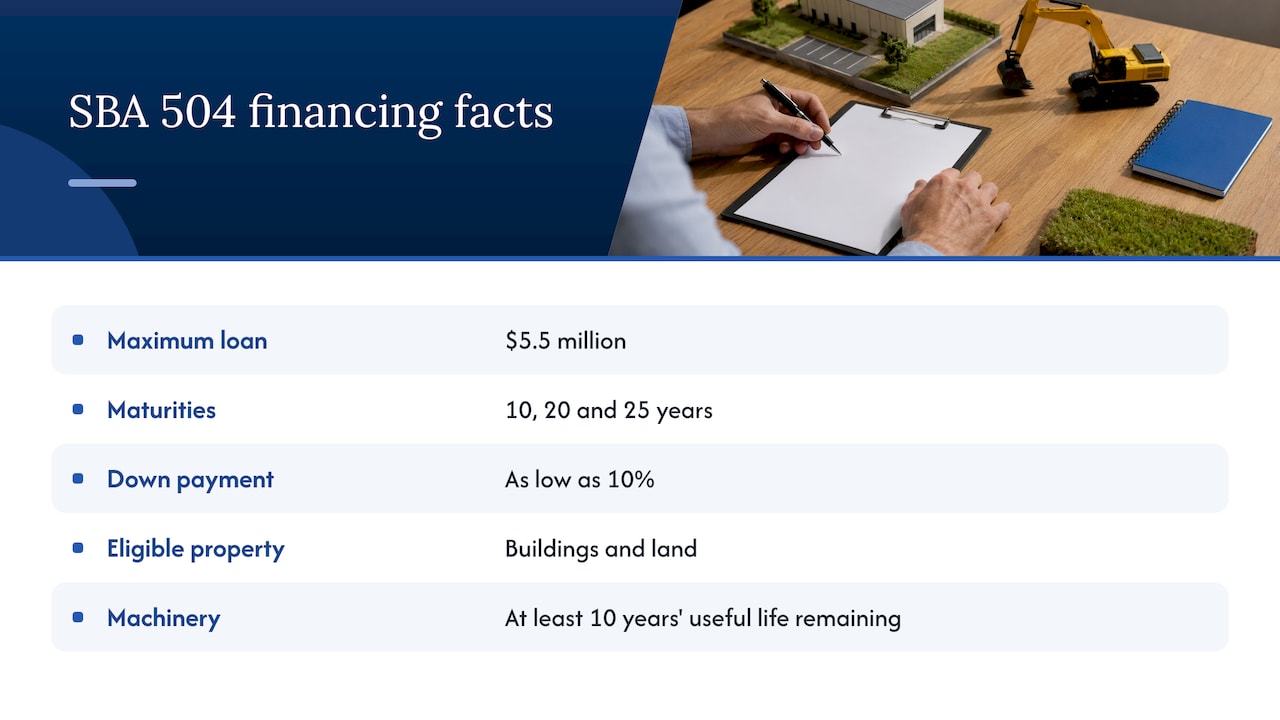
That is how the SBA 504 program is designed. The SBA describes 504 loans as long-term, fixed-rate financing for major fixed assets, with a maximum loan amount of $5.5 million and 10-, 20- and 25-year maturity terms. Eligible uses include buildings and land, and long-term machinery and equipment with at least 10 years of useful remaining life. The rate is pegged to an increment above the 10-year U.S. Treasury rate, so the payment you are quoted is the payment you can plan around. Our explainer on how SBA 504 interest rates are set covers what moves the rate before closing, and the 10, 20 and 25 year terms article shows how each term fits different assets.
A second lever is the down payment. Many conventional commercial loans ask for a large share of the price up front, which is another reason owners look to interest-only structures to preserve cash. FBDC’s 504 financing is available with a down payment as low as 10%, so the cash you keep comes from lower equity required at closing rather than from deferring principal. For a side-by-side view, see how an SBA 504 loan compares with a conventional commercial mortgage in Florida.
Whatever structure a lender offers, get clear answers to these:
If you are a for-profit business buying, building, renovating or refinancing commercial real estate, or buying heavy equipment with a useful life of at least 10 years, the SBA 504 Loan Program is where we would start. We also offer the SBA 504 Refinance Program for existing debt, a bridge loan program for 504 projects, a Direct Lending Program for smaller loans, and VetLoan Advantage Plus for veteran-owned businesses.
Our team can walk through your numbers with you, compare payment structures for your specific purchase, and explain the process from application to funding.
After more than 35 years of SBA 504 lending, we see the interest-only question as a question about timing. Owners ask for it because cash is tight at the start, and that is a reasonable concern. Our answer is to solve the cash problem directly rather than push it into the future.
A low down payment, as low as 10%, keeps more of your capital in the business on day one. A long-term fixed rate gives you a payment you can write into the budget for the life of the loan. Together, they relieve the same pressure an interest-only period is meant to relieve, without a payment increase waiting at the end.
We built our process around small businesses that want certainty: a clear structure, responsive people and expert guidance from the first conversation to the closing. If you are weighing structures for a building or a major piece of equipment, bring us the numbers and we will help you see what each option means for your monthly cash flow and your balance.
PHENYX
It is cheaper each month at first and more expensive overall. Because the principal is not reduced during the interest-only period, you pay interest on the full balance for longer. In the example above, that added roughly $90,000 in interest on a $1,000,000 loan.
Per the CFPB, you may have to pay the balance at once, refinance if that is available, or begin higher monthly payments that pay down the balance. Plan for the higher payment before you sign, not when the date arrives.
Yes. The CFPB’s examination procedures state that interest-only loans can carry fixed or adjustable rates. The rate type and the repayment structure are separate features, so check both.
With interest-only, the balance stays the same because your payment covers the interest. With negative amortization, the payment is less than the interest due, so the unpaid interest is added to the balance and the amount owed grows.
The SBA describes 504 as long-term, fixed-rate financing with 10-, 20- and 25-year maturities. Ask us for the structure that applies to your specific project, and we will lay out the payment schedule with you.

