



The fixed rate on the CDC portion of an SBA 504 loan is set once a month, when the SBA’s bonds (debentures) are priced and sold to investors. Those bonds follow long-term Treasury yields, so the 504 rate moves whenever the market does. The rate also stays fixed for the life of that portion once your loan funds. The bank’s rate on the first-lien portion is a separate number, negotiated with the lender.
Below is how the rate is built, when it locks, which fees sit on top of it, and how the month your loan funds can change your payment.
A standard 504 project has two lenders. A bank or other private lender funds the first lien. A Certified Development Company (CDC) funds the second lien, and that piece is financed through an SBA-guaranteed debenture. The monthly rate you see in rate tables belongs only to the CDC piece.
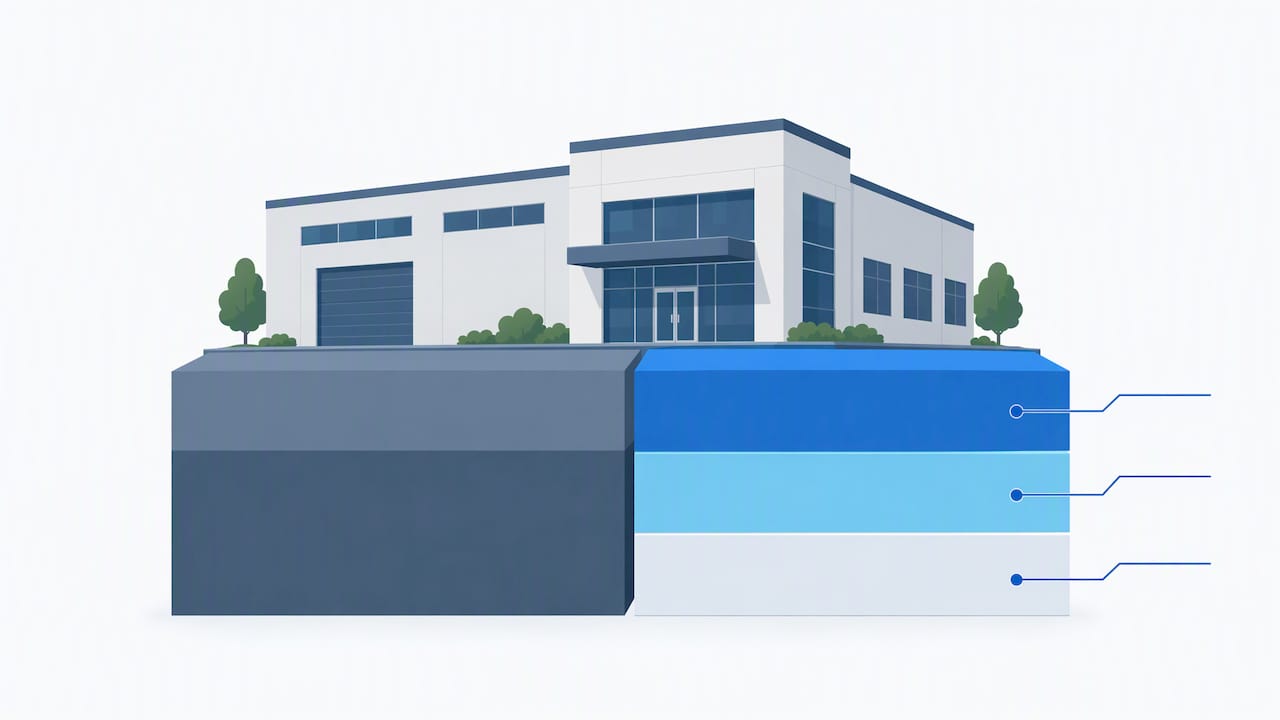
The Congressional Research Service explains the difference. The bank’s rate is negotiated between you and the lender and can be fixed or variable. The CDC portion is a fixed rate that is determined only when the SBA sells the debenture to investors.
Here is a simple illustration. On a $2,000,000 project with a typical structure, the split looks like this:
| Piece | Share | Amount | How the rate is set |
|---|---|---|---|
| Bank first lien | 50% | $1,000,000 | Negotiated with the lender, fixed or variable |
| CDC debenture | 40% | $800,000 | Monthly debenture sale, fixed for the term |
| Your equity | 10% | $200,000 | No interest |
The blended cost of the project is a weighted average of the two rates. Because the CDC portion is fixed and long term, it is the part of the structure that gives you payment certainty. For how the equity share can change with project type, see our guide to SBA 504 eligibility in Florida.
SBA does not pick the 504 rate. The market does. According to the SBA’s Standard Operating Procedure as reproduced in a compliance reference, the rate for 10-, 20- and 25-year debentures is based on market conditions for long-term government debt at the time of sale. In practice the 10-year Treasury is the usual benchmark for 20- and 25-year debentures, and the 5-year Treasury is the benchmark for 10-year debentures.
The chain works like this:
So the rate you pay is the investors’ price for lending to the SBA-backed pool, plus the program’s costs. It is not a markup chosen by your CDC.
The sales happen on a fixed calendar. Per the monthly 504 rate page, 20- and 25-year debentures are pooled and sold on the first Thursday of the first full week of each month, a week that begins on Sunday. Ten-year debentures are sold every other month, starting with the January sale.
Because the sale date moves with the calendar and Treasury yields move every day, each month’s pool prices differently. A few things drive the change:
The swings can be large over time. The SBA announced on November 13, 2020 that 504 debenture rates had fallen to 2.231% for 10 years, 2.364% for 20 years and 2.399% for 25 years. In October 2026, SBA Pulse lists 6.600% for 10 years, 6.975% for 20 years and 6.974% for 25 years, effective October 8, 2026.
That same table also shows lower rates for manufacturing projects: 6.301% for 10 years, 6.725% for 20 years and 6.740% for 25 years. If your project qualifies as a manufacturer, ask your CDC which rate table applies.

Many owners assume SBA approval fixes the rate. It does not. Approval confirms the loan structure, but the rate is not known until the debenture is priced and sold, which happens near funding.
The effective rate is calculated by the Central Servicing Agent once the Fiscal Agent provides debenture pricing. It is usually posted by the day before funding at the latest. In other words, there can be a gap between the day you sign and the day you learn your final CDC rate.
Two practical points follow:
The published 504 rates are not the raw bond yield. They include the program’s costs. The research on this topic points to these components:
The rate table is only part of the cost. Closing costs, legal fees and the up-front fees add to it. Our article on getting a real SBA 504 fee number before you sign walks through how to ask for that figure, and our SBA 504 loan page lists the approximate fees.
The amounts are illustrative only, using the 25-year rate of 6.974% from the October 2026 table and ignoring fees and the short first coupon. On the $800,000 CDC portion from the earlier example, the monthly principal-and-interest payment would be roughly $5,640. If the rate were half a point higher, at 7.474%, it would be roughly $5,900. That is about $260 more each month, or about $3,100 per year, for the same loan.
A few things limit the practical effect:
If you expect to pay off early, read about prepaying an SBA 504 loan first, because prepayment terms affect whether a later refinance makes sense.
Since the rate comes from the sale that funds your loan, timing decisions have a real effect, though not one you can control precisely.
The best you can do is prepare a complete file early and keep your closing on schedule. Our 60 to 90 day closing checklist shows what a CDC needs from you to hit a target funding month. Trying to guess the market is far less reliable than avoiding delays.
The three terms price differently, and the right one depends on the asset. In the October 2026 table, 20- and 25-year rates are nearly identical, while the 10-year rate is lower. Real estate usually fits the longer terms. Equipment is typically matched to useful life, and our guides to 10, 20 and 25 year terms and to matching an equipment loan term explain how to decide.
A shorter term lowers the rate but raises the payment, because you repay principal faster. The same trade-off shows up in other lending, and a piece on comparing mortgage term lengths illustrates it clearly.
If you are choosing between fixed and variable structures for the bank portion, see our fixed versus variable loan comparison.
We have worked with small businesses on SBA 504 financing for more than 35 years, and the monthly rate is the question owners ask most. Our view is that the headline number deserves less attention than the structure behind it.
The CDC portion is a long-term fixed rate set at a single moment. You cannot predict that moment, and you do not need to. What you can control is whether your project is ready to fund when you intend it to, and whether you understand the all-in cost, with fees, before you commit.
We suggest owners do three things:
A fixed rate on the larger-term piece is the reason many Florida businesses choose 504 over a single floating-rate loan. It lets you budget for years, even if one month’s rate is not the lowest you will ever see.
— PHENYX
If you are buying, building, renovating or refinancing commercial property, or buying long-life equipment, we can walk you through the structure, the likely CDC rate and the fees before you commit. Our SBA 504 Loan Program covers purchases and construction, and our SBA 504 Refinance Program covers refinancing existing debt. If timing is tight, ask about our 504 Velocity Bridge Loan Program.
Veterans can also ask about VetLoan Advantage Plus. To discuss your project, reach us through FBDC.
The market sets it. The CDC portion is based on long-term Treasury yields at the time the debenture is sold to investors. Your CDC and the SBA do not choose it. The bank’s rate on the first lien is negotiated separately.
For the CDC portion, loans that fund in the same month and term receive the same effective rate, regardless of which CDC services them. Manufacturing projects can have a different, lower table. The bank’s rate varies by lender and borrower.
No. The rate is determined when your debenture is sold, near funding. The effective rate is typically posted by the day before funding at the latest. After funding, the CDC portion stays fixed.
Yes, the effective rate includes allowable program costs such as the SBA guarantee fee and the CDC servicing fee. Other closing costs are separate. Ask your CDC for an all-in estimate so you can compare it fairly with other loans.

