


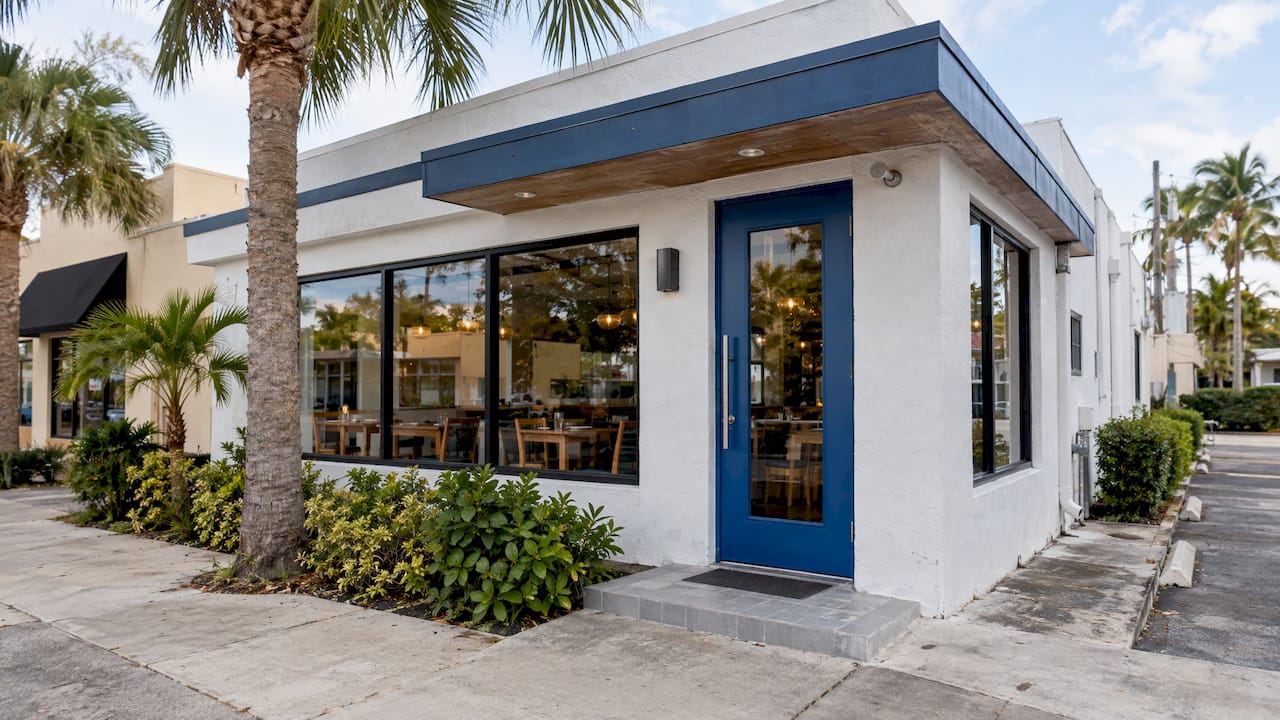
If you run a restaurant in Florida and want to own the building, the SBA 504 loan is built for that job. It lets a for-profit business buy, build, renovate or refinance the property it operates in, with as little as 10% down and a long-term fixed rate on the largest part of the project. At FBDC, SBA 504 lending is what we do, and we have been doing it for over 35 years.
This guide covers what the loan finances, how a restaurant qualifies, what the down payment looks like, which documents you need and how the process runs from first call to closing.
Fbdc
Buy Your Restaurant Building With Less Down
FBDC specializes in SBA 504 lending, with down payments as low as 10% and long-term fixed rates for eligible Florida businesses.
A restaurant owner usually meets four types of financing when looking at property:
For an owner-operator who wants a stable occupancy cost, the 504 is the structure to start with. A down payment of 10%, a fixed rate on the long-term portion and a repayment schedule that does not balloon are the features that make a restaurant building affordable to buy rather than lease. Our guide on how restaurant owners can buy their building with an SBA 504 loan walks through that case in more detail, and our overview of commercial real estate financing in Florida compares the options side by side.
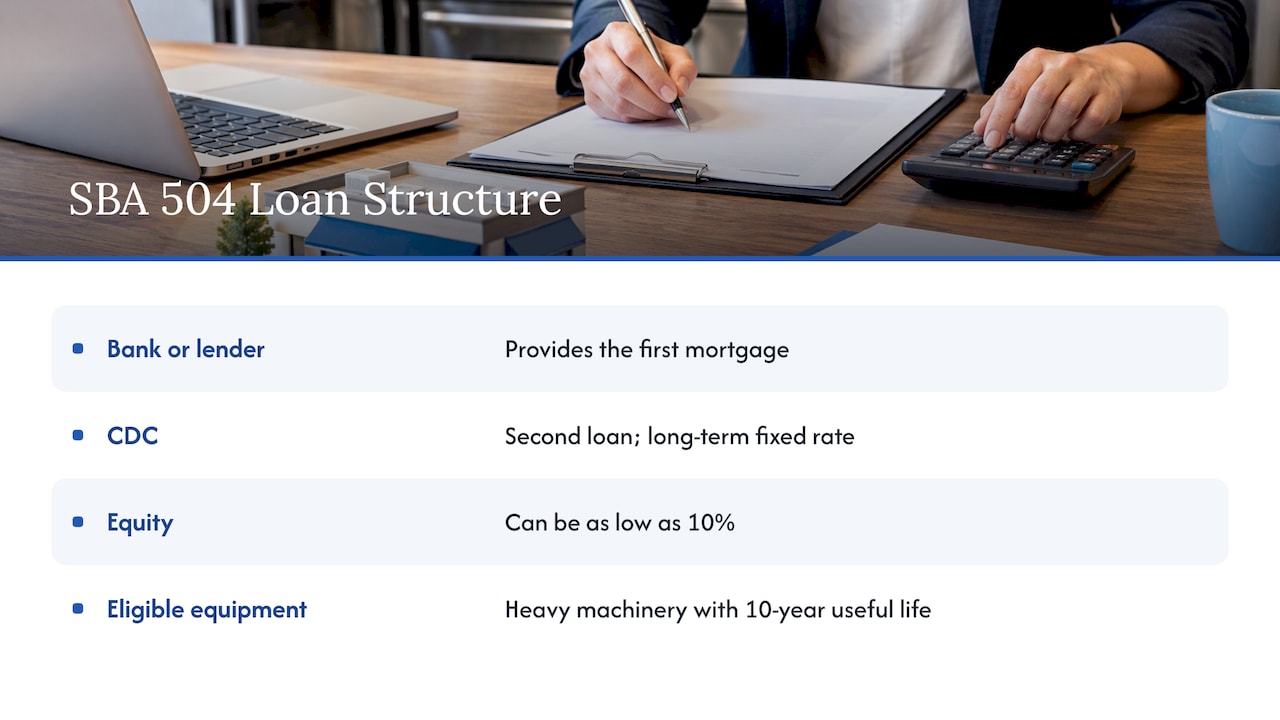
A 504 project is split between lenders. A bank or other lender provides the first mortgage. A CDC provides a second loan, funded through a debenture (a bond sold to investors and backed by the SBA), which is the part that carries a long-term fixed rate. You contribute the remaining equity, which can be as low as 10% of the project.
That split is why the 504 works for restaurants that cannot spare 20% to 30% of a purchase price in cash. The money you do not put into a down payment stays in the business for payroll, inventory and the slow months every restaurant has.
Project costs that can be included are generally the purchase price or construction cost, renovation and some closing costs. The program also covers heavy machinery and equipment with at least a 10-year useful life, which matters if your build-out includes fixed kitchen systems. Our page on equipment financing with 10% down explains what qualifies.
Say you find a $1,500,000 building in Florida where your restaurant will occupy the space. On a standard 504 structure with 10% equity, your contribution is $150,000. The rest comes from the first-mortgage lender and the CDC portion. Compare that with a conventional loan requiring 25% down: your cash at closing would be $375,000. The difference of $225,000 is working capital you keep.
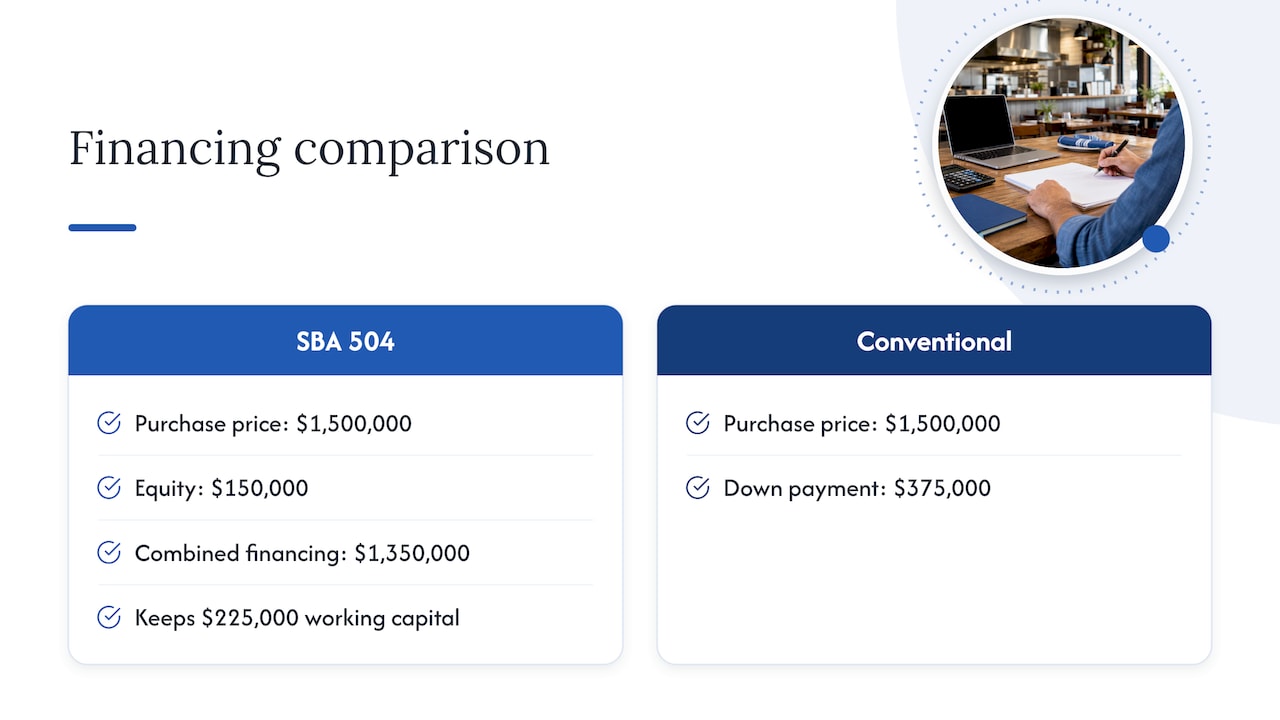
This is an illustration of the arithmetic only. Your actual structure, rate and closing costs depend on the project, the lender and the underwriting. Our page on the SBA 504 loan and its approximate fees lists the fee categories you should expect to see.
Some conventional lenders treat restaurants as special-purpose properties, which usually means a larger down payment. According to a 2025–2026 benchmarks report on SBA underwriting, the SBA program classifies restaurants as standard retail or general-use property for loan-to-value purposes, which allows a standard 90% loan-to-value (10% equity) rather than the higher equity required for assets such as hotels.
For a restaurant owner this is the main point. The building you cook in is not penalized for being a restaurant when the financing runs through the 504.
Restaurants run on thin margins, and lenders know it. The same benchmarks report notes that restaurant deals face a stricter underwriting climate, with typical debt-service coverage ratio requirements between 1.25x and 1.50x.
Debt-service coverage ratio (DSCR) is your annual cash available for debt payments divided by your annual loan payments. At 1.25x, you generate $1.25 of cash flow for every $1.00 of required payments.
That result clears a 1.25x threshold. If your number lands lower, adjust the project: a smaller purchase, a longer-term structure, or more equity. Ownership often improves the picture because a mortgage payment on a building you own can replace rent you were already paying.
Two changes deserve attention before you commit to a property.
Owner citizenship and residency. Effective January 1, 2026, SBA rules generally require owners to be U.S.-resident citizens, nationals or lawful permanent residents, with specified exceptions. The same SBA notice allows up to 5% aggregate ownership by certain foreign nationals and U.S. persons residing outside the country without making the business ineligible, as long as they are not Ineligible Persons under 13 C.F.R. 120.100. If your restaurant has partners or investors outside the United States, map the ownership percentages before you apply. Our post on the 2026 SBA update and how to qualify goes through the changes.
Personal resources test. The benchmarks report states that in 2025 the SBA reinstated a personal-resources test: for packages above $1 million, owners of 20% or more with liquid assets exceeding 1x the financing or $2.5 million, whichever is greater, may be ineligible. This affects only owners with substantial liquid wealth, but it is worth confirming early.
The program also finances for-profit businesses only. Non-profits, and businesses looking for working capital or inventory loans, need a different product.
A complete file shortens the timeline more than anything else you control. Lenders on SBA loans generally ask for three years of business and personal tax returns, interim financial statements, debt schedules and resumes of the principals. The same application form calls for interim business financial statements dated within 120 days and a business plan if the business is under two years old.
For a property project, add:
Keep your interim statements current. A profit-and-loss statement that is older than 120 days is the most common reason a package is sent back for an update.
If timing is the problem, for example a seller who wants a fast close, our 504 Velocity Bridge Loan Program is designed for SBA 504 projects that need bridge financing.
Many restaurant owners already own their property on a short-term or balloon loan that is coming due. The SBA 504 Refinance Program lets eligible businesses refinance commercial real estate into long-term fixed-rate financing, which can steady your monthly payment and your planning.
If you are a veteran, our VetLoan Advantage Plus program is built for veteran-owned small businesses. If the project is smaller, our Direct Lending Program and Down Payment Assistance Program exist for those cases. You can see both on the Direct Lending Program page and the VetLoan Advantage Plus page.
Restaurant owners tend to think of real estate as a second project that comes after the restaurant is established, and they assume it needs a large pile of cash. That assumption is what keeps many good operators renting for decades.
We see the 504 differently. Cash is the scarcest resource in a restaurant, so a financing structure that asks for as little as 10% down, locks the long-term portion at a fixed rate and amortizes it without a balloon is a structure designed for the way restaurants actually earn money. Your occupancy cost becomes predictable, and the building becomes an asset you own.
The other thing we emphasize is preparation. Cash flow, ownership structure and a complete document package decide the speed of a deal. After more than 35 years in SBA 504 lending, our approach is to look at those items with you first, so the process stays swift and streamlined and there are no surprises at underwriting.
PHENYX
FBDC is a Florida SBA 504 lender focused on for-profit small businesses that want to acquire, build, renovate or refinance commercial real estate, or buy long-life equipment, with low down payments and fixed rates. If you have a building in mind or a loan coming due, start with our SBA 504 Loan Program page, or read about SBA 504 loans anywhere in Florida.
We can review your project, your numbers and your ownership structure and tell you how a 504 would be structured for your restaurant.
With an SBA 504 loan, the down payment can be as low as 10%. The SBA treats restaurants as standard-use property for loan-to-value purposes, so the restaurant label alone does not push you into a higher equity requirement. Your actual figure depends on the project and underwriting.
Startups are considered, and the lender will rely heavily on your business plan, the principals’ experience and personal financial strength. Because restaurants face tight underwriting, with typical DSCR requirements of 1.25x to 1.50x, a well-documented plan matters. Our team can review your plan and the structure with you before you apply.
Expect three years of business and personal tax returns, interim financial statements within 120 days, a schedule of debts and resumes for the principals. A business plan is required for businesses under two years old. Property projects add contracts, quotes and environmental reports.
The 504 covers machinery and equipment with a useful life of at least 10 years. That can include fixed equipment that is part of the project. Inventory and working capital are not covered by the program.
They can. Since January 1, 2026, SBA rules generally require owners to be U.S.-resident citizens, nationals or lawful permanent residents, with a limited 5% aggregate exception for certain other owners. Review your ownership table before applying.

