


A restaurant owner can buy the building with an SBA 504 loan by pairing a bank loan with a second, SBA-backed loan from a Certified Development Company (CDC). The owner puts down as little as 10%, gets a long-term fixed rate on the CDC portion, and the restaurant must occupy most of the property. The program is built for owner-occupied real estate, so it fits a restaurant that wants to stop paying rent and start building equity.
Below we explain how the loan is structured, what a restaurant has to prove, what it can and cannot finance, and the order of steps from first call to closing.
Fbdc
Explore SBA 504 Building Financing
FBDC specializes in SBA 504 lending for businesses buying real estate, with down payments as low as 10% and long-term fixed rates.
Rent is usually a restaurant’s second-largest fixed cost after labor, and it resets at lease renewal. An owner who buys the building replaces a payment that can rise with one that is fixed for the life of the loan. That predictability matters in a business where margins are thin and a landlord’s decision can end a lease right after you have invested in a build-out.
Ownership also changes what the buildout is worth. Money spent on hoods, grease traps, patios and dining rooms in a leased space improves someone else’s asset. In a building you own, it improves yours.
Conventional commercial mortgages often ask for 25% to 30% down, which for a $2 million building is $500,000 or more in cash that a restaurant usually needs for operations. The 504 structure exists to lower that barrier. If you want the broader picture of financing paths in our state, see our guide to commercial real estate financing in Florida.
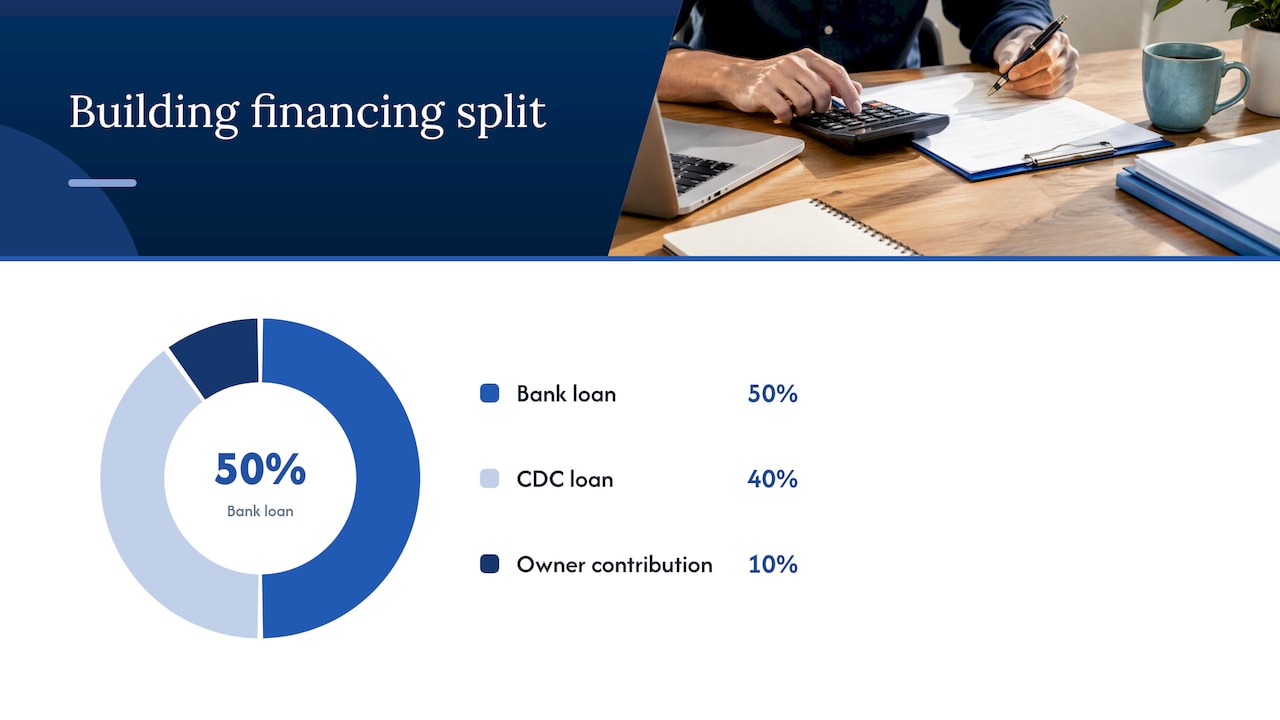
A 504 project has three participants, and each takes a defined share:
ParticipantTypical sharePositionThird-party lender (usually a bank)50% or moreFirst lienCertified Development CompanyUp to 40%Second lienBorrowerAt least 10%Equity
These shares come from the SBA’s lender resources, which also explain that a CDC is a nonprofit corporation certified and regulated by SBA to support economic development in its community. The CDC portion is funded through a debenture backed by SBA, and it is the piece that carries a fixed rate for a 10-, 20- or 25-year term, as described on the SBA’s 504 page.
Suppose a restaurant owner finds a $2,000,000 building. This is an illustration of the structure, not a quote:
Compare that with a conventional loan requiring 25% down, which would mean $500,000 of the owner’s cash. The difference of $300,000 stays in the business for equipment, staffing or a second location’s deposit. Closing costs and fees are separate, and your CDC should itemize them early. Our 504 loan page lists the approximate fees.
The equity requirement is a minimum. Depending on the project, a lender or CDC may ask for more than 10%, so treat 10% as the best case and confirm the number for your own deal.
The senior lender’s willingness to take the first-lien position is often the first gate in the process. A bank that sees a restaurant with solid sales history and a modest loan-to-value on its own share is more likely to say yes, because the CDC’s second lien reduces its exposure. This is the reason CDCs matter. As we explain in how a CDC cuts bank risk and helps close faster, the CDC handles SBA paperwork and gives the bank a smaller, safer piece of the deal.
The 504 program finances owner-occupied property. For an existing building, the business generally has to occupy at least 51% of the space. For new construction, the usual threshold is 60% at the start, with the occupancy expected to grow over time. Our occupancy checklist for Florida small businesses walks through how lenders measure this.
For a restaurant, this works out in practical ways:
The SBA’s own materials describe the occupancy requirement as a core feasibility factor, so ask your CDC to review the floor plan before you sign a purchase contract. For a deeper look at the lender’s perspective, read about owner-occupied versus investment property.
Beyond occupancy, the program has several baseline requirements.
Our article on four checks before approaching a CDC in Florida covers these in more detail, and our 2026 update on SBA qualification and citizenship changes explains what changed this year.
The 504 program finances major fixed assets. For a restaurant buyer, that typically means:
It does not cover working capital, inventory, or general operating expenses. If you need cash for payroll or food costs, plan a separate source.
Many owners buy a building because they want to reconfigure it: a bigger line, better ventilation, more efficient refrigeration. Decide early how much of the work is real estate improvement and how much is equipment, because the two are treated differently. Thoughtful layout also lowers costs later, and resources on commercial kitchen interior design can help you think through workflow before you set a renovation budget. Ask your CDC which equipment items meet the 10-year useful-life standard, since not every appliance will.
Fees paid to secure financing are generally not deducted in full in the year you pay them. An IRS memorandum endorses capitalizing and amortizing such fees over the life of the loan. Ask your accountant how this applies to your closing costs before you build your cash plan.
Timelines vary with the property and the complexity of the file. Our CDC lender checklist for 504 real estate loans outlines a 60 to 90 day path. If a seller will not wait that long, ask us about our 504 Velocity Bridge Loan Program.
We have worked in SBA 504 lending for more than 35 years, and the restaurant owners who do best treat the application as planning, not paperwork. The SBA’s own success stories make a similar point: the process pushes owners to formalize projections and operations, and that discipline helps long after closing.
Three habits we see in strong files:
We also encourage veterans to document their status at the start. Our VetLoan Advantage Plus program is designed for veteran-owned businesses seeking affordable financing, and the details are in our guide to 504 loans for veterans.
FBDC is a Florida-based SBA 504 lender with a focus on owner-occupied real estate, equipment and refinancing. If you are a restaurant owner weighing a purchase, we can review the property, the occupancy math and the structure with you before you commit. Start on our SBA 504 Loan Program page, or if your project is smaller, look at our Direct Lending Program.
Restaurants are approved, but lenders look closely at cash flow, operating history and the strength of the business plan. A real estate purchase can be easier to support than a startup loan, because the building is collateral and the project is owner-occupied. Talk to a CDC early so you know where your file is strong and where it needs work.
The project assets, meaning the building or equipment being financed, generally secure the loan, with the bank in first position and the CDC in second. Lenders may also ask for personal guarantees from owners of 20% or more of the business. Your CDC can tell you what applies to your specific file.
Yes, as long as your restaurant occupies enough of the property to meet the owner-occupancy rule, generally 51% for an existing building. Leasing the rest is possible within that limit. Share your floor plan with a CDC before making an offer.
No. The 504 program is for major fixed assets such as real estate and long-life equipment. Plan a separate source for payroll, inventory and other operating costs.

