


The lowest SBA 504 down payment is 10% of total project cost. That is the federal baseline for most Florida owner-users buying a building or long-lived equipment. The figure rises to 15% for a business that has operated two years or less, or for a special-purpose property. It rises to 20% when both apply. The rest of this guide shows how the percentage is calculated, what counts toward it, and how to plan your cash.
Fbdc
Finance Your Business Purchase With Less Upfront
FBDC provides SBA 504 financing for Florida businesses acquiring real estate or equipment, with down payments as low as 10% and over 35 years of experience.
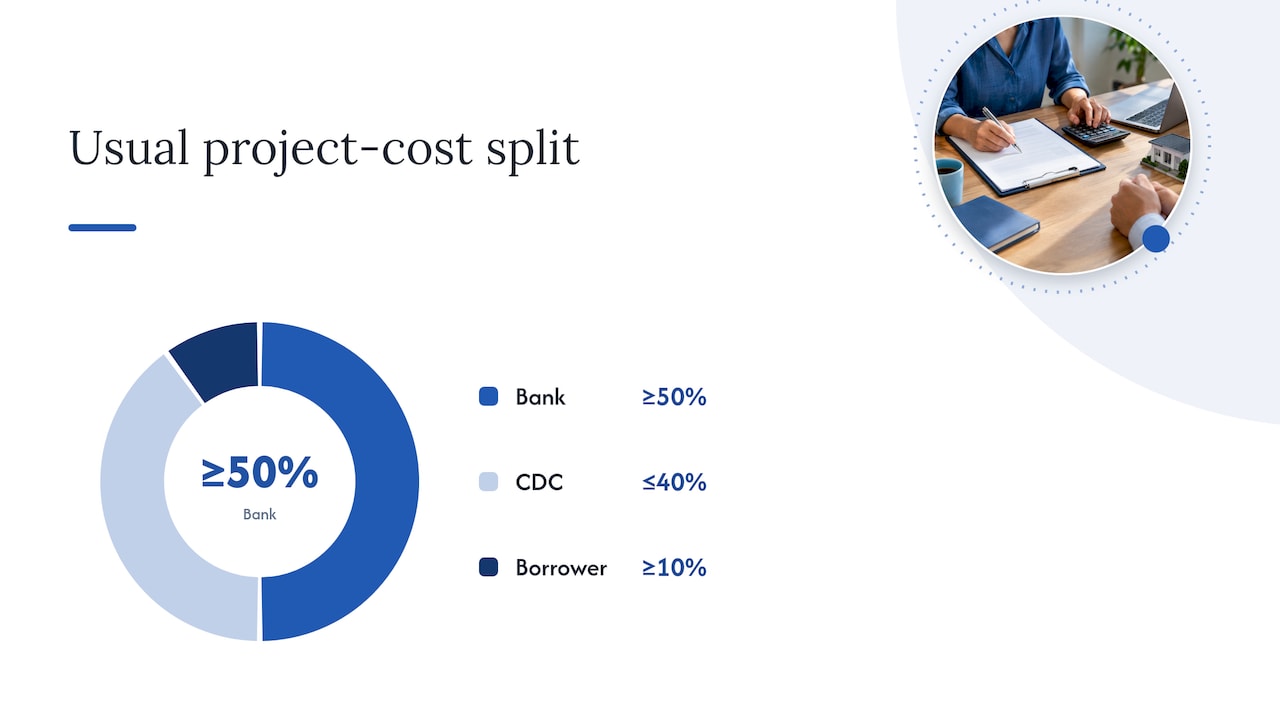
An SBA 504 loan has three parts. A bank or other private lender takes a first lien. A Certified Development Company (CDC) provides a second, SBA-backed loan. You provide the rest. The OCC describes the usual split: the bank covers 50% or more of project cost, the CDC up to 40%, and the borrower at least 10%.
The SBA says 504 loans are available only through Certified Development Companies, which work with a senior lender. FBDC is a Florida CDC that sponsors 504 projects, so the structure above is the one we use every day.
The down payment is called a borrower contribution or equity injection. It is not a fee or a deposit. It is your share of the project, and it reduces what the bank and the CDC have to fund.
The rule sits in the SBA’s regulations for the 504 program. The percentage is measured against project cost, excluding administrative costs. The tiers are:
Your situationMinimum borrower contributionEstablished business (more than two years), standard property or equipment10%Business or operating company operating two years or less15%Limited-use or single-purpose building or structure15%Both a business two years old or younger and a single-purpose property20%
The regulation also lists other circumstances under §120.910, so confirm your exact case with a CDC before you build a budget. The same section says the contribution is measured on project cost, not on the loan amount.
This is the category owners most often miss. A building designed for one specific use, rather than for many kinds of tenants, can trigger the higher percentage. A general office, a light-industrial building or a warehouse is usually the kind of property that fits the standard tier. We review the property type with you at the start, so you know your percentage before you sign a purchase contract. Our guide to Florida warehouse loans with 10% down shows how that works for owner-users.
People searching for an SBA 20% rule are often asking about this top tier. For 504, it applies only when both conditions are met: the business has operated two years or less, and the project involves a limited or single-purpose building. One condition alone gives you 15%.
The National Association of Development Companies publishes a sample with an $800,000 building, $100,000 of renovation, $50,000 of machinery and $50,000 of soft costs. Financing is $500,000 from the bank, $400,000 from the SBA 504 loan, and $100,000 from the borrower.
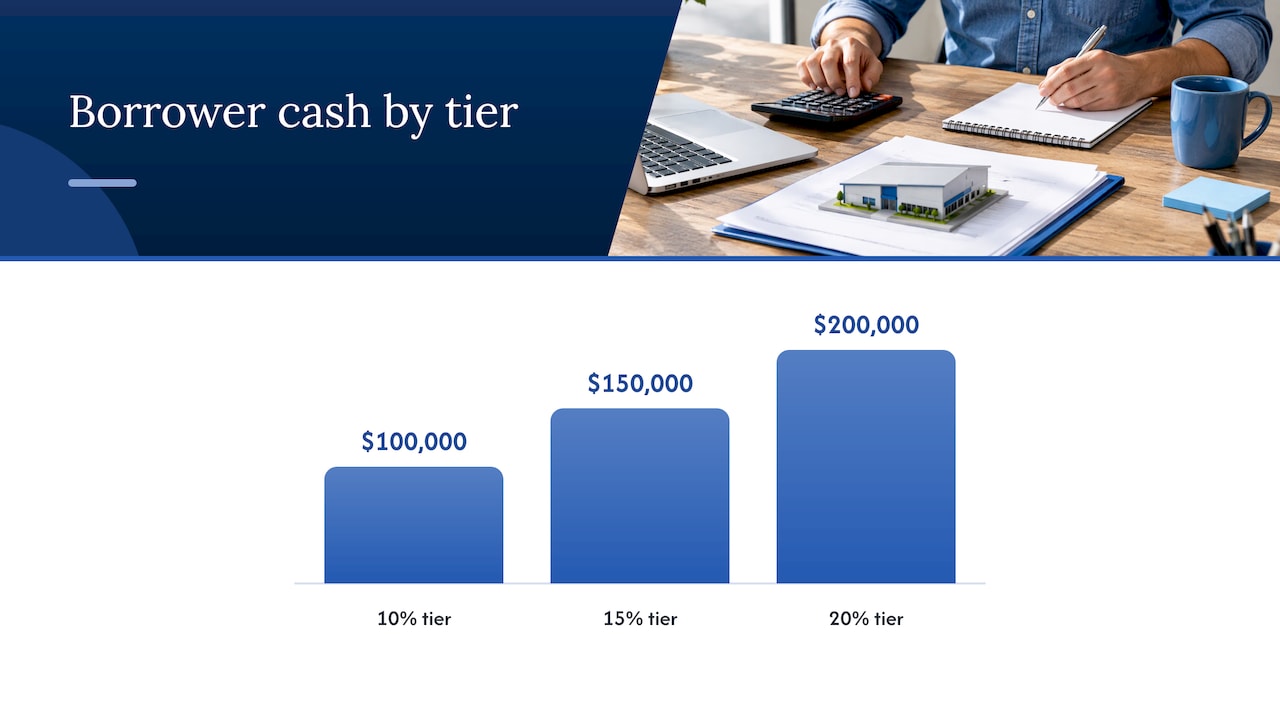
Here is how the borrower share changes with the tier, using the same $1,000,000 project and keeping the bank at 50%:
TierYour cashBank (50%)CDC portion10%$100,000$500,000$400,00015%$150,000$500,000$350,00020%$200,000$500,000$300,000
The CDC figures are our arithmetic from the 50% bank share and the contribution tier. The senior lender negotiates its own rate, term and fees with you. The OCC notes the bank sets its own rate, term and fees with the borrower.
Compare that with a conventional commercial real estate loan, where lenders commonly ask for a much larger share of the purchase price. That difference is why owners who want to keep cash for payroll, inventory and growth look at 504 first. If you are weighing it against another SBA product, our comparison of SBA 504 vs. 7(a) covers the tradeoffs.
Because the percentage applies to project cost, it helps to know what goes into that number. Under 13 CFR §120.882, eligible costs include costs directly attributable to the project, including land acquired for it and expenses incurred before the SBA application. In practice that covers:
For construction, the same rule allows a contingency reserve of up to 10% of construction cost for overruns. That reserve is part of the project budget, so include it when you calculate your contribution.
SBA describes 504 financing as covering land and buildings, plus machinery and equipment with at least a 10-year useful remaining life. Working capital and inventory are not ordinary eligible uses. If your main need is operating cash, a 504 loan is not the right tool.
To see how a lender reads your numbers before they build the structure, review this guide to SBA loan financial statements. A clean set of statements speeds up the project budget and the contribution calculation.
The regulation allows several sources. Your contribution can be cash, property acceptable to SBA obtained with cash, project land, or borrowed cash. Borrowed contributions carry restrictions. The source may be a CDC or any other source except an SBA business loan program, with a narrow exception for SBICs.
Two practical cases come up often:
Your CDC confirms which sources qualify for your deal before you commit to a structure.
Owners often ask whether closing costs sit on top of the 10%. NADCO states that 504 loan fees are added to the loan amount and amortized over the loan term, so they are not out-of-pocket expenses for the borrower. You may still have third-party costs tied to your own purchase, such as appraisals or inspections, so ask for a full sources-and-uses sheet early. Our approximate fees are listed on the SBA 504 program page.
You can put in more than the minimum. The OCC says the bank portion can exceed 50%, or the CDC can finance less than 40%, as long as the required borrower injection is met. A larger contribution shrinks the total you borrow and the payments that follow. Most owners we work with weigh that against the cash they want on hand for operations.
The CDC portion carries a long-term fixed rate, with terms of 10, 20 or 25 years. Our overview of 504 loan terms explains how each term fits different assets.
We built our 504 process around one question: how much cash does an owner need to keep in the business after closing? For most established Florida companies, the answer starts at 10% down, with a long-term fixed rate on the CDC portion.
Owners tend to look at the headline percentage and stop. We look at the whole project. Do the numbers include a construction contingency? Is the building a standard property or a single-purpose one? Is the business past its second year? Answering these first gives you a real figure for your cash, before the purchase contract is signed and before surprises can appear.
After more than 35 years in this work, our view is simple. A 504 loan is best used by owner-users who want to own the property or equipment they operate, and who want to protect working cash. We also have programs around the core loan, including a bridge program and direct lending for smaller projects, so that timing and size do not block a good deal.
PHENYX
Timing matters too. Read how to close an SBA 504 loan in Florida in 60 to 90 days, and check our guide to four eligibility checks before you apply. The SBA says borrowers must be operating, for-profit U.S. businesses that are small under SBA size standards and not in an ineligible category.
Some borrowers need more than the standard structure:
If you are planning to buy, build, renovate or refinance commercial property, or buy long-lived equipment, we can tell you your down payment tier and a realistic project budget before you commit. We offer SBA 504 financing with down payments as low as 10%, and our team guides you through each step.
Start on our SBA 504 Loan Program page, or see 504 loans anywhere in Florida to find out how we serve your area.
Yes, if you qualify for the standard tier. The federal minimum is 10% of project cost, excluding administrative costs, unless a §120.910 exception applies. Your business age and property type decide whether you land at 10%, 15% or 20%.
It is based on the whole project cost. On a $1,000,000 project, 10% is $100,000, even though the bank and CDC portions together are larger. NerdWallet’s explanation of 504 contributions also frames the standard figure as a share of total project costs.
A business or operating company that has operated two years or less must contribute at least 15%. If the project is also a limited-use or single-purpose property, the minimum is 20%. Ask a CDC to review your timeline and property type together.
Sometimes. OCC guidance says seller financing can count when it is subordinate to the SBA loan, has a term equal to or longer than the 504 loan, and is generally on standby for a period. Your CDC confirms whether your seller’s terms qualify.

