


Yes, SBA 504 loans can finance commercial property renovations when the work qualifies as an eligible fixed-asset project cost under SBA rules. The typical capital stack splits the project between a bank (around 50%), a Certified Development Company or CDC (around 40%), and borrower equity (around 10%). The main exceptions are working capital, inventory, and speculative real estate investments, none of which qualify under this program.
TL;DR:
- Eligible costs include construction, site improvements, professional fees, and bridge financing, with contingency capped at 10%; working capital, inventory, and some remediation may be excluded.
- Most borrowers contribute about 10% equity, while new construction or special purpose properties often require 15% or more of the project cost.
- Existing buildings require owners to occupy at least 51% of the space, while new construction requires at least 60% owner occupancy initially.
- Most projects close in 60 to 90 days, but incomplete estimates, environmental reviews, or lien issues can delay funding, so order due diligence early.
- Match the contractor’s payment draws to lender disbursement terms before signing the construction contract, and require lien waivers at each draw.
The 504 program covers a wide range of renovation-related expenses, but each cost category has to fit within eligible project costs listed in 13 CFR §120.882. Lenders and CDCs review these costs line by line before committing funds, so understanding what counts (and what documentation backs each line) saves time during underwriting.
Eligible costs generally include:
Working capital, inventory purchases, and speculative real estate investments fall outside these rules and cannot be funded through a 504 loan. Each cost category needs supporting paperwork: signed contracts, itemized invoices, and a clear scope of work. Skipping this step is one of the most common reasons renovation requests stall in underwriting.
Borrower qualification for a 504 renovation loan hinges on a few consistent thresholds that both banks and CDCs check early in the process.
These thresholds shape how a lender structures the loan from the first conversation, so confirming your occupancy plan and equity position early prevents surprises later in underwriting.
Renovation financing under the 504 program follows a defined sequence, with the bank and CDC each playing distinct roles.
Most 504 renovation projects close within 60 to 90 days, though incomplete cost estimates, pending environmental reviews, or unresolved lien issues commonly push that timeline out. The bank’s portion typically funds first or alongside interim financing, while the CDC debenture funds at closing and carries the fixed-rate, long-term repayment structure that makes 504 financing attractive for renovation projects with long useful lives.
Renovation projects carry more moving pieces than a straight real estate purchase, so lenders and CDCs ask for a specific due-diligence packet before releasing funds.
Environmental remediation costs sometimes fall outside eligible project costs, which can leave a funding gap if contamination surfaces mid-project. Ordering the environmental site assessment early, before finalizing construction contracts, gives you time to address findings without derailing the closing timeline.
Picking a bank and CDC with actual renovation experience changes how smoothly a project moves. Teams that have closed multiple 504 renovation deals together tend to anticipate documentation gaps before they become delays, and that familiarity often shows up in how quickly conditions get cleared ahead of debenture sale.
Budgeting matters just as much as team selection. Build in a contingency reserve from the start, document how any of it gets used, and keep that paper trail ready for cost certification and loan-to-value calculations at closing.
Pro Tip: Align your contractor’s draw schedule with your lender’s disbursement terms before signing any construction contract, not after breaking ground.
A renovation budget built only around hard construction costs tends to run into trouble. Hard costs (materials, labor, site work) usually make up the bulk of the budget, but soft costs (architectural fees, permitting, inspections, interim interest) often add another meaningful layer on top. The standard contingency reserve allowed under §120.882 caps at 10% of construction costs, and that figure is a floor for planning purposes, not a ceiling for every project.
Borrowers who reserve additional cash outside the loan structure for unexpected findings (asbestos abatement, electrical upgrades, foundation repairs) tend to avoid mid-project financing gaps.
A workable cost breakdown separates:
Tracking these categories separately from day one makes cost certification at closing far simpler, since CDCs need to see exactly how contingency funds were spent if they were used at all.
Contractor selection carries more weight in a 504 renovation than in a conventional construction loan, because the CDC and bank both review contractor qualifications before releasing funds. Choosing a contractor with experience on SBA-financed projects, or at least familiarity with draw-based disbursement, tends to reduce friction once construction starts.
A few practices make subcontractor management smoother under 504 draw schedules:
Coordinating the contractor’s draw schedule with the lender’s disbursement terms and any conditions in the CDC’s commitment letter keeps everyone paid on time and keeps lien waivers captured at each stage. Borrowers who treat this coordination as a one-time setup task, rather than an ongoing check-in with their contractor and lender, are the ones most likely to hit cash-flow gaps mid-renovation.
Permit timing is one of the most common sources of delay in 504 renovation projects, largely because permit approval sits outside the lender’s or CDC’s direct control. Local jurisdictions vary widely in processing time, and a renovation that touches structural elements, electrical systems, or occupancy classification often triggers a more involved review than a cosmetic update.
Coordinating permit timing with your lender and CDC from the outset avoids a common bottleneck: construction draws generally cannot proceed without evidence that required permits are in place or actively in process. Submitting permit applications as early as possible, ideally before finalizing your loan commitment, gives the approval process a head start rather than adding it as a step after financing closes.
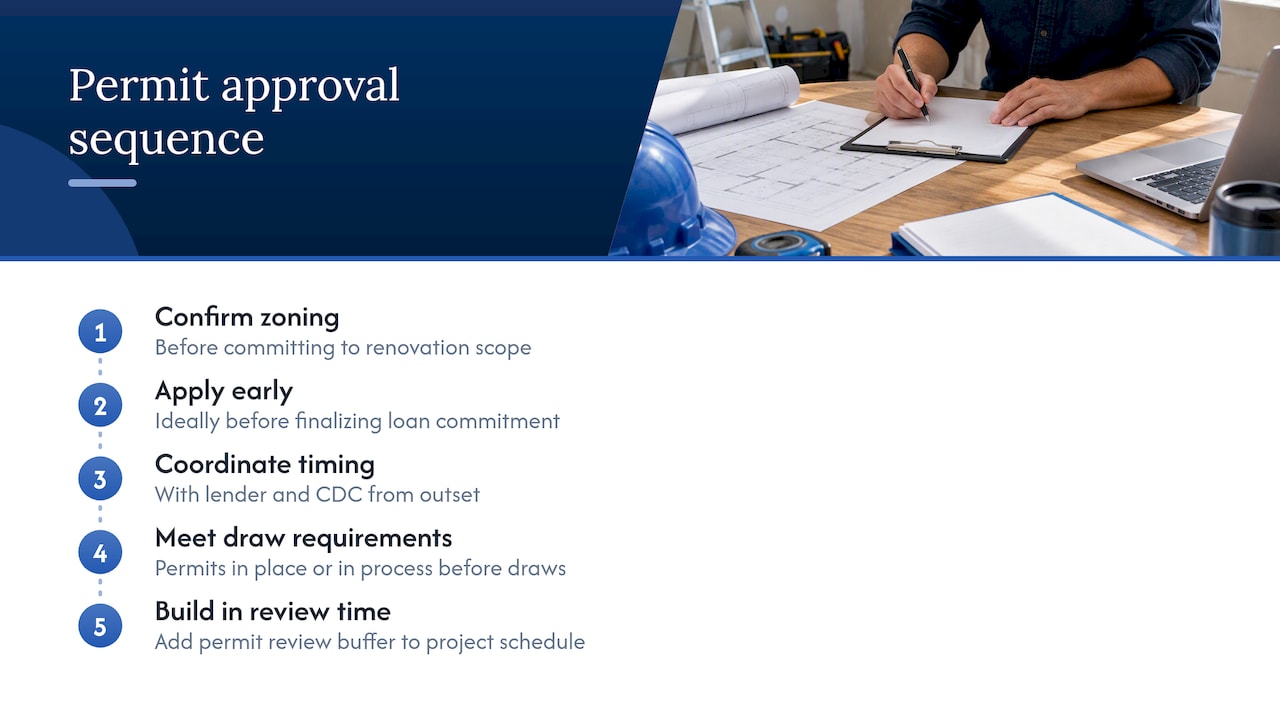
Compliance issues can also surface around zoning, especially when a renovation changes a building’s use or increases occupancy load. Confirming zoning compatibility before committing to a renovation scope prevents a scenario where permits get denied after construction contracts are already signed. Building in a buffer for permit review time, on top of construction time, keeps the overall project timeline realistic rather than optimistic.
Appraisals for 504 renovation projects work differently than a standard purchase appraisal because the valuation needs to reflect the property’s value after renovation, not just its current condition. Appraisers typically use an “as-completed” valuation approach, factoring in the planned scope of work alongside current market comparables.
This matters for loan sizing because the loan-to-value calculation depends on that as-completed figure, not the pre-renovation value. A property that appraises low in its current state but gains significant value from a well-documented renovation plan can still support the full project financing, provided the scope of work and cost estimates are detailed enough for the appraiser to factor them in accurately.
Incomplete or vague construction plans tend to produce more conservative appraisals, since appraisers can only credit value for improvements they can clearly verify from the documentation provided. Detailed plans, specifications, and contractor estimates submitted alongside the appraisal request generally support a more accurate as-completed value, which in turn supports stronger loan sizing.
Renovation scopes financed through the 504 program tend to fall into a few recurring patterns. A common example involves a business purchasing an older commercial building below market value specifically because it needs updating, then using 504 financing to cover both the acquisition and the renovation in a single structured loan. Another frequent scenario involves an existing owner-occupied property where the business has outgrown its current layout and needs an expansion or interior reconfiguration to support growth.
Projects involving specialized facilities, such as medical offices needing code-compliant buildouts or manufacturing spaces requiring upgraded utilities, also show up regularly, since the fixed-rate, long-term structure of 504 debt matches well with improvements meant to last the life of the building. Across these scenarios, the common thread is that the renovation supports the business’s actual operations rather than functioning as an investment play, which lines up directly with SBA’s eligibility standards for owner-occupied fixed-asset projects.
With experience structuring SBA 504 financing, our team has worked through renovation projects of various scopes, from interior buildouts to full-site improvements. We help borrowers organize documentation early, including specialty programs like refinance with expansion for businesses whose renovation needs grew after their original financing closed. If you’re planning a renovation, involving your lender early in the project planning can help keep your timeline on track.
— PHENYX
Financing a commercial renovation doesn’t have to mean juggling separate loans for the building and the construction. Through our SBA 504 Loan Program, we structure acquisition and renovation costs into one long-term, fixed-rate loan, and for projects that need interim funding before the debenture closes, our FBDC 504 Velocity Bridge Loan Program helps manage interim interest so it doesn’t eat into your renovation budget.
For businesses whose renovation needs tie into an existing property they already own, our SBA 504 Refinance Program can fold renovation costs into a refinance with expansion structure. We also work with veteran-owned businesses through our VetLoan Advantage Plus program, built around the same low down payment and fixed-rate advantages. If you’re assembling your financial package for underwriting, Brookmont Capital Ventures’ guidance on commercial real estate packaging is a useful resource for sponsors preparing a strong submission.
Contact lenders or Certified Development Companies to discuss your renovation project needs and obtain closing checklists to help guide the process.
SBA 504 loans carry a fixed rate on the CDC debenture portion, set when the debenture is sold at closing, while the bank’s portion of the loan carries its own separate rate. Current rate figures aren’t published as a fixed number here since they change with bond market conditions at each debenture sale; our team can provide current pricing during a consultation.
An SBA 504 loan can fund the purchase, construction, or renovation of owner-occupied commercial real estate, along with eligible site improvements, professional fees, and equipment with a long useful life. It cannot be used for working capital, inventory, or speculative real estate investments.
Yes, SBA 504 loans can be refinanced, including refinance-with-expansion structures that allow renovation or expansion costs to be added to the refinanced balance. Recent Federal Register amendments clarified refinancing standards, including how the “substantially all” threshold applies to qualifying debt.
Working with a bank and CDC experienced in 504 lending tends to make the documentation and approval process considerably more manageable.
Most SBA 504 renovation projects close within 60 to 90 days from application to funding, though incomplete cost estimates or pending environmental reviews can extend that timeline. Ordering due-diligence items like environmental assessments and permits early helps keep the project on schedule.

