


You buy a Florida warehouse with an SBA 504 loan by occupying the building with your own business, splitting the financing between a bank and a Certified Development Company (CDC), and putting down as little as 10%. A CDC is a nonprofit lender certified by the SBA to finance projects like this. FBDC is a Florida SBA 504 lender with more than 35 years of experience, and the steps below follow the order in which a warehouse purchase actually moves.
Fbdc
fbdc.net
Finance Your Florida Warehouse
FBDC provides SBA 504 financing for businesses acquiring real estate, with low down payments and long-term fixed rates.
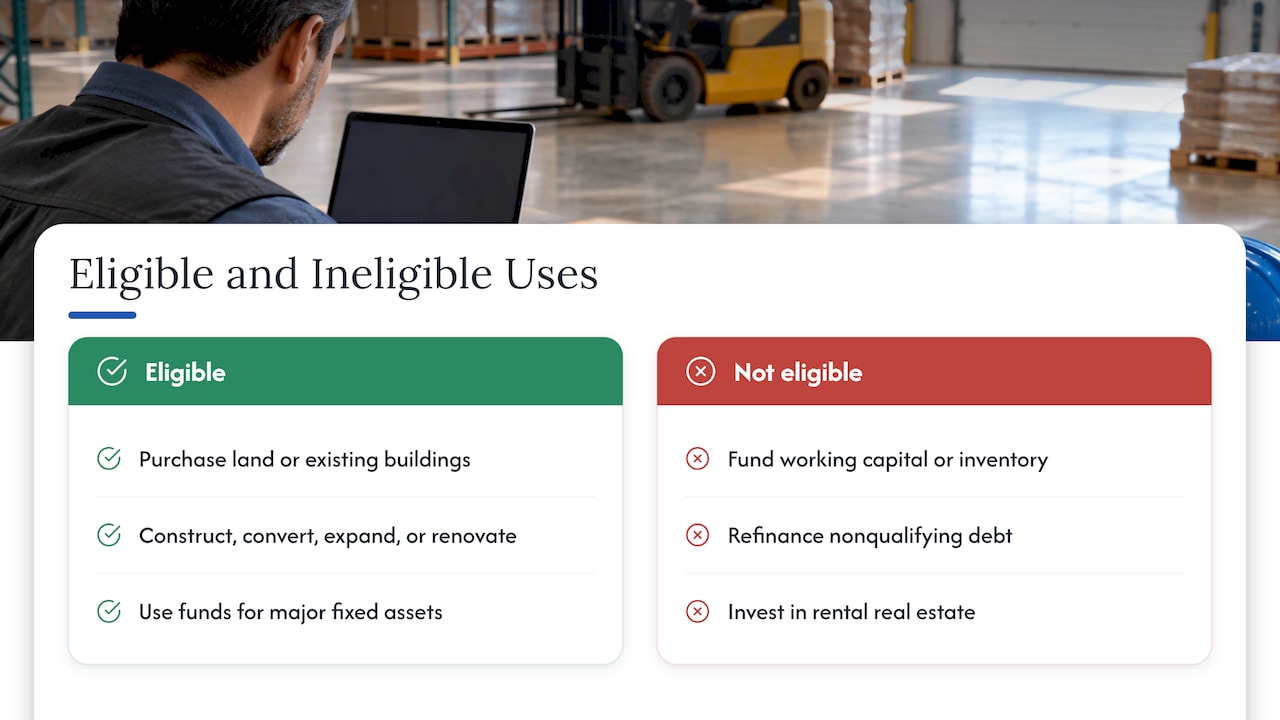
A warehouse is exactly the kind of fixed asset the program was built for. The SBA describes the 504 as long-term, fixed-rate financing for major fixed assets, usable to purchase, construct or renovate existing buildings or land. Federal regulation lists the eligible uses in more detail: acquiring land, buying existing buildings, converting, expanding or renovating them, and building new ones (13 CFR 120.120).
The same rules also say what the loan cannot do. It does not fund working capital or inventory, it cannot refinance debt that does not qualify, and it cannot be used for speculation or investment in rental real estate. If you need cash for stock or payroll alongside the building, plan that money separately.
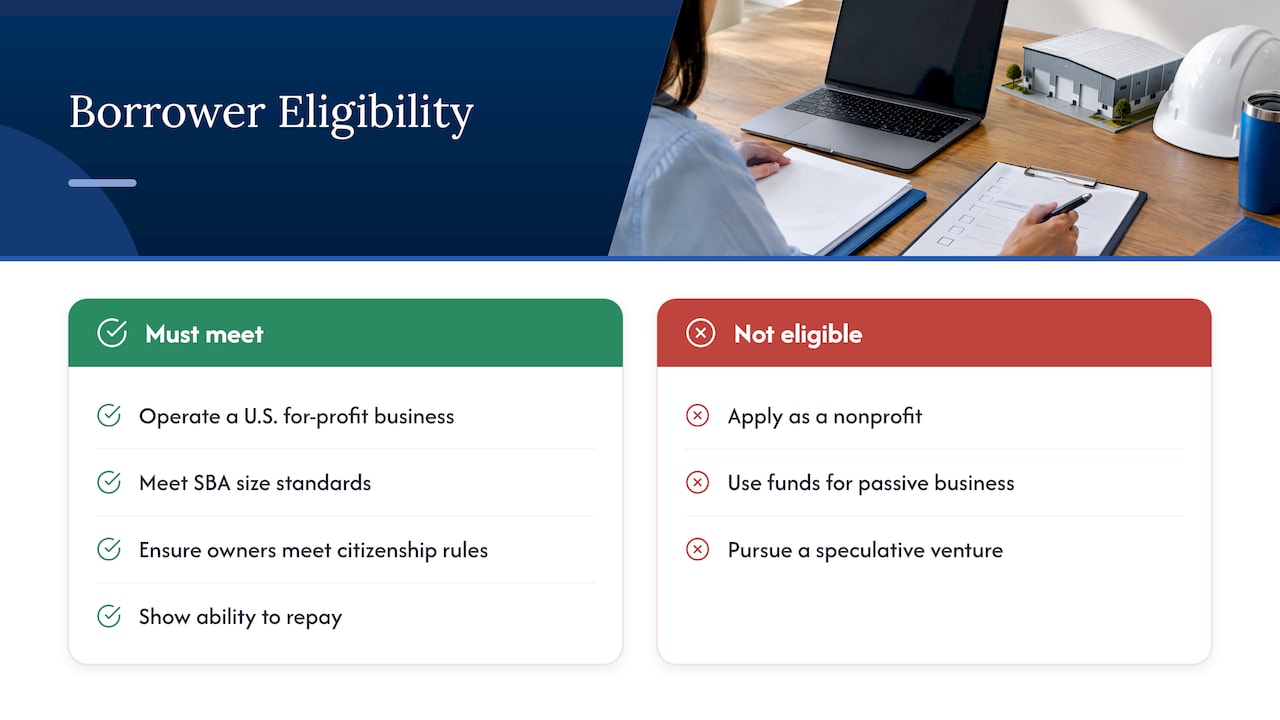
The SBA requires the borrower to be an operating, for-profit business located in the U.S. and small under SBA size standards, including its affiliates. You also need qualified management, a feasible plan, good character and the ability to repay (SBA). Nonprofits, passive businesses and speculative ventures are not eligible.
Ownership rules have tightened. Under SBA SOP 50 10 8.1, since March 1, 2026 all owners and SBA-required guarantors must be U.S. citizens or nationals with a U.S. principal residence (SOP 50 10 8.1). Check this before you sign anything, because it applies to every owner and guarantor, not only the majority holder.
LLCs are fine as borrowers. Many warehouse buyers use a two-entity structure, covered in Step 3. Startups and veteran-owned businesses can also use 504 financing. A new business typically needs a larger down payment, and FBDC’s VetLoan Advantage Plus is built for veterans who want affordable terms. For a fuller walkthrough, see our guide on SBA 504 eligibility in Florida.
Occupancy is where most warehouse deals go wrong. For an existing building, your business must occupy at least 51% of the rentable space, and you can lease up to 49% to third parties. For new construction the threshold is 60%. The SBA verifies this at funding (SOP 50 10 8.1).
In practice that means:
If you plan to grow into the building, say so up front. Our occupancy checklist shows how to document current and future use before a lender asks.
Location matters to your operating costs too. When freight is a large share of logistics spending, the choice of site can outweigh a small difference in loan terms, so review warehouse site selection factors alongside your financing plan.
A 504 deal is built from two loans plus your equity. The typical split is a bank first-lien loan covering about half the project, a CDC debenture (a long-term, SBA-backed loan) covering up to 40%, and your down payment covering the rest. The CDC portion carries a fixed rate pegged to an increment above the 10-year U.S. Treasury market rate, and repayment terms of 10, 20 and 25 years are available (SBA). Payments go through the Central Servicing Agent, usually by monthly ACH draw.
Because the debenture rate is tied to Treasury rates and set when the debenture is sold, it moves with the market. Ask your CDC for the rate on your specific project rather than relying on any published average.
The owner-operator structure. Many buyers set up a separate real estate LLC, called an Eligible Passive Company, which owns the warehouse and borrows. It leases the building to your operating company, which occupies it and guarantees the loan. The lease should run at least as long as the loan, and rent is set to cover the debt service.
The standard 504 down payment is 10%. The requirement rises by 5% each for a new business and for a special-purpose property, so a buyer who is both a startup and buying a special-purpose building would put down 20%. FBDC offers down payments as low as 10%, and its Direct Lending Program includes a Down Payment Assistance Program for qualifying borrowers.
The SBA states that the fee package totals approximately 3% of the debt and can be financed with the loan (SBA). That means closing costs do not have to come out of your cash reserves. Fees are reset each federal fiscal year, so use our page on SBA 504 fees to get a real number for your project.
Take a $2,000,000 warehouse purchase by an established business with a standard 10% down payment:
PieceShareAmountBank first-lien loanabout 50%about $1,000,000CDC debentureup to 40%up to $800,000Your down payment10%$200,000
Your monthly payment is the sum of two fixed-rate pieces: the bank loan, whose rate and term the bank sets, and the CDC debenture on a 10-, 20- or 25-year term. Your lender can model both once your project is scoped. The same project with a 20% down payment would require $400,000 of your own cash, which is why the equity tier matters when you compare options.
You apply through a CDC. Under 13 CFR 120.191 the application includes:
The CDC also submits SBA Form 1244, which asks for the legal name, EIN, NAICS code, entity type, loan purpose and every owner holding 20% or more. The form separates amounts for the existing building, land and machinery, so know your budget breakdown before you start. Our SBA 504 documentation guide lists what to gather so the file is complete the first time, which is what keeps the timeline short.
From a complete application to closing, a typical timeline is roughly 60 to 90 days. If you need to move before the debenture sells, the FBDC 504 Velocity Bridge Loan Program is designed to bridge SBA 504 projects. For warehouses you plan to build or renovate rather than buy as-is, read about 504 construction loans in Florida.
The SBA’s other major loan, the 7(a), is a single loan that can also include working capital. The 504 is a better fit when you are buying or building only real estate and want a long-term fixed rate on the CDC portion with a low equity requirement. We compare the two in SBA 504 vs. 7(a). If the building is the main goal and you want to preserve cash, the 504 is where we start.
What we see in warehouse deals
A warehouse purchase succeeds or stalls on three things: occupancy, documents and timing. We built our process around those, because owners who settle them before they sign a contract close faster and with fewer surprises.
The 504 structure is designed so that a business can own its building without tying up working capital in a large down payment. Down payments as low as 10%, long-term fixed rates on the CDC portion and fees that can be financed all serve the same goal: keeping your cash in the business, where it grows the company.
After more than 35 years of SBA 504 lending, our view is simple. If you will occupy the building and you need predictable payments for decades, start with the 504 and bring us the property early.
PHENYX
FBDC’s SBA 504 Loan Program finances commercial real estate and heavy equipment for for-profit Florida small businesses. Bring the property address, your last three years of financials and your occupancy plan, and we will walk you through structure, fees and timing. You can also see our Florida warehouse loan guide for owner-users.
Yes, within limits. For an existing building you must occupy at least 51% of the rentable space, and you can lease up to 49% to others. For new construction the occupancy requirement is 60%.
Yes. The program covers long-term machinery and equipment with at least 10 years of useful remaining life. It does not cover inventory or working capital.
The down payment starts at 10% of the project. The fee package is about 3% of the debt and can be financed with the loan, so it does not have to be paid in cash.
Yes. A common setup is a real estate LLC that owns the building and leases it to your operating company, which occupies it and guarantees the loan.

