


An SBA 504 loan has two sets of requirements: the ones you must meet as a borrower, and the ones the banks and nonprofit lenders behind the loan must meet. Knowing both tells you how your deal will be structured and what the lenders will ask of you. A Certified Development Company (CDC) that is experienced with the program can walk you through both sides. At FBDC, we have been doing this for over 35 years for Florida small businesses buying real estate and long-life equipment, with down payments as low as 10%.
Fbdc
Explore SBA 504 Financing
FBDC has over 35 years of experience guiding Florida small businesses seeking financing for real estate and long-life equipment.
The SBA’s 504 program offers long-term, fixed-rate financing for major fixed assets. These loans are made through SBA-certified nonprofit CDCs working with a senior lender. Almost every lender requirement follows from this three-party design.
Per a Congressional Research Service report on the program, the split works like this:
ParticipantShare of projectRoleThird-party lender (bank)At least 50%First-lien loan, rate negotiatedCDCUp to 40%SBA-guaranteed debenture, second lienBorrowerAt least 10%Equity contribution
The CDC’s share drops to 35% for businesses two years old or younger or for limited- or special-purpose properties. It drops to 30% when both apply. Under 13 CFR § 120.801, the debenture is guaranteed 100% by the SBA and sold into debenture pools. That is why the CDC portion carries a long-term fixed rate.
Example: On a $2,000,000 building purchase for an established business, the bank would cover at least $1,000,000, the CDC up to $800,000, and you would put in at least $200,000. A startup buying the same building would put in 15%, or $300,000, and the CDC share would drop to 35%.
SBA limits on 504 loan amounts have been revised. We explain what the SBA rule change did on our site. Check the current limits there before you size a project.
Under 13 CFR Part 120, an applicant must be:
The lender or CDC must also certify that the credit is not available on reasonable terms from non-government sources. Beyond those tests, the SBA lists qualified management expertise, a feasible business plan, good character and the ability to repay. Nonprofit, passive and speculative businesses are excluded.
The SBA’s size test has two paths. A business can meet the industry-based standard, or it can use the alternative standard: tangible net worth of $20 million or less, and average net income after federal taxes of $6.5 million or less over the two preceding full fiscal years. This is set out in the SBA’s lender and CDC procedures (SOP 50 10 8, effective June 1, 2025). Most small businesses that want to buy a building or machinery are far below these limits.
The business must use the project property. Under 13 CFR § 120.880, an Eligible Passive Company may own the property and lease it to the operating company. Speculating or investing in rental real estate is not allowed. The same part makes relocations ineligible if they cut the workforce by one-third or more, unless the CDC justifies key economic reasons and community benefits. Projects in foreign countries are ineligible.
Per the SBA, eligible uses include:
Working capital and inventory are not eligible. 13 CFR § 120.884 also excludes short-term equipment, most furniture, automobiles, trucks and airplanes. Heavy-duty construction equipment is allowed only when it is integral to your operations and has at least 10 years of remaining life. Match your equipment list to these rules before you apply.
As 13 CFR Part 120, Subpart H sets it out, the minimum is 10% of project cost. It is 15% if the business is two years old or younger or the building is limited- or single-purpose, and 20% if both apply. Contributions can be cash, SBA-acceptable property obtained with cash, or land you already own for the project. If you borrow your contribution, it must carry a reasonable rate. If it is secured by project assets, it must be subordinate to the 504 liens and cannot be repaid faster than the 504 loan without SBA’s written approval. For a Florida-specific view, see our guide to how little you can put down.
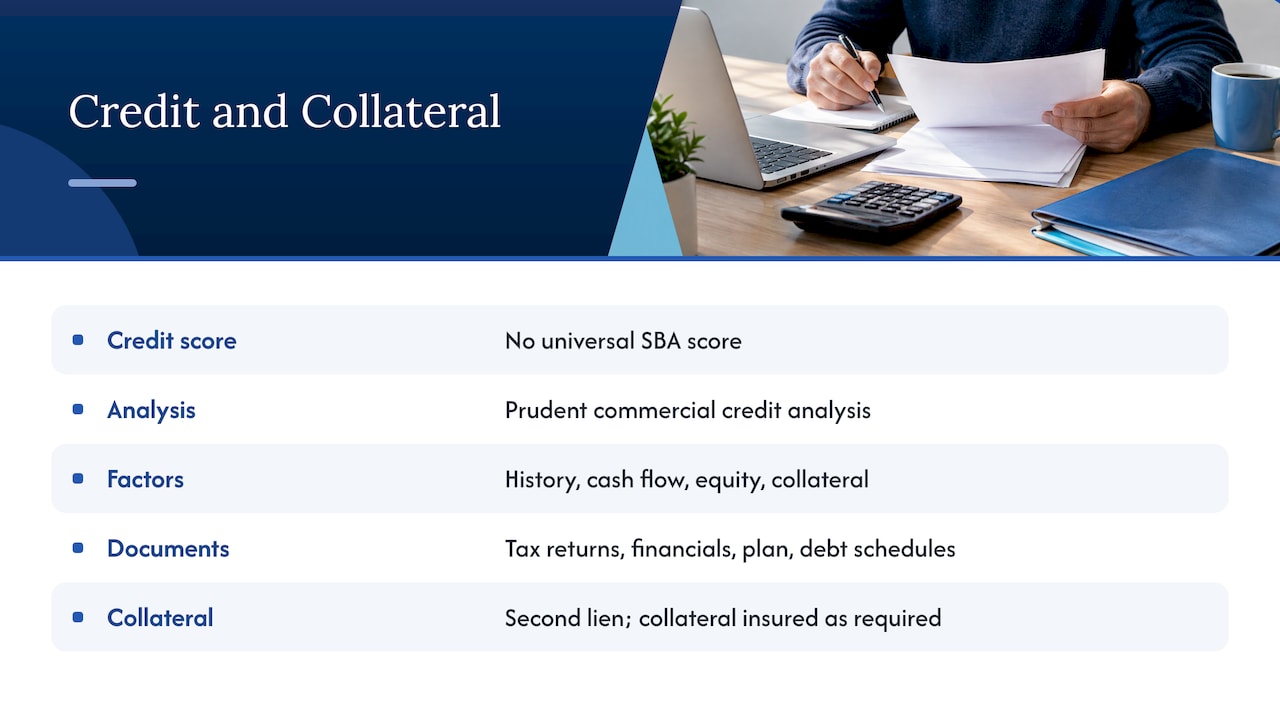
The SBA does not set one universal credit score. Under 13 CFR § 120.150, lenders and CDCs must use prudent commercial credit analysis consistent with their non-SBA loans. They may consider credit history of the applicant, its associates and guarantors, cash flow, and equity or collateral. Expect to provide tax returns, financial statements, a business plan and debt schedules.
The CDC typically takes a second lien on the project property, and extra collateral is sometimes required. All collateral must be insured as SBA requires, per 13 CFR § 120.934. Our page on what secures your loan covers this in more depth.
Startups can qualify, but the equity is higher and documentation is heavier. See what a 504 startup must document. Veterans can look at our VetLoan Advantage Plus program.
Borrowers often ask why the lender side matters. It matters because every party must be in good standing for your loan to be approved, closed and serviced.
CDCs. According to the SBA’s lender resources, a CDC must be a nonprofit corporation in good standing, have a board with at least nine voting directors, maintain full-time professional management and staff, and meet a minimum level of lending activity.
Participating banks. Under 13 CFR § 120.410, a participating lender must have a continuing ability to evaluate, process, close, disburse, service and liquidate small business loans. It must also:
Both lenders must follow the SBA’s “Loan Program Requirements,” which are rules set by statute, regulation, SBA agreements, standard operating procedures and official notices. The current procedures, SOP 50 10 8, say program eligibility should be determined as early as possible and properly documented. Lenders that handle borrower financial data also carry their own security duties. Their obligations are summarized in this GLBA Safeguards Rule checklist.
Terms are generally 20 or 25 years for real estate and 10 years for equipment, according to the same CRS report. For a closing timeline for real estate, see our CDC checklist for 504 real estate loans.
Our view: why the CDC matters
We see the 504 program as a partnership, and the borrower gets the most from it when the CDC knows both sides of the table. Our team has more than 35 years of experience with SBA 504 lending. We focus on a swift, streamlined process with expert guidance, because most delays come from a package that is incomplete or an equipment list that does not match the rules.
For Florida business owners, the appeal is plain: down payments as low as 10%, long-term fixed rates, and a team that stays with you through the process. Our goal is certainty about what the lenders will need and when.
PHENYX
We sponsor SBA 504 loans for Florida businesses buying, building, renovating or refinancing commercial real estate, and for long-life machinery and equipment. We also offer a refinance program, a bridge loan program for 504 projects, and direct lending for smaller loans. If you are a for-profit business planning a purchase, our team can review your project against these requirements with you.
To start, see SBA 504 loans anywhere in Florida.
The SBA rules do not set one fixed score. Lenders and CDCs analyze the credit history of the applicant, its owners and guarantors, along with cash flow and collateral. A strong repayment record and steady cash flow help every part of the review.
Yes. A business two years old or younger puts in at least 15% instead of 10%, and 20% if the property is also limited- or single-purpose. The CDC’s share also falls to 35% or 30%.
No. The program finances fixed assets: land, buildings, and machinery or equipment with at least 10 years of remaining useful life. Working capital, inventory and rental real estate investment are ineligible uses.
No. The CDC itself is a nonprofit, but the borrower must be a for-profit operating business. Nonprofit, passive and speculative businesses are not eligible borrowers.

