


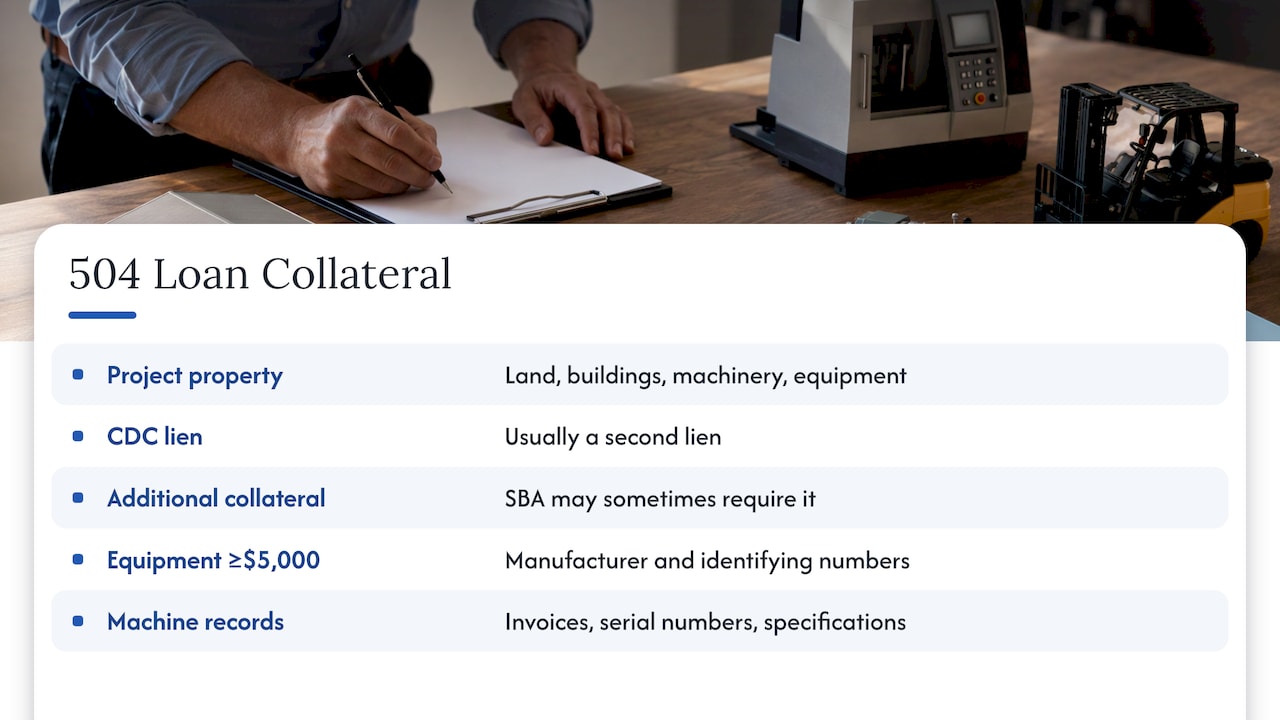
SBA 504 loans are secured mainly by the assets they finance. The Certified Development Company (CDC), the SBA-certified nonprofit lender that sponsors the loan, normally takes a second lien on the land, building, machinery or equipment you are buying or improving. A first lien goes to the bank that funds the rest. Owners with 20% or more of the business also sign personal guarantees, and in some cases a lender asks for extra collateral. This guide shows how that works, so you know what to expect before you apply.
We are the Florida Business Development Corporation (FBDC), and SBA 504 lending is our specialty. The sections below explain the rules in plain terms, with one worked example.
Fbdc
fbdc.net
Finance Property and Equipment with Clarity
FBDC specializes in SBA 504 lending for small businesses acquiring real estate, heavy machinery, and equipment with low down payments and fixed rates.
The 504 program finances long-term fixed assets: land, buildings, and machinery or equipment acquired or improved for the business. Those same assets are the collateral. Under 13 CFR §120.934 in SBA’s 504 rules, the CDC usually takes a second lien on this “Project Property.” The regulation also says SBA may sometimes require additional collateral, and only rarely permits other collateral to stand in for the Project Property.
For most borrowers this is the key difference from a general-purpose business loan. You are not asked to pledge unrelated inventory or receivables to a 504 loan as a matter of course. The property you are buying or building does the work.
If you buy equipment, the paperwork gets specific. SBA’s Third Party Lender Agreement (Form 2287) describes common collateral as the real or personal property named in the loan authorization. Equipment valued at $5,000 or more is identified by manufacturer and serial or other identifying numbers. Keep the invoices, serial numbers and specifications for each machine, because the collateral description has to match them.
A 504 project has three parts. Under 13 CFR §120.801, a standard project generally combines:
A debenture is a bond that the CDC issues to fund its share of the loan. Because that portion carries a long-term fixed rate, the structure matters to you beyond collateral.
Here is an illustrative $1,000,000 project, built only from the structure above:
PieceShareAmountLien positionBorrower contribution10%$100,000NoneCDC (504) loan40%$400,000Second lien on the projectBank loan50%$500,000First lien on the project
In this example the bank is secured by the property for $500,000. The CDC is behind it for $400,000, and your $100,000 is the equity cushion in front of both. Real projects vary with the loan program and the borrower, so treat the numbers as a model of the structure.
The Third Party Lender Agreement states that the CDC’s lien on common Project Property is junior and subordinate to the bank’s lien, unless the parties and SBA agree otherwise in writing. In practice, if the property were ever sold to repay the loans, the bank’s loan would be paid first.
The bank also faces limits. Under SBA’s third-party loan rules, a bank may take additional collateral only after it has exhausted reasonable collection avenues by disposing of the Project Property and applying those proceeds to its own balance.
If your project includes a short-term construction or interim loan, expect that lender to be secured as well. For help with timing, see our guide to the 60 to 90 day close for SBA 504 real estate loans.
SBA’s current Standard Operating Procedure, SOP 50 10 8.1, starts from a favorable position. It states that SBA’s second lien will generally be considered adequate. Factors that support that view include:
If your business fits that profile, the project assets alone are often enough. Additional collateral is considered when:
The SOP also puts a limit on the CDC. It should not encumber assets, or require contributions, that the business needs to keep operating when that added collateral has little liquidation value. The goal is adequate security, not stripping the business of working assets.
If you are planning a renovation or build-out, our article on the 10% contingency cap in SBA 504 renovation loans covers how those costs are treated.
Collateral and guarantees are separate, and owners often confuse them. Under 13 CFR §120.160, holders of at least 20% ownership generally must provide personal guarantees. A guarantee is your written promise to repay the loan personally if the business cannot.
The 20% figure is a baseline, not a ceiling. SBA or an SBA lender may require full or limited guarantees from other individuals or entities, including minority owners and nonowners, when credit or other reasons warrant it.
The link to collateral comes from the SOP. If business assets do not fully secure the loan, available personal assets must be pledged to secure the guaranty. A strong project with solid cash flow tends to keep that conversation short. A thinly secured one makes it more likely.
Two practical points follow:
Collateral is only as good as its value, so appraisals matter. The same regulation, §120.160, authorizes SBA to require professional appraisals of applicant or principal assets, as well as surveys and feasibility studies. The CDC must consider restrictions that affect value and marketability and document that analysis.
The SOP’s appraisal guidance addresses a shortfall directly. If the appraised value comes in below 90% of the estimate, the usual fix is one of these:
Strong, consistent cash flow may still support approval through the applicable SBA process. That is why a low appraisal does not always end the deal, but it does change the numbers. Our post on avoiding SBA 504 appraisal rework and the $500,000 rule explains how to avoid surprises at this stage.
One more requirement belongs to collateral. For 504 projects over $500,000, §120.160 requires hazard insurance on all collateral. Price that coverage into your closing costs and have the carrier ready early.
The general rule is the same everywhere, but what the lender looks at differs by project.
The building and land are the collateral, with the bank in first position and the CDC second. Owner-occupied property is the typical 504 project, and the appraisal sets how much cushion exists. Our guide to the 10% down SBA 504 owner-occupied loan shows what that looks like for Florida businesses.
Equipment with a useful life of at least 10 years is what we finance. The lien attaches to each item, identified by serial number when valued at $5,000 or more. Keep records of purchase price, delivery and installation. Used equipment may call for an independent value opinion, so expect that conversation early.
A new business has no operating history to lean on, so the lender looks harder at projections and the borrower’s own investment. Weak startup projections are one of the credit factors the SOP lists for extra collateral. A startup that documents its plan carefully is in the strongest position. Our article on what SBA 504 startups must document lists what to prepare.
When you refinance existing debt on property you own, the property you already hold is again the main security. We cover the program on our SBA 504 refinance page.
SBA’s SOP 50 10 8.1 became effective on October 1, 2026. According to SBA’s August 2026 Information Notice, it applies to applications issued an SBA loan number on or after that date. Applications submitted through September 30, 2026 remain under SOP 50 10 8.0.
If you apply now, the newer SOP is the version your lender applies. The regulations cited here, 13 CFR Part 120, are the underlying rules, and the SOP is SBA’s guidance on how lenders apply them. Both can be amended, so ask your CDC to confirm the current text when you apply.
A clean file speeds up underwriting and reduces the chance of a request for more. Gather:
Our SBA 504 documentation checklist goes through each item in more detail, and the four eligibility checks for Florida are worth reading before you start. If you want a view of how 504 compares with a bank-only loan on collateral and down payment, see our comparison of SBA 504 and a conventional commercial mortgage.
FBDC is a Florida SBA 504 lender with more than 35 years of experience. We work with for-profit small businesses that want to buy, build, renovate or refinance commercial real estate, or purchase heavy equipment. Our loans are built around low down payments, as low as 10%, and long-term fixed rates. We also offer a bridge loan program for 504 projects, direct lending for smaller loans and a program for veterans.
If you have a project in mind, start with our SBA 504 loan program page, which also lists approximate fees. Veterans can look at VetLoan Advantage Plus, and smaller projects may fit our Direct Lending Program. To see whether a project in your part of the state fits, visit our page on SBA 504 loans anywhere in Florida.
Business owners often arrive worried that an SBA 504 loan will put everything they own on the line. The program was built differently. The property or equipment you are buying is the main security, and the second-lien structure is why a 504 loan can need as little as 10% down.
We think the most useful thing a borrower can do is know the structure before applying. When you understand who holds which lien, who signs guarantees and what an appraisal can change, the loan process becomes predictable.
Our experience over more than 35 years of SBA 504 lending is that organized borrowers move faster. We aim to give you expert guidance and a streamlined process, so you know what we will need and why. For for-profit Florida businesses buying real estate or equipment, that clarity, together with long-term fixed rates, is what makes the 504 program worth considering.
PHENYX
Yes. The assets being financed, such as land, buildings, machinery and equipment, serve as the collateral. The CDC normally takes a second lien on them, behind the bank’s first lien. SBA may sometimes require additional collateral if the project assets are not sufficient.
Generally, anyone who owns 20% or more of the business must provide a personal guarantee under 13 CFR §120.160. SBA or the lender can also require full or limited guarantees from other individuals or entities when credit reasons justify it. If business assets do not fully secure the loan, available personal assets may be pledged behind the guaranty.
The bank. Its lien on the project property is the first lien, and the CDC’s lien is junior and subordinate to it unless the parties and SBA agree otherwise in writing. This is the standard 504 structure and the reason the CDC portion can carry a lower down payment requirement.
Under the SOP’s appraisal guidance, a value below 90% of the estimate generally means reducing the debenture or adding borrower or guarantor investment or collateral. Strong, consistent cash flow can still support approval through the applicable SBA process. Talk to your CDC as soon as you see the appraisal.
For 504 projects over $500,000, 13 CFR §120.160 requires hazard insurance on all collateral. Plan for it before closing so it does not delay funding.

