


Yes, a Florida business can use an SBA 504 loan to buy a commercial building, as long as the business will occupy it. The program splits the project between a private lender, a Certified Development Company (CDC) and your own equity, which is how a purchase can close with as little as 10% down and a long-term fixed rate on the largest part of the loan. Below is how the structure works, who qualifies, what the money can and cannot be used for, and what the process looks like from first call to closing.
Yes. The 504 program is a federal program, and it works the same way in Florida as in any other state: the SBA backs the CDC portion, and a CDC certified to operate in your state packages the loan. The building has to be for your own business. The program exists to finance long-term fixed assets such as land, buildings and heavy equipment, and to support job creation and local economic growth.
Typical Florida uses include a contractor buying a shop and yard, a medical or dental practice buying its office, a manufacturer buying a warehouse, or a restaurant group buying the property it already leases. You can also build, renovate or refinance, which we cover later.
The OCC describes the 504 program as a partnership between banks and SBA-certified nonprofit CDCs that provides long-term financing and promotes economic development. That partnership is the reason the loan looks different from a conventional mortgage.

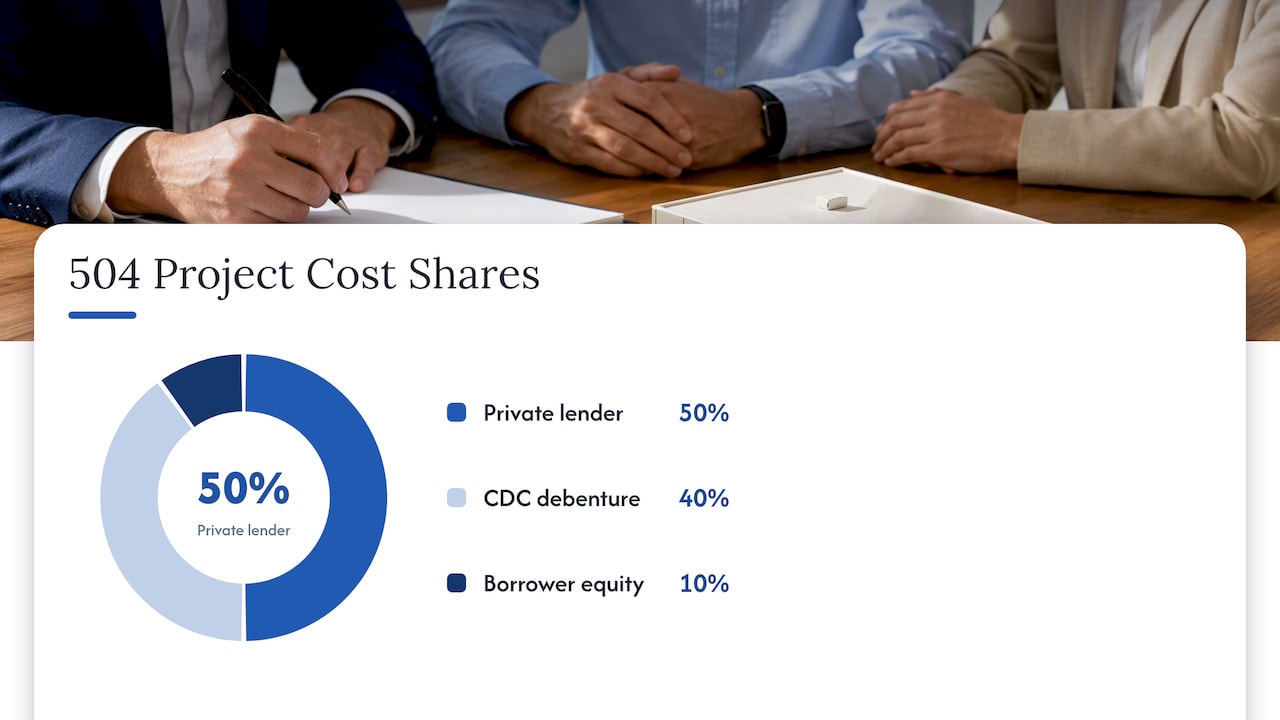
Under SBA rules for financing a 504 project, three parties fund the purchase:
Here is an illustration with round numbers. Say a Florida business buys a building for $2,000,000:
| Source | Share | Amount |
|---|---|---|
| Private lender, first lien | 50% | $1,000,000 |
| CDC debenture, second lien | 40% | $800,000 |
| Borrower equity | 10% | $200,000 |
This is a simplified example, not a quote. Actual project costs can include closing costs, an appraisal and environmental review, and a CDC can tell you how those fit into the financing. The point is the shape: you put in a tenth, and 40% of the project sits in a long-term fixed-rate piece instead of a bank loan that reprices or comes due early.
Lenders are also putting more technology into this process, and automation in SBA lending is one of the areas where banks and their partners are investing to handle the documents a 504 file requires.
The CDC portion is where the 504 advantage is clearest. According to the National Association of Development Companies, 504 terms are 10 or 20 years, the rate is fixed when the debenture is sold, and there are no balloon payments. The same source puts the maximum debenture generally at $5 million, rising to $5.5 million for manufacturers or projects that meet an Energy Policy Goal.
What that means for a building purchase:
The first-lien lender’s portion is priced separately by that lender, so ask about its rate and term early. Our approximate fees page lists the costs associated with a 504 loan so you can plan before you apply.
On July 7, 2026, the SBA announced that qualified borrowers who secure a 7(a) loan first may access up to $5 million through each program, for up to $10 million in combined SBA-backed financing. For a business that needs both a building and operating funds, that means the two loans no longer compete for the same limit. If you are weighing the programs, our comparison of SBA 504 vs. 7(a) explains which fits which need.
The 504 program is for owner-users, and the occupancy requirement is the rule that most often decides whether a building qualifies. Under 13 CFR 120.131:
In practice, a business that needs 6,000 square feet can consider a 10,000-square-foot building and lease the rest to tenants, provided it meets the 51% threshold. Leasing the extra space can offset your costs. Our occupancy checklist for Florida small businesses walks through how lenders count space.
Other basics:
For a fuller walk-through, see our guide to SBA 504 eligibility in Florida.
The SBA’s rules in 13 CFR 120.130 do not allow 504 proceeds for working capital, inventory, speculation or investment in rental real estate. A building you buy to lease out to others as an investment will not qualify, and a loan to cover payroll or stock will not either.
What the program does cover for a property project:
If you also need heavy equipment, read how 504 financing for equipment works with 10% down.
Most Florida owner-users ask the same thing: why not just get a bank mortgage? The answer comes down to down payment, rate structure and term. A conventional commercial loan commonly asks for a larger down payment, and many carry a rate that resets or a balloon that comes due in a few years. The 504 gives you a smaller equity requirement and a fixed-rate, fully amortizing CDC portion.
| Feature | SBA 504 | Typical conventional commercial mortgage |
|---|---|---|
| Your equity | As little as 10% | Set by the lender, often higher |
| Rate on largest long-term piece | Fixed, set at debenture sale | Varies by lender, may adjust |
| Balloon payment | None on the CDC portion | Often present |
| Use | Owner-occupied real estate and equipment | Broader, including investment property |
The tradeoff for those terms is the occupancy rule and the owner-user focus. For a side-by-side with real numbers, see our page on SBA 504 vs. a conventional commercial mortgage in Florida, and for other routes, our overview of commercial real estate financing in Florida.
The process takes several weeks from gathering documents to an approval decision, and it is smoother when the file is complete the first time. A typical path in Florida:
In our experience as a CDC, the file preparation is where time is won or lost. Our article on closing an SBA 504 loan in Florida in 60 to 90 days describes what a well-prepared file looks like.
We have worked in SBA 504 lending for over 35 years, and the owners we see do best share one habit: they treat the building as a long-term business decision and not only a payment comparison. Rent is a cost you never get back. A 504 purchase turns that cost into equity in a property you control, on a payment that does not move on the largest portion of the debt.
The low down payment is what makes this realistic for a growing company. At 10%, a business does not have to drain the cash it needs for payroll, hiring and inventory to own its location. That is what the program was designed for, and it is why we focus on it.
We also encourage owners to come to us before they sign a purchase contract. A short conversation can confirm that the occupancy math works, that the project costs are eligible, and that the timeline fits your closing date. We built our process around speed and certainty, with experienced staff who stay with you from the first call to funding. If your situation is different, such as a smaller loan, a startup, a veteran-owned business or a need for interim financing, we have programs for those as well.
— PHENYX
The standard 504 is not the only tool. Depending on your project, one of these may be a better fit:
See more about 10% down purchases in our post on the owner-occupied loan for Florida small businesses and on how to grow your business by buying property.
If you have a building in mind, we can review the project with you, confirm eligibility and outline the structure before you commit to a contract. FBDC serves businesses throughout the state, and you can start on our page for SBA 504 loans anywhere in Florida.
For the program details, current approximate fees and how to begin, visit our SBA 504 loan page and request a consultation.
Not any building. It must be real estate your business will occupy, at least 51% for an existing building. Investment property purchased to lease out, or speculation, is not eligible under SBA rules.
The borrower contributes at least 10% of the project, with the lender providing about 50% and the CDC up to 40%. Your exact equity depends on the project’s total cost and details, so a CDC should confirm the figure for your deal.
Gathering documents through an approval decision typically takes several weeks. Complete files move faster, because the CDC has to prepare the credit memorandum and exhibits before the SBA reviews them.
The debenture maximum is generally $5 million, or $5.5 million for manufacturers or projects meeting an Energy Policy Goal. Since July 2026, qualified borrowers who obtain a 7(a) loan first can access up to $5 million through each program, for $10 million combined.

