


The most cash-efficient way to finance a second location in Florida is usually to buy or build the property with an SBA 504 loan, which typically requires about 10% down, instead of paying 20% to 30% to a bank on a conventional commercial loan. The remaining cost is split between a bank and a Certified Development Company (CDC), and the CDC portion carries a long-term fixed rate. This guide explains how that structure works, what it can and cannot pay for, and how to line up the pieces so your second site does not drain the cash your first one depends on.
Fbdc
Finance Your Next Florida Location
FBDC specializes in SBA 504 financing for business real estate, with down payments as low as 10% and long-term fixed rates.
Your first location grew with you. The second arrives all at once: a deposit, closing costs, build-out, equipment, new hires, and a few months of operating before the site earns its keep. Meanwhile the original location still needs working capital.
A conventional commercial real estate loan makes this harder because it asks for a large down payment. Every dollar locked in a down payment is a dollar unavailable for payroll, inventory or marketing at either site.
Credit conditions add pressure. Federal Reserve Vice Chair for Supervision Michelle Bowman noted in March 2026 that credit conditions for small businesses remain tight, with banks reporting tighter standards for commercial and industrial loans because of economic uncertainty. Government-backed programs exist partly to offset that, since a guarantee encourages lenders to lend.
The right choice depends on whether you are buying, building or leasing, and on how much working capital you need.
OptionTypical useCash up frontRate structureSBA 504 loanBuy, build, renovate or refinance owner-occupied real estate; long-life equipmentAs low as 10% downFixed rate on the CDC portion, up to 25 yearsConventional commercial mortgageProperty purchaseCommonly higher down paymentOften shorter terms, rate may adjust or balloonEquipment financing or leaseMachinery, vehicles, fit-out itemsVaries by lenderFixed, short termsLines of credit, working capital loansPayroll, inventory, launch costsLow or noneVariable, shorter termsLeasing the spaceRetail, office, flexible footprintsDeposit plus build-outRent, no equity
Leasing keeps cash needs low at first, but you build no equity and rent can rise. If the location is core to your business for the next ten years or more, owning with a low down payment often costs less over time. If you only need working capital, a 504 is not the tool, and you should look at a line of credit or other short-term product instead.
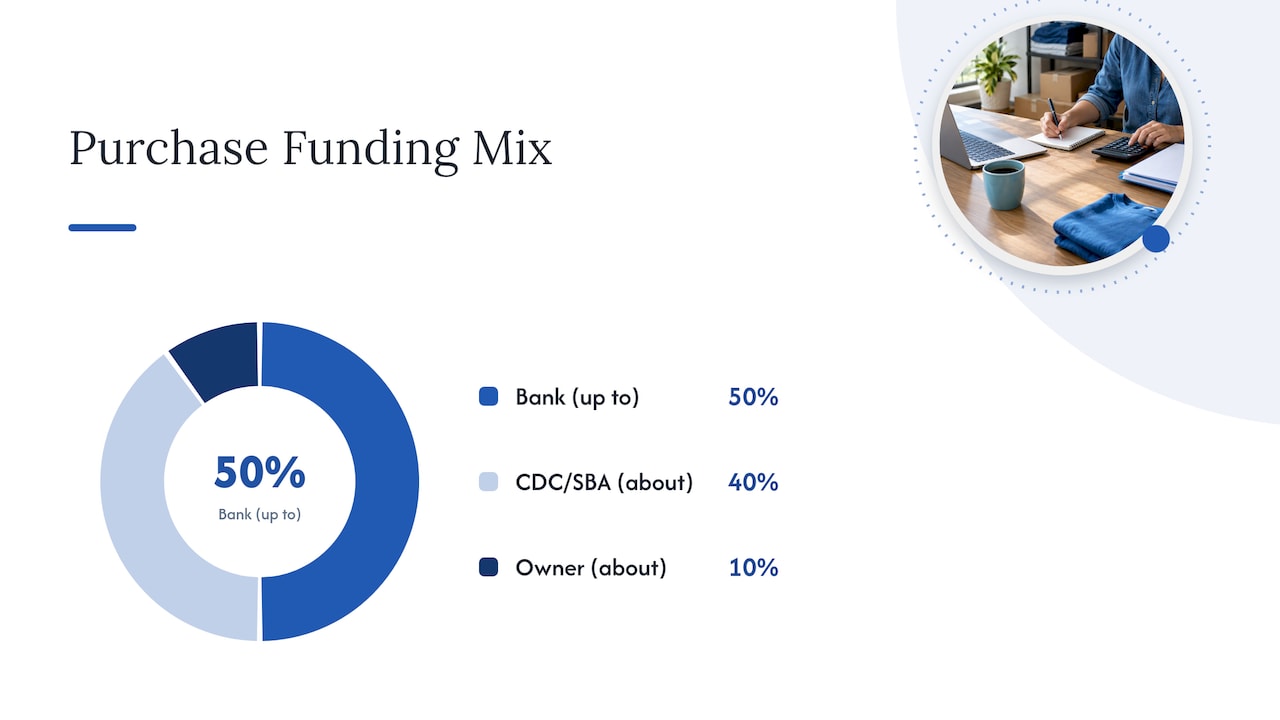
A 504 project is financed in layers, with three parties involved:
The lower down payment is the headline, but the fixed rate matters just as much for a second location. Your largest recurring cost is locked for the life of that portion, so the new site’s occupancy cost does not move while you are still ramping up. Specific terms for 10, 20 and 25 years are covered in our guide to SBA 504 terms for long-term business financing.
Say your second location is a $2,000,000 building purchase, including closing costs. These figures are illustrative, not a quote.
If a conventional lender asked for 25% down on the same building, you would need $500,000. The difference, $300,000, stays in your business for build-out, hiring and working capital. Actual percentages depend on your project, and some projects, such as those involving startups or special-purpose properties, can require a larger contribution.
For a closer look at property purchases, see our article on buying property with 10% down using SBA 504. If your second site is a distribution or storage space, warehouse loans in Florida with 10% down walks through that case.
The 504 program is built for fixed assets, so it fits expansion projects well when the second location involves any of the following:
It is not designed for working capital, inventory or general operating costs. If your plan includes those, pair the 504 with a separate working-capital source. Since mid-2026 that pairing has more room: the SBA announced a rule letting eligible borrowers combine 7(a) and 504 loans for up to $10 million in SBA-backed financing, up from the previous $5 million cumulative limit. For a business opening a second site, that means real estate and operating needs can both sit inside SBA-backed programs.
If equipment is a large part of your budget, our comparison of when an SBA 504 equipment loan beats a lease shows how to weigh ownership against monthly payments.
The 504 program is for businesses that occupy the property. If you plan to buy a building for your second location, your company must use a required share of it, and any space you lease to others is limited. Check this before you fall in love with a multi-tenant building. Our occupancy checklist for Florida small businesses lays out what a lender will want to see.
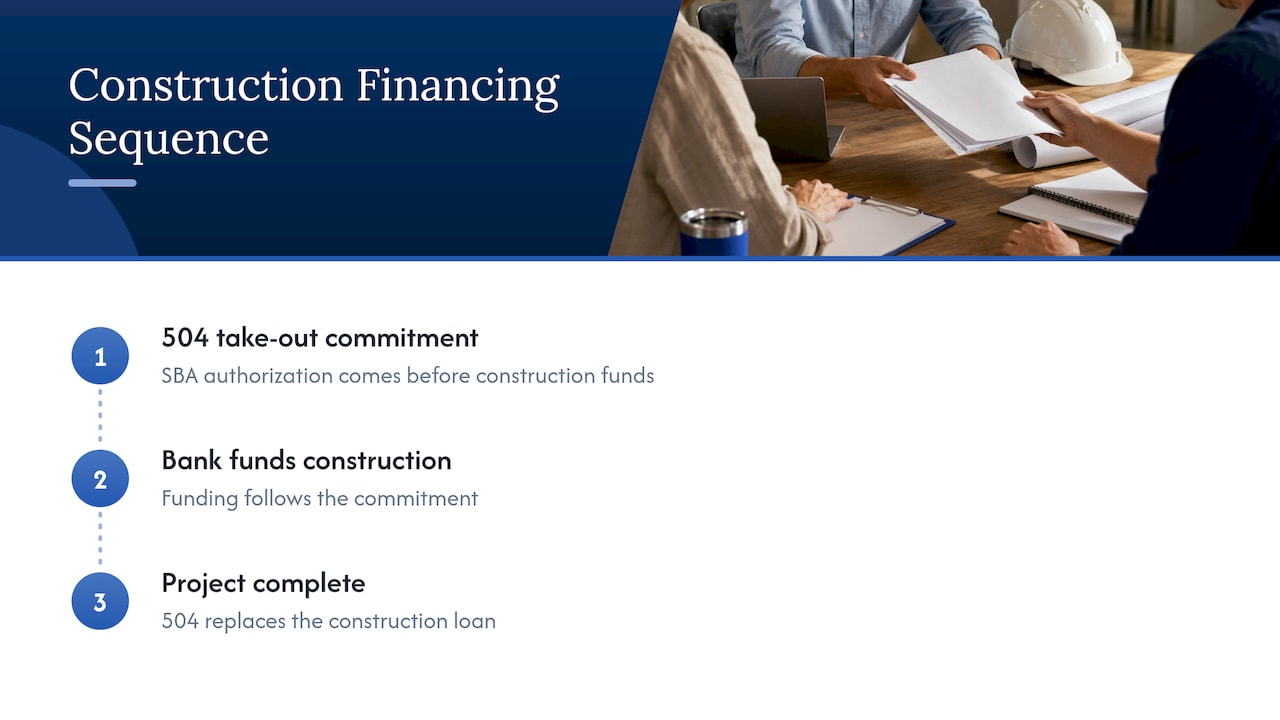
The 504 is permanent financing. It does not fund interim construction on its own. If you are building the second location, a bank typically funds construction, and the 504 takes out that construction loan once the project is complete. Banks want to see an SBA-authorized 504 take-out commitment before releasing construction funds, which is why speaking with a CDC early matters.
Timing also matters for purchases. If a seller will not wait for the standard process, a bridge product can cover the purchase until the 504 closes. FBDC offers the 504 Velocity Bridge Loan Program for projects in this situation. For the usual timeline on a purchase, see how to close an SBA 504 loan in Florida in 60 to 90 days and our CDC lender checklist for real estate loans.
If you already own the property at your first site, you may be able to put that equity to work. A refinance combined with expansion can free up cash for the second location. Our guide to SBA 504 refinancing with expansion explains the 75% rule and the steps, and our article on refinancing up to 90% loan-to-value covers the Florida specifics. The SBA 504 Refinance Program page outlines what FBDC offers.
Second locations tend to go wrong for one of three reasons, and none is the interest rate.
First, owners commit to a property before talking to a financing partner. A purchase contract signed without checking occupancy, appraisal and timeline can leave you scrambling. We would rather you call us while you are still comparing buildings.
Second, they treat the down payment as the whole cash requirement. Closing costs, build-out, equipment and the first months of payroll at the new site are separate lines in your budget. A 10% down structure helps most when you use the savings to fund those lines on purpose, not when it simply lets you spend more on the building.
Third, they overlook how much the first location depends on the cash they are about to spend. Before you sign, run your numbers as if the new site takes six months longer than planned to break even. If the business still holds up, the plan is sound.
FBDC works as a CDC focused on SBA 504 lending, and we have more than 35 years of experience helping Florida small businesses buy property and equipment with minimal capital. For a clearer picture of what a CDC does, read how a Certified Development Company cuts bank risk and closes faster.
Not every second location fits the standard structure, so FBDC also offers:
These are only for for-profit businesses. Non-profits and requests for pure working capital or inventory financing fall outside what we do.
If you are weighing a building, a build-out or major equipment in Florida, we can show you how an SBA 504 structure would look for your project, including the down payment, the fixed-rate portion and the likely timeline. Start with the SBA 504 Loan Program page, which includes approximate fees, and contact our team to schedule a consultation.
Yes, for an eligible project, an SBA 504 loan typically requires about 10% down. The exact amount depends on the project. Startups and special-purpose properties can require a larger contribution, so confirm your structure with a CDC before making an offer.
No. The program finances property your business owns and occupies, plus long-life equipment. If you plan to lease, consider equipment financing for fit-out items and a separate working-capital source for opening costs.
Not directly. It finances fixed assets. Since the SBA’s 2026 rule change, eligible borrowers can combine 7(a) and 504 financing up to $10 million, which allows operating needs and real estate to be financed under SBA programs.
A bridge loan can cover the purchase until the permanent 504 financing funds. Talk to a CDC early so the bridge and the 504 are planned together rather than separately.
Yes, but in two stages. A bank funds construction, and the 504 serves as permanent take-out financing. Banks want a firm 504 commitment before releasing construction money, so begin the CDC conversation before you break ground.

