


If you run a Florida dental or medical practice and want to own your building, the SBA 504 loan is usually the lowest-down-payment, longest fixed-rate route available. It works for buying an existing office, building a new one, renovating, or refinancing, as long as your practice occupies enough of the property. This guide compares 504 financing with the other ways practices buy buildings, so you can see where each one fits.
Fbdc
Finance Your Florida Practice Building
FBDC specializes in SBA 504 lending for businesses acquiring real estate, with low down payments and long-term fixed rates.
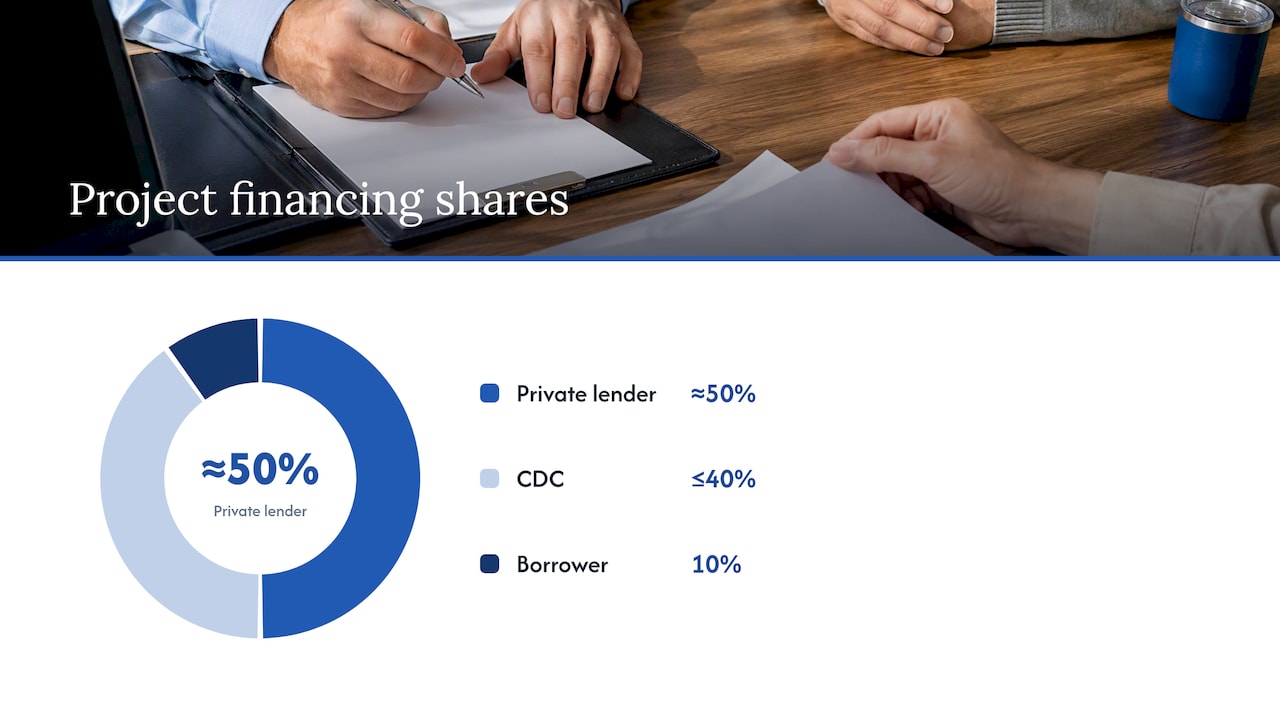
A 504 loan is branded as one product, but it is two loans. According to the SBA’s program description, a private lender provides a conventional first loan, typically about 50% of the project. A Certified Development Company (CDC) provides a government-guaranteed debenture for up to 40%. You contribute the remaining 10%. Because the private lender holds the senior lien on a smaller share of the project’s value, its risk drops, and that is what makes the low down payment possible.
The CDC portion carries a fixed rate for its full term. The SBA states that 504 financing is delivered through CDCs, which are community-focused organizations working with private lenders. We explain how that partnership shortens closings in our guide to the Certified Development Company role, and how the terms differ in our overview of 10, 20 and 25 year terms.
For a practice, the 504 structure fits well because a building is exactly what the program targets: a major fixed asset that will serve the business for decades. Equipment qualifies too, but only when it has a useful life of at least 10 years. Treadmill-style lifespan questions come up with imaging and diagnostic gear. Ask your vendor in writing how long the equipment is expected to last before you plan to include it.
The basics: the borrower must be a for-profit business located in the U.S. and meet SBA size standards. Nonprofits do not qualify. Most solo and group practices fall well within size limits, but affiliates count, so a practice owned alongside other businesses should be reviewed as a group.
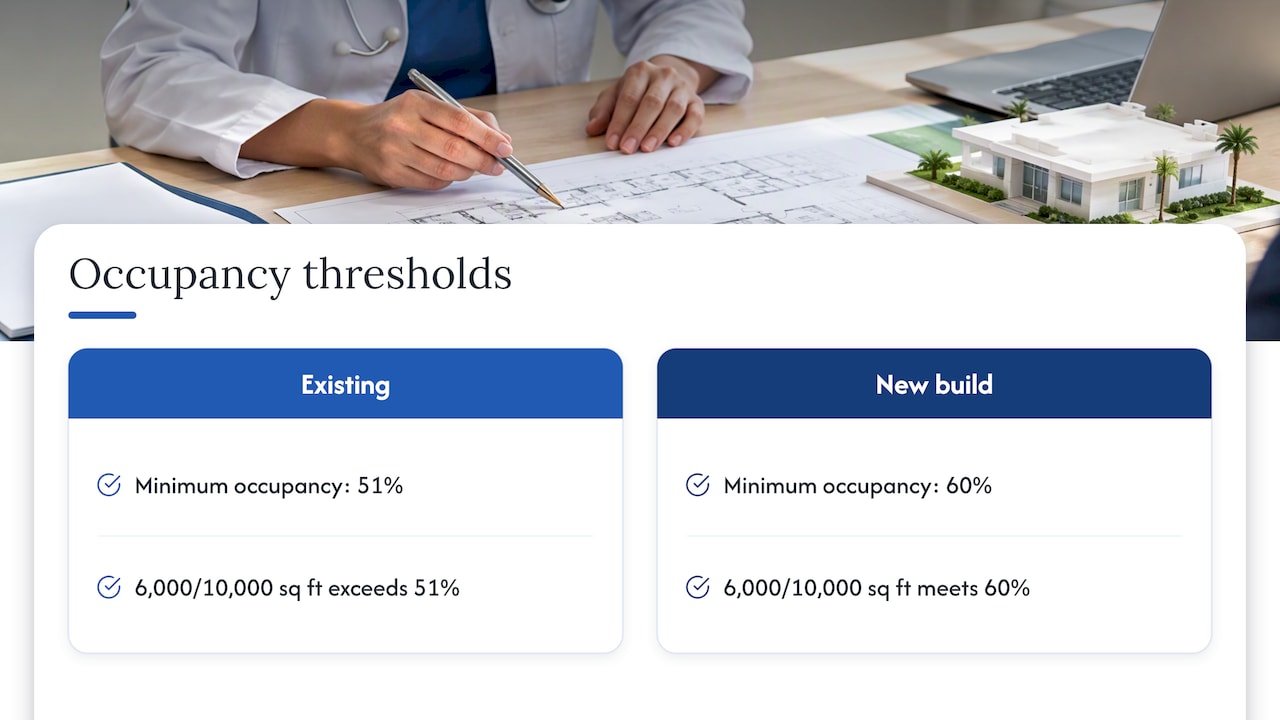
This is the rule that matters most for office buildings. Under 13 CFR 120.131, a borrower that buys an existing building must occupy at least 51% of the rentable space. For new construction the requirement is 60%. These are regulatory thresholds, and your lender documents compliance in the application.
A practical example: you buy a 10,000-square-foot medical building. Your practice needs 6,000 square feet. That is 60%, so you clear the existing-building test with room to spare, and you can lease the remaining 4,000 square feet to a compatible tenant such as a physical therapist or a lab. If the same project were new construction, 6,000 square feet would be exactly at the 60% line, with no cushion if plans change.
Our occupancy checklist walks through the documents lenders ask for, and our explanation of owner-occupied versus investment property covers where the line sits.
SBA rules exclude passive and speculative businesses. The eligibility rules in 13 CFR 120.880 govern what counts as an eligible borrower in the 504 program. In practice this means the entity applying should be the one treating patients. Many owners hold real estate in a separate property company and run the practice in an operating company. That structure can work, but it has to be set up the way the program requires, with the operating company as a co-borrower. Raise it with your CDC before you sign a purchase contract, not after.
New practices can use 504 financing, but lenders look harder at projections and the owner’s clinical track record. If you are refinancing rather than buying, the research we reviewed indicates the business generally needs two years of operation to use the debt refinancing option.
Practice owners usually compare four routes. Here is how they stack up on the criteria that matter most when you are buying a medical or dental building.
CriterionSBA 504SBA 7(a)Conventional bank loanCommercial bridge or short-term loanTypical down paymentAs low as 10%Often 10% or more, set by the lenderFrequently higher, set by the lenderVaries widelyRate structureFixed on the CDC portionOften variableFixed or variable, often with a shorter fixed periodUsually higher, short termTerm for real estate10, 20 or 25 years on the CDC portionLonger terms availableOften shorter terms with a balloonMonths to a few yearsBest useBuilding, construction, major equipmentWorking capital, acquisition, mixed usesStraightforward purchases for well-capitalized borrowersClosing quickly before permanent financingOwner-occupancy rule51% existing, 60% newAlso applies to real estateSet by the lenderSet by the lenderCan fund working capitalNoYesSometimesRarely
Treat the table as a framework. Individual lenders set their own pricing and underwriting, so get quotes on the same project from each route.
If you are buying another practice and need money for goodwill, receivables and working capital along with a small amount of real estate, a 7(a) loan can cover a mix that 504 cannot. A 504 loan finances fixed assets, not operating expenses or inventory. Some owners combine the two programs. In our article on the July 4, 2026 loan limit change we cover how the higher combined ceiling affects larger projects.
A practice with substantial cash, strong collateral and a banking relationship it values may find a conventional loan perfectly workable, especially for a quick purchase. The trade-off is usually a larger equity contribution and less rate certainty over the long term. If preserving cash for equipment, hiring and a build-out is a priority, 504 normally leaves you with more of it. We lay out the numbers in fixed versus variable loans.
Here is a simple illustration, with round numbers chosen for clarity and not as a quote. A dentist buys an office for $2,000,000.
The same purchase with a conventional loan requiring 25% down would need $500,000 in equity, leaving $300,000 less cash for equipment, marketing and staff. Closing costs, fees and renovation budgets are additional and vary by project. FBDC publishes approximate fees on its SBA 504 loan page.
About 60% of medical and dental 504 deals, according to one broker guide, involve buying an existing building, with the rest split between construction and other projects. That fits what practice owners tell us: most want to stop paying rent on space they already occupy.
A move is also a records project. Patient files, referrals and insurer forms all travel with you, and any transfer of protected health information has to follow privacy rules. If your office still sends records by fax during the move, review these HIPAA rules for faxing medical records before the change of address. Build that into the move schedule that your lender will want to see.
We have worked in SBA 504 lending for over 35 years, and practice owners are some of the clearest cases for the program. They have steady income, a real asset to finance and a strong reason to own: rent is money that does not build equity.
The applications that move fastest share a few traits. The owner knows the occupancy math before choosing a building. The entity structure is settled early. Equipment lists have been checked for useful life. And the owner can explain, in plain terms, how the new space will let the practice add chairs, rooms, providers or patients, because the program exists to support job creation and growth.
The most common mistake is waiting to talk to a CDC until the contract is signed. A short conversation first can catch occupancy shortfalls and structure problems while they are cheap to fix. We also encourage owners to compare us on the details that count: how quickly we respond, how clearly we explain each step and how reliably we close. Our process is built to give you certainty, with experienced staff who know Florida practices.
FBDC is a Florida lender focused on SBA 504 financing for small businesses that need real estate or major equipment. For practice owners, we offer the SBA 504 Loan Program for building purchases and construction, a Direct Lending Program for smaller loans, and VetLoan Advantage Plus for veteran business owners. If you are weighing options for a building, talk to our team and bring your project details, and we will tell you plainly whether 504 is the right fit.
Yes. The SBA 504 program is built for buying, building and renovating major fixed assets such as medical and dental office buildings. Your practice has to be an eligible for-profit business and occupy at least 51% of an existing building or 60% of a new one.
The structure is typically 50% from a private lender, up to 40% from the CDC and about 10% from you. Some projects need more, so ask your CDC to confirm the figure for your specific property and practice.
Yes, within limits. You can lease the space your practice does not need, such as to another provider, as long as your practice keeps meeting the occupancy minimum under 13 CFR 120.131. Your lender will want lease details in the file.
The SBA’s 504 page lists up to $5.5 million for the 504 loan. Limits were also changed for combined 7(a) and 504 borrowing in 2026, so confirm the current ceiling for your project with a CDC before you finalize plans.

