


The most direct way to finance a second location in Florida is an SBA 504 loan when the project is a building, land, construction or long-life equipment. It splits the cost between a bank, a Certified Development Company (CDC) and you, with a fixed rate on the CDC’s share and a down payment that can be as low as 10%. At FBDC, a CDC with more than 35 years of experience in SBA 504 lending, this is the loan we build second-location projects around.
This guide shows what each financing option covers, how the 504 structure works with real numbers, what you need to qualify and the order of the steps from first call to closing.
A second location usually has two kinds of cost: fixed assets (the building or land, construction, build-out, heavy equipment) and operating costs (inventory, payroll while the site ramps up, marketing). Loan programs are built around one or the other.
Per the USDA Rural Development and SBA loan comparison, the SBA 504 program funds the purchase, construction or improvement of commercial real estate, long-term machinery, or debt refinancing as part of an expansion with new facilities or equipment. The same comparison shows the 7(a) program also covers business acquisitions, fixtures, inventory and working capital.
Florida’s own Guide to Starting a Business in Florida describes the same split: the 7(a) is the most popular loan for working capital, the CDC/504 program targets major fixed assets such as equipment or real estate, and the SBA Microloan Program offers short-term loans up to $50,000 for working capital, inventory, furniture, fixtures, machinery or equipment.
In practice:
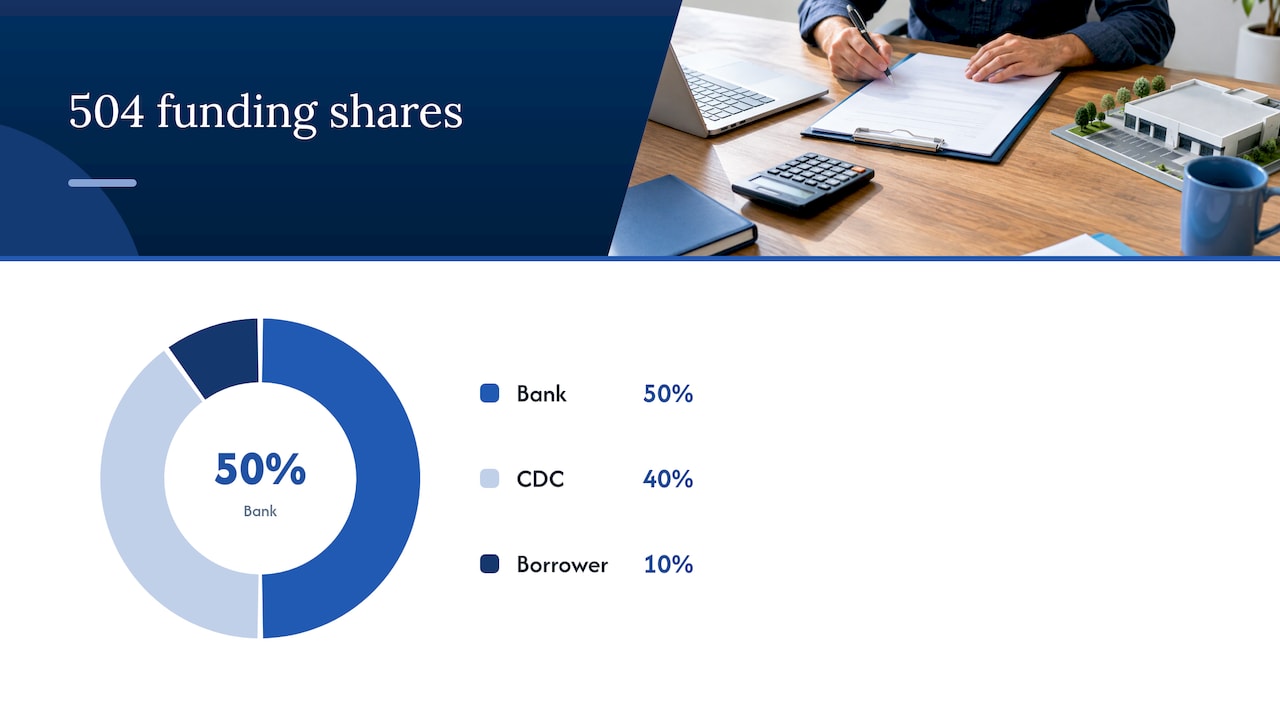
A 504 project has three parts. According to NerdWallet’s SBA real estate loan comparison, 40% comes from a CDC, 50% from a bank or credit union and 10% from the borrower. The CDC portion carries a fixed rate and a term of up to 25 years for real estate.
Here is the same source’s example on a $1 million purchase:
| Source of funds | Share | Amount |
|---|---|---|
| Bank or credit union (first lien) | 50% | $500,000 |
| CDC (SBA-backed debenture) | 40% | $400,000 |
| Borrower down payment | 10% | $100,000 |
The fixed CDC portion is what makes payments predictable on the larger part of the debt after the bank’s share is accounted for. NerdWallet’s 2026 comparison puts CDC rates at roughly 5% to 7% fixed. Rates on the CDC portion follow market conditions at the time the loan is funded, so treat any published range as a reference for that year, not a quote.
For a second location, that structure matters because your first location is probably still consuming cash. Keeping the down payment near 10% leaves money for the build-out, hiring and the months before the new site covers itself.
Three products compete for the same project. The differences that matter for an expansion:
| SBA 504 | SBA 7(a) | Conventional commercial mortgage | |
|---|---|---|---|
| Best for | Real estate and heavy equipment | Mixed uses, including working capital and inventory | Borrowers with strong cash and collateral |
| Structure | Bank, CDC and borrower | Single lender | Single lender |
| Typical down payment | 10% to 20% | About 10% | 10% to 30% |
| Real estate term | Up to 25 years | Up to 25 years | Set by the lender |
| Maximum | Up to $5 million per the NFIB | Up to $5 million per the NFIB | Set by the lender |
The down payment ranges come from NerdWallet’s minimum down payment guide, which lists SBA 7(a) at about 10%, SBA 504 at 10% to 20% and commercial real estate loans at 10% to 30%. It notes that the exact amount depends on the loan type, size, purpose and your financial profile.
A 7(a) is the flexible tool. A 504 is the tool for a building or heavy equipment, where a long fixed-rate portion and a low down payment do the most for your cash position. If you are weighing the 504 against a bank mortgage on a specific building, our comparison of SBA 504 and a conventional commercial mortgage in Florida goes line by line.

The 504 is for for-profit U.S. businesses. Per the NFIB (November 2025), the business needs a tangible net worth under $20 million and average net income under $6.5 million. Eligible costs include buying or constructing buildings, land, new facilities, machinery or equipment, improving land, streets, utilities and facilities, and refinancing qualified debt.
The SBA’s Form 1244 application for 504 loans shows what the file needs to hold:
The SBA revises this form over time, so your CDC will give you the version currently in use.
A new business is not automatically out. We offer specialized programs for startups and veterans that keep down payments low and rates fixed. If you are opening a second location, your first location’s track record also helps show the business can carry the new debt.
For the paperwork side, see what to gather before you apply for an SBA 504 loan.
Plan for three buckets, not one:
If the gap is the down payment itself, our Down Payment Assistance Program under direct lending is designed for that situation. For a timing gap, such as needing to move on a property before the 504 closes, the FBDC 504 Velocity Bridge Loan Program is built for 504 projects.
Our article on financing a second business location with less cash walks through budgeting examples.
The 504 is a federal program, so the loan rules are the same in every state. What changes in Florida is the property and the location. Before you sign a contract, check these with the local authorities and your attorney:
If the second location is a new subsidiary or a separate entity, talk to your attorney about how it is owned before the loan application, because the SBA reviews every owner of 20% or more.
We lend across the state. Our page on SBA 504 loans anywhere in Florida explains how we work with borrowers from the Panhandle to the Keys.
The SBA issued SOP 50 10 8.1 on August 14, 2026. Per its information notice, it took effect October 1, 2026 for 7(a) and 504 applications that receive an SBA loan number on or after that date. Applications submitted through September 30, 2026 stay under the earlier version, SOP 50 10 8.0.
The update adds change-of-ownership lending and new flexibilities for SBA Express and refinancing debt within the same institution. It also lists policy notices on citizenship and residency requirements and on coordinating 7(a) and 504 maximum loan limits. If you are applying now, your file falls under the new version, and your CDC applies it for you.
If your second site is a building, land or heavy equipment, the 504 is where we start. We offer the 504 for purchase, construction, renovation and refinance, a bridge program for 504 projects, direct lending for smaller loans and specialized loans for startups and veterans. To see which fits your project, start with our SBA 504 Loan Program page or talk to our team about your specific site.
Veterans can look at VetLoan Advantage Plus, and owners whose existing building carries a higher-cost loan can look at the SBA 504 Refinance Program.
Owners tend to ask us how much a second location will cost. The better question is how much cash the second location will leave in the business a year after opening.
A 504 is designed around that question. The bank and the CDC fund 90% of the project, the CDC portion is fixed, and the term runs long for real estate. Your first location keeps its working capital, and your payment on the new site stays predictable while the site ramps up.
After more than 35 years in 504 lending, we put the most value on preparation: an early look at the project, a clear list of documents and a bank and CDC working on the same schedule. That is how we aim to give borrowers certainty on timing and cost before they commit to a property.
PHENYX
No. The 504 is built for major fixed assets such as real estate and long-term equipment. Inventory and working capital fall under programs like the 7(a), so budget those costs separately from the property financing.
With an FBDC 504 loan the down payment can be as low as 10% of the project. National ranges for 504 loans run 10% to 20% depending on the project and the borrower’s profile, so the exact figure is confirmed once we review your financials.
The CDC portion, which is 40% of the project, carries a fixed rate for the full term of up to 25 years on real estate. Because the rate follows market conditions when the loan is funded, ask us for the current figure when you are ready to move.
Yes, we offer specialized programs for startups and for veterans that keep down payments low and rates fixed. Eligibility still depends on the project and the business meeting SBA requirements, so the first step is a conversation about your numbers.

