


There is no single minimum income figure for an SBA 504 loan. The program has an income ceiling, not a floor: your average net income must stay under a cap to count as a small business. Separately, your business must show enough cash flow to cover the new payment, and that repayment test is where most applications are won or lost.
This guide explains both sides, shows a worked example with illustrative numbers, and lists what to gather before you talk to a Certified Development Company (CDC).
When owners ask how much income they need, they usually mean one of two things.
The SBA’s own 504 loan overview lists the basics: an operating business, operated for profit, located in the U.S., small under SBA size requirements, and not an ineligible type of business. It also mentions the ability to repay the loan as a general standard, without naming a dollar threshold.
A 504 borrower can qualify as small in two ways: by industry-based size standards, or by the alternative size standard. Most 504 borrowers use the alternative standard. Under the SBA’s February 2024 final rule, the alternative standard allows:
Some older articles still quote $15 million and $5 million. Those were the previous figures, so check the date on anything you read. NADCO, the national association of development companies, still describes the program as open to most businesses worth under $15 million, which is a rough rule of thumb rather than the current limit.
Two practical points:
If your business is a small or mid-sized operating company buying a building or major equipment, you are very likely well under these caps.
There is no minimum revenue, no minimum annual profit and no minimum personal income written into the program. According to NADCO’s eligibility guidance, eligible legal entities include corporations, partnerships, sole proprietors and LLCs, and repayment is judged through the business’s historical financial statements and the ability of the project to meet debt service.
That means a business with $400,000 in annual cash flow can qualify for a modest project, while a business with $4 million in revenue and thin margins can be declined. What the lender cares about is the relationship between the cash you generate and the debt you carry.

The SBA’s loan origination rules, collected in SOP 50 10, govern how lenders and CDCs review 504 applications. The review is a comprehensive look at cash flow and management capability, not a pass/fail income number. A new edition, SOP 50 10 8.1, takes effect October 1, 2026 for applications that receive an SBA loan number on or after that date, so ask your CDC which edition applies to your file.
The core measure is DSCR:
DSCR = cash available for debt service ÷ total annual debt payments
A ratio of 1.0 means you earn exactly enough to cover your payments with nothing to spare. Lenders want a cushion above that, and the exact cushion varies by lender, industry and the strength of the rest of the file. A weak DSCR is a frequent reason for declination even when a business fits the size standards.
Suppose a Florida distribution company plans to buy a $1,000,000 warehouse. These figures are hypothetical, to show the mechanics.
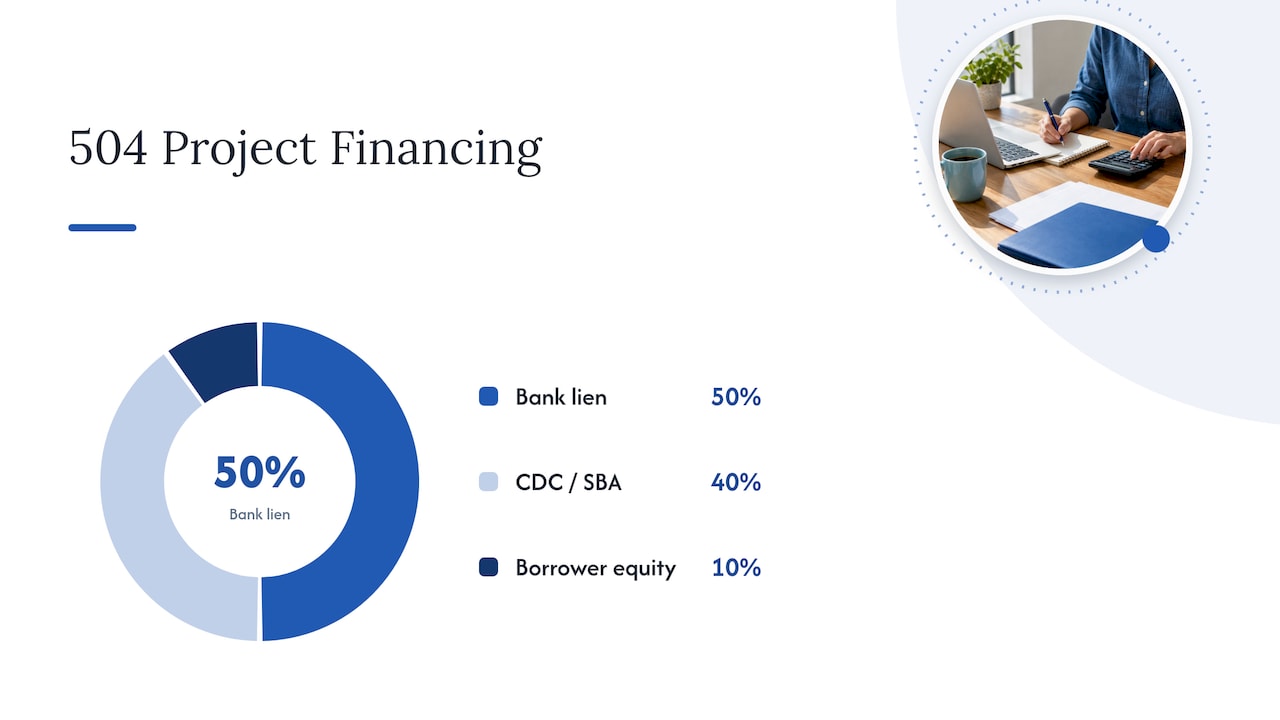
| Piece of the project | Share | Amount |
|---|---|---|
| Bank first lien | 50% | $500,000 |
| CDC / SBA 504 portion | 40% | $400,000 |
| Borrower equity injection | 10% | $100,000 |
This 50/40/10 layout is the typical 504 structure NADCO describes.
Now the repayment test. Say the company’s adjusted cash flow available for debt service is $130,000 a year, and the combined annual payments on the bank loan, the 504 portion and its other existing debt come to $95,000. The DSCR is 130,000 ÷ 95,000, about 1.37. That is a comfortable margin.
If the same company had only $100,000 of cash flow against the same $95,000 of payments, the ratio would be about 1.05. The business is profitable, yet the file is thin. The usual fixes are a smaller project, a longer amortization on the bank portion, paying down other debt first, or documenting a credible increase in cash flow from the new property, such as no longer paying rent.
The rent point is worth noting. When you buy the building you occupy, the new payment partly replaces rent you already pay, and a CDC will look at that offset.
Expect to provide:
The SBA’s own Form 1244, the 504 loan application, shows the information a small business applicant completes, so you can preview it before you start.
Because the test is cash flow, anything that smooths and documents it helps. Service businesses in particular can lose weeks of cash flow when deposits and invoices lag the work. Practical habits such as requiring deposits on service jobs bring cash in earlier, keep your monthly statements steadier and give the lender a cleaner picture of what is available for debt service. Start those habits at least two or three quarters before applying, because lenders read trends, not one good month.
Income gets you through the repayment test, but cash gets you to closing. The standard minimum down payment is 10%. Per NADCO’s financial guidance, special-purpose properties and startups can trigger a requirement of 15% to 20%. Examples include car washes, bowling alleys and hotels.
The lender will verify where the money comes from, and it should not be borrowed. Keep a clear paper trail: bank statements showing the funds, or documentation of a sale or gift. If you are a startup, our guide to what 15% to 20% down requires you to document walks through the paperwork.
The 504 program exists to support growth, so you generally need to create or retain one full-time equivalent job for every $65,000 of the SBA 504 portion, according to NADCO. Manufacturing and energy-efficient projects have higher thresholds.
In the example above, a $400,000 SBA portion works out to roughly six full-time equivalent jobs. Existing staff count when the project helps you retain positions, so most established businesses already meet it. Track headcount in your business plan from the start.
Income is not the only gate. According to NADCO’s eligibility page, the following are typically ineligible:
The SBA also expects the property or equipment to be used by the borrower, which is where occupancy rules come in. For a Florida-specific walk-through, see our four checks before approaching a CDC.
We have worked in SBA 504 lending for more than 35 years, and the pattern is consistent. Owners ask for a number, and there is not one. What we look for is whether the business can carry a long-term, fixed-rate payment, and whether the paperwork shows it clearly.
Three things tend to separate smooth files from slow ones:
The 504 structure exists so a bank can lend against a project that might be too tight under a stand-alone commercial loan, because the bank holds the first lien on 50% while the CDC portion sits behind it. That is why businesses that hear no from a conventional lender often still qualify here.
— PHENYX
If you are earlier in the process, our overview of how to qualify for an SBA loan covers the 2026 changes, and the real estate checklist shows what a 60 to 90 day close looks like.
If your numbers look workable, the next step is a conversation about the structure. FBDC sponsors the SBA 504 Loan Program for Florida businesses buying, building, renovating or refinancing commercial real estate, or buying heavy machinery and equipment with at least a 10-year useful life. We also offer a Direct Lending Program for smaller loans, a 504 refinance option and VetLoan Advantage Plus for veterans. Contact us with your last two years of tax returns and a description of the project, and we will tell you where you stand.
No. The program does not set a minimum revenue or minimum personal income for the owner. Lenders judge repayment ability through the business’s financial statements and whether the project can cover its debt service.
Under the alternative size standard, average net income after federal income taxes must be $6.5 million or less for the two full fiscal years before you apply, and tangible net worth must be $20 million or less. Industry-based size standards are another route for some businesses.
It depends mainly on cash flow, the equity you can document and whether the business is an eligible operating company. Businesses with steady statements, a clear source for the down payment and a realistic project tend to move through faster than those with gaps in their records.
Non-profit status, passive real estate holding, speculative activity, lending as a business, poor character findings and prior federal loan defaults are the common causes. Weak cash flow relative to the proposed payment can also lead to a decline.

