


For a small business buying the building it operates in, an SBA 504 loan is usually the better fit than a CMBS loan. The 504 is built for owner-occupied real estate and long-life equipment, with fixed rates and a low down payment. CMBS financing is built for stabilized, income-producing property and for larger loans that investors buy as bonds. This guide shows where the two differ and how to decide.
Fbdc
Finance Your Owner-Occupied Property
FBDC specializes in SBA 504 lending for small businesses acquiring real estate, with low down payments and long-term fixed rates.
CMBS stands for commercial mortgage-backed securities. The U.S. Securities and Exchange Commission defines CMBS as debt securities backed by cash flows from mortgages on income-producing commercial or multifamily property. Originators place one or more mortgages in a trust. The trust issues bonds divided into classes with different risk, duration and yield.
For a borrower, this means your loan is one piece of a pool. A servicer collects your payments, and investors in the bond classes receive them. First American’s borrower guide explains that payments flow through a seniority-based waterfall. The highest-rated classes are paid first, and subordinate classes absorb losses first.
The U.S. Small Business Administration says a 504 loan is originated by a CDC, which is SBA-certified and regulated, working with a senior lender. The program provides long-term, fixed-rate financing for major fixed assets. Eligible uses include acquiring, constructing or renovating buildings, and buying machinery and equipment with a long useful life.
The borrower makes a down payment, a senior lender finances one part of the project, and the CDC finances another part. We design our own program around this structure. Our SBA 504 loan program offers down payments as low as 10% for qualified borrowers.
FactorCMBS (conduit) loanSBA 504 loanBuilt forStabilized, income-producing commercial propertyOwner-occupied property and long-life equipmentWho funds itInvestors who buy bonds from a pooled trustSenior lender plus a CDCBorrower typeUsually property owners and investorsFor-profit small businesses that meet SBA size rulesPrepaymentCommonly restricted, often by defeasanceSet by the 504 program and your closing documentsIf the loan strugglesSpecial servicer handles distressLender and CDC work with the borrower under SBA rulesEquipmentNot the purposeEligible if useful life is at least 10 yearsWorking capitalNot the purposeNot eligible
The SBA states that 504 borrowers generally must operate a for-profit business in the United States and meet SBA size requirements. They also need qualified management, a feasible business plan, good character and the ability to repay. Proceeds cannot pay for working capital, inventory or speculative investment in rental real estate.
Occupancy matters too. An OCC community affairs publication notes that 504 real estate projects require at least 51% owner-occupancy for existing buildings and 60% for new construction. If you plan to lease part of the building, read our guides on owner-occupied vs. investment property and the occupancy checklist before you choose a property.
Equipment must have at least a 10-year useful life. That fits items such as heavy machinery and production equipment, and it excludes vehicles or software that wear out sooner.
CMBS lenders underwrite the property itself. They look at its cash flow, occupancy by paying tenants, location and condition, and they want a stabilized asset. A business buying a building mainly for its own use can fit this box, but the loan is priced and documented for investors, not for a small operating company. The lender’s attention is on the real estate, not on your plans for growing the business.
Because the bonds are sold to third parties, the loan documents are standardized. S&P’s criteria describe a typical structure in which the borrower’s note and loan documents go to a depositor that places the loan in a trust, which issues securities sold to investors. Standard documents mean fewer negotiated exceptions once you have signed.
The 504 is designed for borrowers who want to keep cash in the business. The SBA says 504 loans carry 10-, 20- and 25-year maturities, with rates pegged to an increment above the 10-year U.S. Treasury rate. Fees total approximately 3% of the debt and can be financed with the loan. Our own program advertises down payments as low as 10%, depending on the project and the borrower. The fee detail for our loans is on our approximate fees page.
CMBS terms vary by lender and by property. Conduit loans are generally fixed-rate and sized to the property’s income and value, and the structure is aimed at larger loans. Ask each lender for the written term sheet and compare four items side by side:
A monthly payment alone does not settle the comparison. A loan with a lower rate but a large equity requirement can take more cash out of your business than a 504 with a slightly different rate.
The SBA’s 504 page lists a maximum loan amount of $5.5 million for the program. In May 2026 the agency announced that, effective July 4, 2026, eligible borrowers can combine 7(a) and 504 loans for a cumulative total of up to $10 million, up from $5 million, with up to $5 million available through the 504 itself. Limits for special categories can differ. For example, the SBA lifted the cap on the number of 504 loans for qualifying clean energy projects, and we cover that route in our 504 green loan guide. Check the SBA page and your CDC for the limit that applies to your project on the day you apply.
Many owners focus on the rate and learn about prepayment terms late. With CMBS, they matter early.
Fried Frank’s borrower-side guidance says CMBS loans commonly restrict voluntary prepayment because investors expect predictable payments. Before the open period, payoff may be prohibited or may require defeasance. Defeasance replaces the real estate collateral with government securities, and it generally involves legal, accounting, consultant and servicing costs.
This matters if you might sell the building, move, or refinance when your business grows. A loan you cannot exit cheaply constrains those choices. When you plan to hold property for the long term, a fixed-rate 504 with a 20- or 25-year term gives you a predictable payment. You should still read the prepayment terms in any loan and ask how they apply to a sale or an early payoff.
If you already hold a loan and want to restructure, see our SBA 504 refinance program and our comparison of 504 vs. conventional refinancing in Florida.
A Federal Reserve study of mortgage lenders found that distressed or seriously delinquent CMBS loans are handled by special servicers, while bank loans are more likely to receive extensions. A small business that hits a slow quarter may find that a negotiating partner who knows your business matters more than a rate difference. The Federal Reserve research also found that balance-sheet lenders such as banks underwrote higher-quality loans than lenders who sold their loans on.
In a 504, the senior lender and CDC both stay involved. That relationship is also why paperwork matters. The OCC notes that the SBA may not honor or may reduce its guaranty payment if a lender underwrites inconsistently with SBA standards, with incorrect eligibility decisions and thin documentation as primary reasons. A CDC that checks eligibility at the start protects the loan and the borrower from surprises later.
Use the facts of the project, not the loan name, to decide.
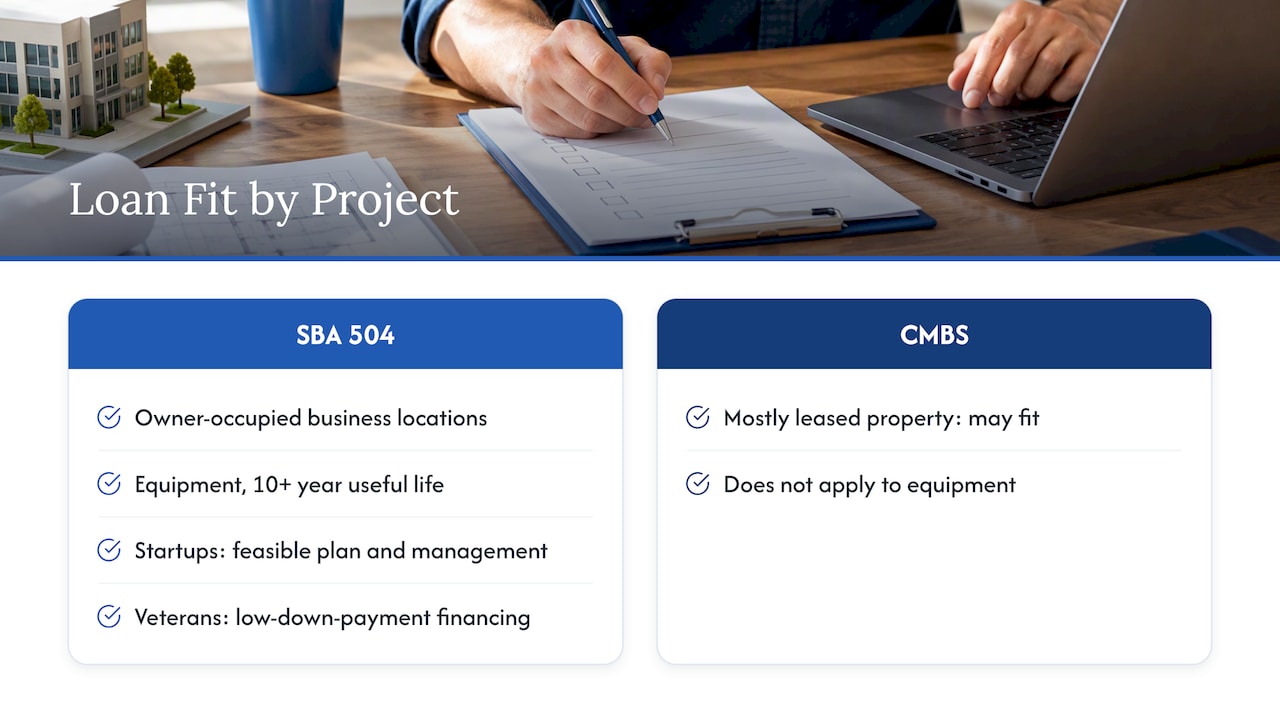
A business buying or building its own location. The 504 matches the use case. You occupy the property, you want a fixed payment, and you want to preserve cash for operations. Restaurant owners, for example, can read how to buy their building with a 504 loan.
A business buying heavy machinery. A 504 can finance equipment with a useful life of at least 10 years in the same structure. CMBS does not apply to equipment.
A startup. Startups often cannot show the history a conventional lender wants. The 504 still requires a feasible business plan and qualified management, and our programs for startups focus on low down payments and fixed rates.
A veteran-owned business. We built our VetLoan Advantage Plus program for veterans who need affordable financing with a low down payment.
A building that is mostly leased to other tenants. This is investment property. The 504 does not allow speculative investment in rental real estate, so CMBS or another investor loan may be the place to look.
A business relocating. The 504 can fund a move if the project meets the program rules. See our guide to 504 relocation rules.
Business owners often arrive with a term sheet from a conduit lender and ask whether it beats a 504. The question we ask back is simple: will your business occupy this building for years?
If the answer is yes, we believe the 504 is built for you. It was designed for owners who want to put the least cash into real estate and keep the rest working in the company. Our 35 years of experience have taught us that a fixed payment and a clear exit path matter more to an operating business than a headline rate.
We also see the value of a fast, organized process. Our team guides each borrower through eligibility, occupancy and documentation from the first call, so the CDC and the senior lender are aligned before closing. That is how we help small Florida businesses own their property and create jobs in their communities.
PHENYX
A typical 504 path has five steps. Our real estate loan checklist goes deeper on each.
If you are building rather than buying, read how to avoid extra interim interest. The OCC warns that 504 construction carries heightened credit risk for bank lenders during construction, because the CDC takeout depends on project completion and stabilization. If you must act on a property before permanent financing is ready, our 504 Velocity Bridge Loan program is designed for that gap, and our guide to bridge loan risk explains how to plan it.
If you plan to buy, build or refinance a property your business will use, we can tell you quickly whether a 504 fits and what your down payment could look like. We also offer direct lending for smaller loans and a down payment assistance program.
Start with our SBA 504 loan program page, or see our SBA 504 loans across Florida. If you are weighing the 504 against a 7(a), our 504 vs. 7(a) comparison covers that decision.
It can in some cases, if the property is stabilized and the loan is large enough for a conduit lender. The loan is underwritten like an investor loan and follows standardized documents. If your goal is to occupy and own the building, compare it with a 504 before you commit.
Yes. The SBA describes the 504 as long-term, fixed-rate financing, with 10-, 20- and 25-year maturities. Rates are pegged to an increment above the 10-year U.S. Treasury rate. Confirm the rate and fees in writing with your CDC before closing.
Defeasance is a way to pay off a CMBS loan early by substituting government securities for the real estate collateral. It generally involves legal, accounting and servicing costs. It is a CMBS feature, not part of the 504 program. Review any prepayment clause in your 504 closing documents with your attorney.
No. The SBA says 504 proceeds are for fixed assets such as land, buildings and long-term equipment. They cannot cover working capital, inventory or speculative rental real estate investment.

