


Most SBA 504 denials trace back to a short list of causes: the business or project is not eligible, the cash flow does not support the payment, the projections do not hold up, the borrower does not occupy enough of the property, or the file reaches underwriting incomplete. Nearly all of these can be found and fixed before an application is submitted. Some can be fixed afterward, because SBA rules allow a declined request to be reconsidered.
This guide walks through each reason in the order a CDC (Certified Development Company) reviewer is likely to meet it. It also covers what to do if you already have a decline letter.
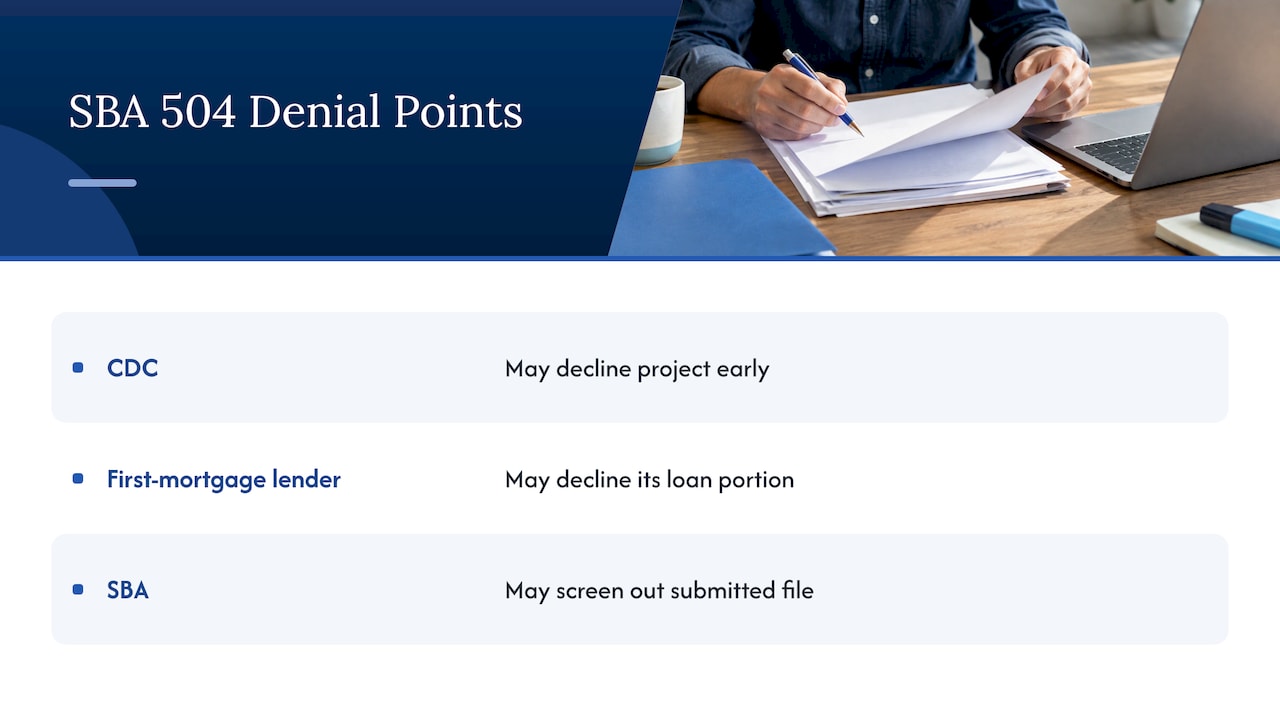
The 504 program provides long-term, fixed-rate financing for major fixed assets such as buildings, land and long-term machinery and equipment, and 504 loans are available only through CDCs. A “denial” can happen at several points. The CDC can decline a project early. The third-party lender on the first-mortgage portion can decline it. Or SBA can screen out a submitted file.
The notice should tell you why. SBA’s regulations provide that a notice of denial includes the reasons for denial. Keep that letter, because it is your repair list.
Eligibility is the first screen, and it is the one you cannot fix with better paperwork. SBA states that a 504 borrower must be an operating business, operate for profit, be located in the U.S., be small under SBA size standards and not be an ineligible type of business (SBA 504 loans).
13 CFR § 120.110 lists the ineligible business types. They include:
Project-level rules matter too. Under SBA’s loan-making policies for 504 loans, a project that relocates a business and reduces its workforce by one-third or more is ineligible unless the CDC can justify the loan under specified conditions. Property outside the United States or its possessions is also ineligible. If you are planning a move, read our guide to SBA 504 relocation rules first.
If you are unsure where you stand, our article on four eligibility checks before approaching a CDC in Florida is a good starting point.
The 504 program is built for businesses that use the property they finance. SBA’s rules add that the borrower must use the project property, except that an Eligible Passive Company may lease it to an Operating Company (13 CFR Part 120, Subpart H).
Problems appear when a purchase is really an investment, when the business plans to occupy only a small share of the building, or when the ownership structure between the property entity and the operating company is unclear. Fix this before applying: confirm how much space you will occupy, who will own the property and who will operate in it. Our occupancy checklist for Florida small businesses covers these questions in order.
Repayment ability is the most common financial reason for a decline. SBA lists the ability to repay among its 504 eligibility criteria (SBA). Lenders test it by comparing the cash your business produces to the payment on the proposed debt. One lending advisory firm describes an underwriting working test of roughly $1.25 of cash flow for every $1 of loan payment. Treat that as an illustration of how lenders think, not a promise of any particular lender’s cutoff.
Common causes of weak coverage:
What to do: before applying, build a simple schedule of your last three years of income, add-backs you can document and every existing debt payment. Then compare it to the estimated payment on the new loan. Our piece on how much income your business needs for an SBA 504 loan goes through that math.
There is a less obvious cash flow issue. SBA’s Standard Operating Procedure requires that the applicant’s need for the desired credit be documented. If the applicant’s cash flow and collateral would let the loan meet conventional credit standards, the project is not eligible. The same SOP says a loan can be screened out when the lender cannot adequately address this need.
In practice, strong borrowers sometimes need to show why the structure of a 504 loan (a lower down payment, a long fixed rate on the CDC portion) is needed, not just preferred. If your business is strong, talk to your CDC about how this requirement will be documented.
Good character and credit history are part of the picture. SBA lists good character as an eligibility criterion, and feasibility guidance names credit issues as a denial reason. Typical flags are recent late payments on business or personal debt, collections, unresolved judgments or tax liens, and past defaults on government-backed debt.
What to do:
A clear, honest explanation is usually easier for a reviewer to work with than a surprise discovered in underwriting.
This one catches startups and expansions. Lenders and SBA reviewers want to see that the business plan is feasible. A lending advisory firm lists these feasibility failures: unproven demand, overly optimistic financial projections, a management team whose experience does not match the business, missing equity, unresolved zoning or environmental issues, and third-party studies the lender cannot rely on.
Fix them like this:
The 504 program is known for its low down payment, and with FBDC it can be as low as 10%. The contribution can be higher in riskier situations, such as a newer business. Whatever the percentage, you must show the money exists and where it came from. Typical problems are funds that appear in an account just before the application, gifts without documentation, and borrowed money that adds debt the cash flow cannot carry.
If your cash is tight, ask early about structure. FBDC’s Direct Lending Program and Down Payment Assistance Program are designed for borrowers who need a smaller loan or help with the down payment.
The property has to qualify as much as the borrower does. Reviewers look at zoning, the appraisal, the condition of the building and environmental risk. The same advisory source above names unresolved zoning and environmental issues as feasibility failures, and a general industry article on 504 environmental policies is not needed here: what matters in practice is that a Phase I environmental report, a zoning confirmation and an appraisal that supports the price must all be ordered at the right time and in the right form.
Common avoidable mistakes:
For appraisal timing, see our article on how to avoid SBA 504 appraisal rework. For the full closing sequence, our CDC checklist for SBA 504 real estate loans lays out the documents lenders ask for.
A lot of screen-outs are not about the business at all. A lending expert’s webinar materials describe common 504 screen-outs as authorization errors, incomplete documentation, eligibility issues left unaddressed, and financial analysis problems, such as a profit and loss spread that is inaccurate or a balance sheet and debt schedule that do not reconcile.
These are the cheapest problems to prevent:
Signing and identity steps are where files stall when owners are in different places. A workflow that collects signatures, verifies identity and keeps an audit trail, as described in this piece on financial services document verification, helps keep forms complete and consistent.
| Denial reason | Warning sign | Best fix |
|---|---|---|
| Ineligible business or project | Nonprofit, passive investment, relocation that cuts the workforce | Confirm eligibility with a CDC before applying |
| Occupancy | Plans to lease out most of the building | Restructure ownership or occupy more space |
| Cash flow | Thin profit after existing debt payments | Document add-backs, reduce project size, pay down debt |
| Credit | Recent lates, liens, collections | Resolve items and write explanations |
| Feasibility | Rosy projections, no track record | Use conservative case and support with contracts |
| Down payment | Unseasoned or undocumented funds | Document source early |
| Property | Zoning, appraisal or environmental gap | Order correct reports in the right order |
| Incomplete file | Missing forms, unreconciled numbers | Use a master checklist and reconcile every schedule |
Start with the decline letter, since it states the reasons. Then:
If the denial came from a bank on a standard loan, the lender and not SBA made the decision, so the repair work goes to the lender or to a different lender.
After more than 35 years in SBA 504 lending, we see the same pattern: very few good projects fail because the business is weak. They stall because the project was never tested against the rules before money was spent.
That is why we start with a conversation, not an application. Before you order an appraisal or an environmental report, we can look at eligibility, occupancy, the down payment and how the cash flow supports the payment. Our process is designed to be fast and clear, and our team’s job is to guide you through the file so there are no surprises in underwriting.
If a project needs a different shape, we have programs built for that: direct lending for smaller loans, a bridge loan for 504 projects, a refinance program and a loan designed for veterans. A denial from one lender does not have to be the end of a project. It is often a signal that the structure needs adjusting.
PHENYX
If you plan to buy, build, renovate or refinance commercial real estate, or buy long-life equipment, FBDC can review your project against these checks before you submit anything. Our SBA 504 Loan Program offers long-term fixed rates and down payments as low as 10%. We also offer a bridge loan for 504 projects and a veterans’ loan.
Not sure which program fits? Compare SBA 504 and 7(a) loans, or contact our team at FBDC for a consultation.
Being a nonprofit, a business primarily engaged in lending, a passive real estate holder that does not use the property, a speculative business or certain foreign-located businesses can disqualify you under 13 CFR § 120.110. Projects can also be ineligible, such as a relocation that cuts the workforce by one-third or more without CDC justification. Poor repayment ability can also end an application.
Yes. SBA rules allow reconsideration within six months if you overcome all legitimate reasons for denial. After six months, you submit a new application. Start by fixing each item in the decline letter, then update your financial statements.
SBA regulations provide that a denial notice includes the reasons. Keep the notice and share it with your CDC, since the stated reasons tell you what to correct.
With FBDC, the down payment can be as low as 10%. It can be higher for riskier situations, such as newer businesses, so confirm your exact figure with a CDC before planning your budget.

