


Yes, a franchise can get an SBA 504 loan. The brand has to be eligible, the project has to be fixed assets such as real estate or long-life equipment, and the franchisee has to run the business, not hand it off. If you are opening or expanding a franchised location in Florida, the Florida Business Development Corporation (FBDC) is a Certified Development Company (CDC), the SBA-certified lender that packages 504 loans. We can walk you through whether your brand and project fit before you spend money on plans.
The SBA 504 program provides long-term, fixed-rate financing for major fixed assets that promote business growth and job creation. A CDC works with a senior lender: the senior lender provides a first-position loan, and the CDC provides the SBA-backed portion. The SBA lists a maximum loan amount of $5.5 million, and 10-, 20- and 25-year terms.
For a franchisee, this matters because the usual franchise build-out has two big costs: the real estate (or a major renovation) and the equipment. Those are the assets the 504 was designed for. The fixed rate on the CDC portion also means the largest part of your long-term obligation does not move with the market after closing.
The SBA says the CDC debenture rate is pegged above the current market rate for 10-year U.S. Treasury issues. That means the rate depends on Treasury yields at the time the debenture is sold, so any rate you see quoted is a snapshot. Ask your CDC for the rate that applies to your closing, not an old figure from an article.

This is the step that sets franchise borrowers apart from other 504 applicants.
Under SBA SOP 50 10 8.1, the SBA’s operating manual for lenders and development companies (effective October 1, 2026), a brand that meets the FTC definition of a franchise in 16 CFR § 436 must be listed on the SBA Franchise Directory before the loan can be submitted or approved. If the brand is not listed, the application cannot proceed.
Three points trip people up:
Before the closing, the CDC must also obtain the executed franchise agreement for closing counsel, so have a signed copy ready, not a draft.
The practical order: look up your brand on the SBA Franchise Directory first, then talk to a CDC. If the brand is missing, ask your franchisor to resolve it with SBA. That conversation takes the franchisor’s time, not yours, and it can decide your timeline.
The SBA states that a 504 loan can finance buildings or land, long-term machinery and equipment with at least 10 years of remaining useful life, and qualified debt consolidation or refinancing. It cannot fund working capital, inventory, non-qualified debt, or speculation or investment in rental real estate.
For franchisees, the line that matters most is in 13 CFR 120.884: franchise fees are an ineligible ancillary expense that cannot be paid with 504 proceeds. The same section lists working capital, counseling and management fees, incorporation costs and advertising. Short-term equipment, automobiles, trucks and airplanes are also ineligible fixed-asset components.
So plan your sources and uses early:
| Cost in a franchise project | Can 504 proceeds pay for it? |
|---|---|
| Land and building purchase | Yes |
| Construction and renovation | Yes |
| Long-life machinery and equipment (10+ years) | Yes |
| Franchise fee | No |
| Working capital and inventory | No |
| Advertising and grand-opening costs | No |
| Vehicles | No |
Soft costs tied to the project are allowed. Under 13 CFR 120.882, eligible project costs include land acquisition, a construction contingency reserve up to 10% of construction cost, and professional fees essential to the project, such as title insurance, architectural and engineering costs, appraisals, environmental studies and legal fees for zoning and permits. Interim financing can be repaid, including points, fees and interest. If you are renovating a location to meet brand standards, our guide to the 10% contingency cap lenders check shows how that reserve is handled.
The business must be operating, for-profit, located in the U.S. and small under SBA requirements. Under 13 CFR 120.880, the borrower must use the project property, with one exception: an eligible passive company may own the property and lease it to an operating company. The borrower and its affiliates together must meet one of the SBA size standards. Projects in foreign countries are barred, as are certain relocations that cut the workforce by a third or more.
Franchise owners who plan to hire a manager should read this carefully. Under the SOP’s franchise rules, a management agreement that gives the management company sole discretion over operations creates an ineligible passive business. You stay eligible by exercising meaningful oversight: approving the annual budget, approving significant capital and operating expenditures, controlling the bank accounts, and overseeing your own employees. A franchisee using a management company that is, or is affiliated with, the franchisor is not eligible.
If you own several units and run them through a management company, bring that agreement to your first conversation so the structure can be reviewed before anything is filed.
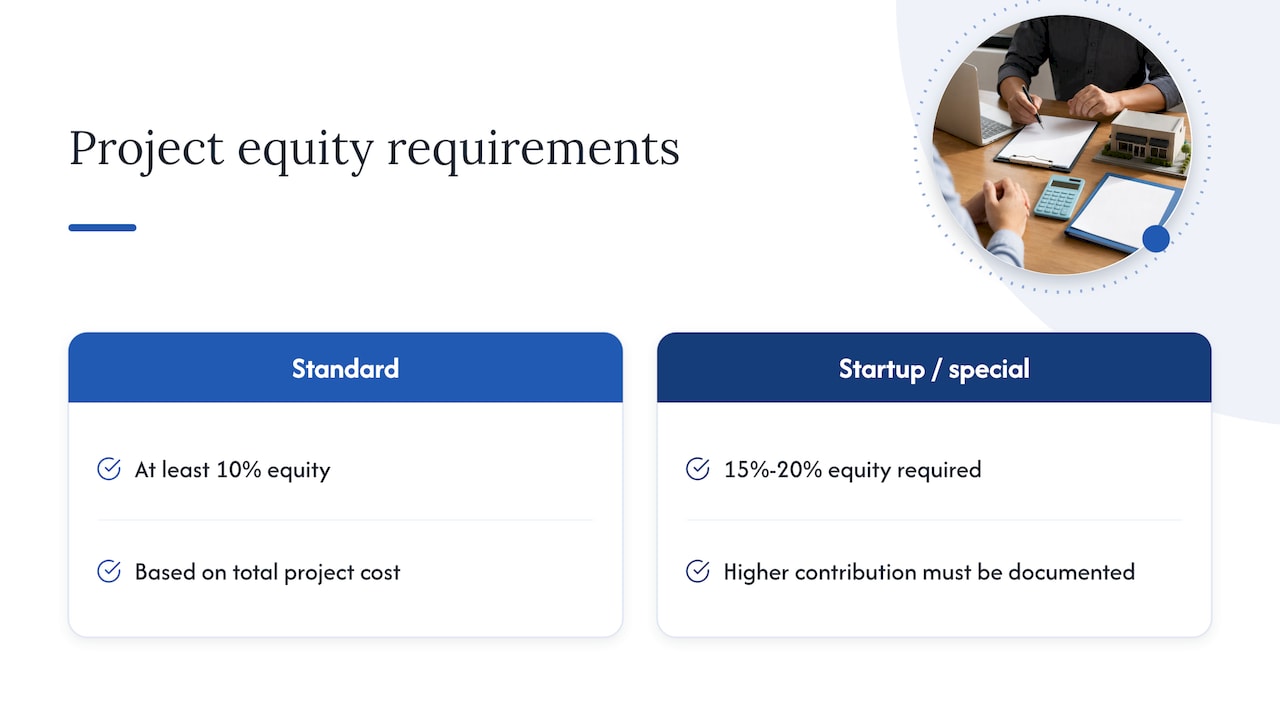
The SBA’s lender guidance describes a borrower contribution of at least 10% equity of the total project cost. Our program is built around down payments as low as 10%. For startups, the requirement is higher: a new business or a special-purpose property raises the equity the borrower must document, which we cover in 15%-20% down: what SBA 504 startups must document. A new franchise unit of an established multi-unit operator may be treated differently from a first-time franchisee, so the way your entity is structured matters.
Plan for the franchise fee and working capital separately, from your own funds or another source, since the 504 cannot cover them. Many franchisees underestimate this and arrive with enough for the down payment but not for the opening costs.
The SBA’s 504 page puts total costs at approximately 3% of the debt. The fee structure traces to SBA rulemaking. A 1999 Federal Register rule allowed the SBA guarantee fee, funding fee, CDC processing fee, certain borrower closing costs, a CDC closing fee up to $2,500 and the underwriters’ fee to be paid from loan proceeds. It also set the minimum CDC servicing fee at 0.625% and allowed an SBA fee of up to 0.9375% annually on unpaid principal. Fee amounts can be updated, so confirm the current schedule on our SBA 504 loan page, which lists approximate fees.
Because many of these costs can be paid from proceeds, they can be folded into the project instead of coming out of your cash. Ask for a written sources-and-uses summary before you commit to a location.
Is it hard to get a 504 loan as a franchisee? It is more document-driven than difficult. Expect the CDC and senior lender to review:
Our checklist, SBA 504 documentation: what to gather before you apply, covers the full set, and three steps for franchise real estate financing shows how to avoid the delays that come from missing items. For the eligibility basics in Florida, see four checks before a CDC.
A 504 loan is not the only structure we offer, and the right one depends on your timing and size:
Franchise borrowers usually come to us with a location picked and a franchisor timeline running. The loan itself is rarely what slows them down. The paperwork is: a brand that has not been checked against the SBA Franchise Directory, an unsigned franchise agreement, or a management structure that was never reviewed for owner involvement.
That is why we start with eligibility, not the application. With over 35 years of experience in SBA 504 lending, we know which documents closing counsel will ask for and in what order, and we organize the file so your project moves in a straight line.
The 504 gives a franchisee a low down payment, a long-term fixed rate on the CDC portion and terms up to 25 years. For a business that will own its real estate for decades, that predictability is worth building the project around.
PHENYX
If you plan to buy, build, renovate or refinance a franchise location in Florida, FBDC can review your brand, project costs and structure with you. Our process is designed to be swift and streamlined, with expert guidance at each stage. Start at our SBA 504 loan page, or see how a Florida closing typically runs.
Yes. The business must meet standard 504 eligibility, and if the brand meets the FTC franchise definition it must be on the SBA Franchise Directory before the loan can be approved. The project must also be eligible fixed assets, not fees or working capital.
No. Federal regulation lists franchise fees as an ineligible ancillary expense, along with working capital and advertising. Plan to cover the fee from other funds and use the 504 for real estate and long-life equipment.
The SBA puts total costs at approximately 3% of the debt. Many closing costs can be paid from loan proceeds. Our SBA 504 page lists approximate fees, and we can give you a written estimate for your project.
The CDC debenture rate is pegged above the market rate for 10-year U.S. Treasury issues and is fixed for the term, which can be 10, 20 or 25 years. Because it follows Treasury yields, ask for the rate that applies to your closing.

