


SBA 504 prequalification is the early review you do with a Certified Development Company (CDC) before you submit a formal application. A CDC is an SBA-certified nonprofit lender that finances the 504 portion of your project. You show the CDC your business, your owners and your project. It tells you whether the deal fits the program and what is missing. It is not a final approval, but it is the cheapest point at which to find a problem. Fixing it later can cost you weeks on a closing date, or a purchase contract.
This guide is for for-profit business owners who want to buy or build commercial real estate, or buy long-life equipment, with a low down payment and a fixed rate. It covers what the review looks at, what to gather, how the money is split, and the 2026 ownership rule that now applies to every applicant. At Florida Business Development Corporation (FBDC), we have focused on SBA 504 lending for more than 35 years.
Fbdc
Prepare for SBA 504 Prequalification
FBDC specializes in SBA 504 lending, helping small businesses finance real estate and long-life equipment with expert guidance.
“Prequalification” is the everyday word borrowers use for the first screening of a deal. The SBA’s own program page does not use it as a formal step. What the SBA does state is that 504 loans are available only through CDCs, which work with senior lenders and are SBA-certified and regulated. So the early review happens with a CDC, and the formal file follows.
The formal file is SBA Form 1244. According to the form, the applicant gives information to the CDC, which uploads it to the SBA’s E-Tran system. The form is used to review eligibility, indebtedness, creditworthiness and disclosures. Prequalification is how you make sure that file has no surprises when it is built.
Three things separate prequalification from approval:
Start with the two eligibility tests, because they are the ones that cannot be fixed with paperwork.
The business. It must be an operating, for-profit entity located in the U.S. that meets SBA size standards. Nonprofits do not qualify. Neither does a company looking for working capital or inventory money, because the 504 program finances fixed assets.
The project. Eligible uses include purchasing land or buildings, construction or renovation, and long-term machinery or equipment with at least 10 years of useful life. A delivery truck with a short working life, a stock of materials or a payroll gap does not fit. A warehouse, a medical office, a heavy press or a fabrication line usually does.
If you are in Florida, our guide to four eligibility checks before you contact a CDC walks through these in more detail.
Ownership is where many first reviews slow down, so list it before anything else.
The 20% guarantee. Under federal regulation, guarantees are required from every individual or entity holding at least a 20% ownership interest in the business. Map out your cap table, including holding companies, trusts and any family members who own shares. Each person or entity at 20% or more is part of the file.
The 2026 citizenship rule. SBA Standard Operating Procedure (SOP) 50 10 8.1 became effective on October 1, 2026. It requires that all direct and indirect owners and required guarantors be U.S. citizens or U.S. nationals who maintain their principal residence in the United States. “Indirect” means owners behind another entity. If an LLC owns part of your company, the people who own that LLC count too.
This is the most important early check for any deal with a partner, investor or family co-owner whose status you have not confirmed. A prequalification conversation is the time to learn it, not the week before closing. Our summary of the 2026 SBA update on qualifying and citizenship changes covers what the change means for owners.
A standard 504 project has three parts. According to the Federal Register’s description of the structure:
Here is a worked example for a $1,000,000 building purchase:
SourceShareAmountSenior lender (bank)at least 50%$500,000CDC (504 portion)up to 40%$400,000Borrower equityat least 10%$100,000
That 10% minimum is the reason the program appeals to owners who would rather keep cash in the business. Our own 504 financing is built around down payments as low as 10% and long-term fixed rates. Startups and some special-purpose properties are treated differently on equity, and our guide on what 504 startups must document explains what to expect.
The cost figures that move your payment are on the CDC side. The rate on the 504 portion is pegged to a market-based increment above the 10-year U.S. Treasury rate, and borrowers can choose 10-, 20- or 25-year terms. Treasury yields move daily, so ask for the rate in writing at the time you lock the deal rather than relying on a figure you read weeks earlier. Our article on 10, 20 and 25 year terms shows how term length changes the payment. Fees are listed on our SBA 504 loan page.
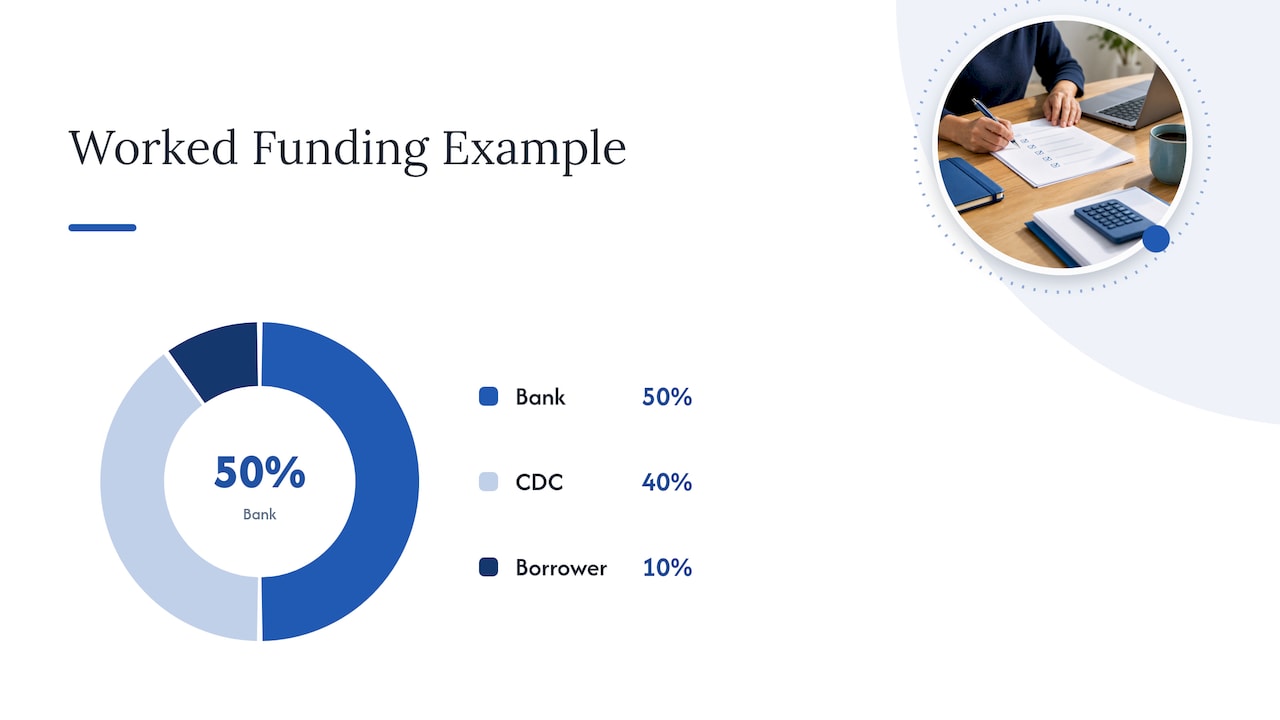
A CDC cannot say much about a project that has no cost breakdown. Before the first call, list every cost: purchase price or construction bid, closing costs, equipment installation, fees, and the equity you plan to contribute. A clear project budget breakdown helps you see which line items belong to which source of money, which is exactly how the bank, CDC and borrower layers are sized.
If you are building or renovating, timing matters too, because interest accrues on money drawn during construction. Our article on avoiding a month of extra interim interest explains where that cost comes from, and our guide to SBA 504 construction loans in Florida covers building your own space.
Have these ready before the review. Our guide to what to gather before you apply has the longer version.
One tip: set up your legal entities early. If the company that will own the real estate is separate from the company that operates in it, decide that structure before the review, not after.
Once the early review confirms the deal fits, the CDC assembles the SBA file, and the senior lender runs its own credit process in parallel. For a real estate purchase, the later stages include an appraisal, environmental review, title work and closing. We lay out that sequence in our CDC and lender checklist for 504 real estate loans.
If you are comparing the 504 with a conventional mortgage, see how the SBA 504 compares with a conventional commercial mortgage in Florida.
Most of the delays we would want an owner to avoid are decided before an application exists. They come from an ownership chart that was never written down, a guarantor whose status was assumed, or a project budget that did not add up. All three can be settled in a first conversation.
That is why we think of prequalification as the most useful hour in an SBA 504 loan. FBDC has specialized in SBA 504 lending for over 35 years, and our approach is built on expert guidance and a streamlined process, so that a business owner knows early where the project stands.
The program rewards owners who plan. A 10% down payment, a long-term fixed rate and a structure that leaves working capital in your business are strong reasons to own your building or equipment. They work best when the file is clean from the start.
PHENYX
If you are a for-profit business in Florida planning to buy, build, renovate or refinance commercial real estate, or buy long-life equipment, our team can review your project against the 504 requirements. Start on our SBA 504 loan page, or see how we help with SBA 504 loans anywhere in Florida.
We also offer a 504 refinance program, a 504 Velocity Bridge Loan program, a Direct Lending Program for smaller loans, and VetLoan Advantage Plus for veterans.
No. Prequalification is an early review of your business, owners and project. Approval comes after the formal application goes through the CDC, the senior lender and the SBA. The early review simply shows whether the deal is ready for that step.
Under SOP 50 10 8.1, effective October 1, 2026, all direct and indirect owners and required guarantors must be U.S. citizens or U.S. nationals living in the United States. Confirm each owner’s status before you start, including owners behind holding entities.
The standard structure calls for borrower equity of at least 10%. On a $1,000,000 project, that is $100,000. Closing costs and special situations can change the total, so bring your full project budget to the review.
No. The program finances fixed assets: land, buildings, and machinery or equipment with at least a 10-year useful life. Businesses that need working capital or inventory money are outside what we finance.

